You're managing eight clients. Each has three to five social channels. You post three times a week per channel. That's between 72 and 120 pieces of content per month, just for one person to track, write, review, approve, and schedule. Now add a second client. And a...
Redesign For multi-location brands
all your locations, one content flow
For multi-brand companies
content collaboration at scale
For agencies
impress your clients and take on more
“The team loved it from the start. Planable helps us overview the entire marketing efforts.“
The first time a client asks what ChatGPT says about their brand, you find out how much AI brand monitoring your stack really does.
Your listening dashboard may have nothing, because nothing was posted. The answer was generated for one reader, in one session, and then it was gone.
AI brand monitoring is the practice of tracking how AI assistants and AI search results mention, describe, compare, and recommend your brand across repeated prompts.
Key takeaways
AI brand monitoring covers what models generate about your brand. Social and web monitoring cover what people publish about it.
The four core measurements are mention share, share of voice, citation sources, and sentiment and framing.
AI visibility metrics are samples, not fixed rankings. A movement should repeat across checks and related prompts before you act on it.
Report results per engine and per metric. One blended AI visibility number can hide meaningful differences between where and how your brand appears.
What is AI brand monitoring?
AI brand monitoring tracks what AI systems say about your brand when people ask relevant questions. Social listening, by comparison, tracks what people publish about your brand across social platforms, forums, and other online channels.
In Pew Research Center’s analysis of Google searches conducted in March 2025, AI summaries appeared for 18% of the searches studied. Among those AI summaries, 88% cited three or more sources.
Those citations add a measurable source-visibility layer. You can track whether your brand appears in an AI-generated answer, how it is described, which competitors appear alongside it, and which sources are cited.
This is the first distinction I straighten out when a client asks what AI says about their brand. Three surfaces can carry a description of you:
Social platforms, where people publicly post and discuss your brand.
The open web, including news coverage, blogs, forums, reviews, and comparison pages about your category.
AI-generated answers, from assistants such as ChatGPT and Perplexity, plus search experiences such as Google AI Overviews and AI Mode.
How is AI brand monitoring different from social listening?
Social listening monitors what people publish about your brand. AI brand monitoring monitors what an AI system generates about your brand.
That difference matters because a generated answer can combine several sources, rewrite them in new language, compare you with competitors, or produce a claim that does not correspond to any single public mention.
Replying to comments and DMs is a different job again. That’s community management. In Planable, it lives in its own add-on, Social Inbox, separate from mention monitoring.
Citations make the AI-answer layer easier to investigate. When an answer names its sources, you can read the pages behind those citations and see which sites are contributing to the description.
An answer with no visible sources can still be monitored. You can record what the system says and compare it over time. What you lose is a direct trail back to the cited pages.
Why does AI brand monitoring matter?
The answer is becoming a destination of its own.
Zero-click searches, where someone gets what they came for without visiting a site, reached 68.01% of US Google searches in early 2026, up from 60.45% in 2024, reported by Search Engine Land.
That changes what you’re defending.
When a buyer asks an assistant which tools handle multi-location approvals, the generated answer may be the only description of your brand they see. Nobody on your team necessarily wrote it or checked it.
See which sources shape AI answers
When an AI answer includes citations, those links give you somewhere to investigate.
Log the cited pages on every run. Over time, you can see which domains repeatedly appear when an engine explains your category, describes your brand, or compares you with competitors.
That turns a vague question, “Why is the AI saying this about us?”, into a more useful one: “Which sources keep appearing when it says this?”
Understand your share of the answer
Being mentioned is not the same as owning the answer.
A model can name your brand in four words and give a competitor an entire paragraph. Monitoring lets you see both whether you appear and how much attention you receive relative to the other brands in the response.
The comparison matters because a buyer often reads those descriptions side by side. The model is not simply introducing your brand. It may also be defining the competitive frame around it.
Establish a baseline before visibility changes
AI visibility numbers become more useful as a trend.
Take a baseline before you rewrite a page, change your positioning, update your pricing, or start a new campaign. Without the earlier reading, a movement you see later has nothing to be compared against.
I’d also be careful making the case for AI brand monitoring purely in traffic terms.
AI referral traffic (visits sent from an AI assistant or AI search result to a website) averaged 770.7 million visits a month worldwide and grew 117.4% year over year, according to Similarweb. It still represents a low single-digit percentage of traffic for most sites.
The growth is real. The volume is still small.
Mike King, CEO of iPullRank, frames the shift this way:
“Classic search measurement is really about performance, but AI Search channels are more branding channels so you have to think about performance differently.”
That’s the case I’d take to a client this quarter.
What AI brand monitoring metrics should you track?
I use four measures to separate whether a brand appears from what happens once it does:
Mention share: how often the brand appears across repeated prompt runs.
Share of voice: how much of an answer is devoted to the brand compared with competitors.
Citation sources: which visible sources are cited around the answer.
Sentiment and framing: how the brand is described once it appears.
Each measure answers a different question. Blending them into one score usually removes the distinction you need to make a decision.
Let’s take them step by step.
1. Mention share: how often the model names your brand
Mention share is the percentage of prompt runs in which your brand is named, measured engine by engine across a fixed prompt set.
A prompt set is the list of buying questions you run repeatedly so that one week’s result can be compared with the next.
Some tools call this mention rate or visibility rate. It is different from brand-presence or link-presence counts, which tally appearances across engines rather than measuring a fixed sample of repeated prompt runs.
Four caveats should travel with mention share every time:
It measures your prompt set, not the whole market. The result reflects the questions you chose to ask.
It varies by engine. ChatGPT, Gemini, Perplexity, and Google AI surfaces should not automatically be averaged together.
Run-to-run variance is wider than rank tracking. A small week-on-week movement may simply be model variability.
A mention isn’t necessarily a recommendation. A model can name your brand while describing it inaccurately or unfavorably.
Nobody loves that answer. But the alternative is a single confident percentage that may contradict itself next month.
2. Share of voice: how much of the answer covers your brand
AI share of voice measures how much of a generated response is devoted to your brand compared with the other brands named in the same answer.
A model can mention you once and spend the rest of the answer on a competitor. Mention share records the appearance. Share of voice records how much room you received.
It still doesn’t tell you whether that visibility helped. That’s why framing needs to be measured separately.
3. Citation sources: which pages appear behind the answer
Citation sources are the pages an AI answer links to or attributes when discussing your brand or category.
This is one of the most actionable measurements because it gives you specific URLs to investigate.
It also has a clear limitation: visible citations are only the visible part of the sourcing picture. Models can generate material without showing a source for every claim.
So treat a citation report as a map of observable sources, not a complete record of everything that influenced an answer.
4. Sentiment and framing: how the model describes your brand
Sentiment applies the logic of social media sentiment analysis to generated answers: does the description read as positive, neutral, or negative?
Framing is usually more useful.
A neutral-sounding answer that gets your plan limits wrong can be more damaging than a mildly negative answer that is accurate. Track the attributes the model attaches to your brand, the strengths or limitations it repeats, and the situations in which it recommends or excludes you.
How do you measure AI brand visibility?
The goal is not to ask ChatGPT about your brand once.
The goal is to create a repeatable sample: a fixed set of relevant prompts, run consistently across the AI surfaces that matter to your buyers, with the same measurements recorded each time.
Step 1. Build a fixed prompt set
Start with the questions a buyer would actually ask.
We stopped tracking a long tail of hundreds of prompts. It looked rigorous and produced a dashboard nobody could act on.
A shorter set tied to real buying questions is easier to repeat, interpret, and connect to a business decision.
Examples of useful prompt categories include:
category discovery questions;
feature or capability questions;
comparison questions;
alternative or replacement questions;
use-case questions;
questions tied to an important buyer constraint.
Keep the wording stable once you establish the baseline. If the prompt changes every week, the result is harder to compare.
Step 2. Run prompts consistently across each AI engine
The methodology should stay as similar as possible across engines: use the same prompt wording, start with a fresh session where possible, repeat the prompt more than once, and save the resulting answer.
Tracking brand mentions in ChatGPT
Run each prompt in a fresh or temporary chat so earlier conversation context does not steer the answer.
Run it several times before you treat the result as a measurement.
For each run, record:
whether your brand appears;
which competitors appear;
how your brand is described;
which sources are visibly cited.
The answer matters. The citation list matters separately.
Tracking visibility in Google AI Overviews and AI Mode
AI Overviews are generated summaries inside Google Search. AI Mode is Google’s separate conversational search experience.
Treat them as separate surfaces because the same query can produce different outputs.
Run the query in a clean search session and save the generated answer alongside the visible source links. For AI Overviews, also record whether an overview appeared at all, because the trigger rate can change independently of whether your brand appears inside it.
Tracking brand mentions in Perplexity and Gemini
Perplexity makes source capture relatively straightforward because citations appear inline.
With Gemini, save the answer together with any visible source information.
The discipline is the same either way: identical prompt wording, a fresh session where possible, repeated runs, and the same fields recorded every time.
If running several engines manually becomes unrealistic, automation is where a dedicated AI visibility product starts to make sense.
SE Visible is the separate product where you can track AI search visibility on a schedule. Planable Analytics also includes an AI Visibility Snapshot, a panel powered by SE Ranking that shows the previous month’s figures. It requires the Analytics add-on and the full tracking product remains in SE Ranking.
Step 3. Record the same measurements for every run
A useful monitoring log needs enough structure to be comparable later.
For each prompt run, record at least:
the engine or AI surface;
the prompt;
the date;
whether your brand appeared;
which competitors appeared;
how your brand was framed;
which visible sources were cited.
You can derive mention share and other trend metrics from those records later.
The important part is consistency. If you change what you record every week, you lose the baseline you’re trying to build.
How do you distinguish a real change from model variance?
A single prompt run is one sample.
That’s why I would not react to one unusual answer or a tiny week-on-week movement.
Shayna Burns, SEO and GEO Principal at Luminary, calls a one-off “snapshot” of AI search performance “almost meaningless.”
A movement is worth investigating when all three conditions hold:
It persists for at least two consecutive checks.
It appears across a cluster of related prompts.
You can name a plausible cause, such as a page update, a new roundup, a competitor launch, or a product change.
If one prompt moves for one week and nothing else changes, I shrug.
That caution is supported by SparkToro’s study of 2,961 prompt runs from 600 volunteers. It found less than a 1-in-100 chance that 100 identical prompts would return the same brand list, and roughly a 1-in-1,000 chance of returning the same ordering.
Pro tip: when a provider ships a new model, treat it as a potential break in the series. Reset the baseline rather than assuming the old and new readings are directly comparable.
What should you monitor alongside AI-generated answers?
AI answers are one layer of the job.
You also need to watch the material those answers can reflect: public mentions, open-web coverage, and third-party pages that repeatedly show up as sources.
Each layer runs on a different clock.
AI-generated answers: check on a fixed cadence
Run your prompt set on a fixed schedule and repeat prompts enough times to reduce the impact of one-off outputs.
For an active program, weekly checks give you enough frequency to spot a sustained movement while still leaving room to distinguish a trend from normal model variance.
Daily sampling can easily turn into watching noise. Monthly sampling can make it harder to connect a change to its cause.
Whatever cadence you choose, keep it stable.
Social platforms and the open web: monitor on the tool’s refresh cycle
What people publish about your brand is a separate monitoring layer and potential input into how your brand is represented elsewhere.
Planable’s Social Listening tracks brand mentions across eight social and web sources, although the coverage method is not identical for every source:
X and YouTube use each platform’s API.
Reddit, TikTok, Facebook, Instagram, and LinkedIn use search discovery plus third-party scraping.
The open web, including news, blogs, and forums, uses search.
Social Listening is a workspace add-on at $99 a month or $990 a year and starts with a free trial. Each workspace covers one brand keyword and three topic keywords, with three competitor keywords tracked separately.
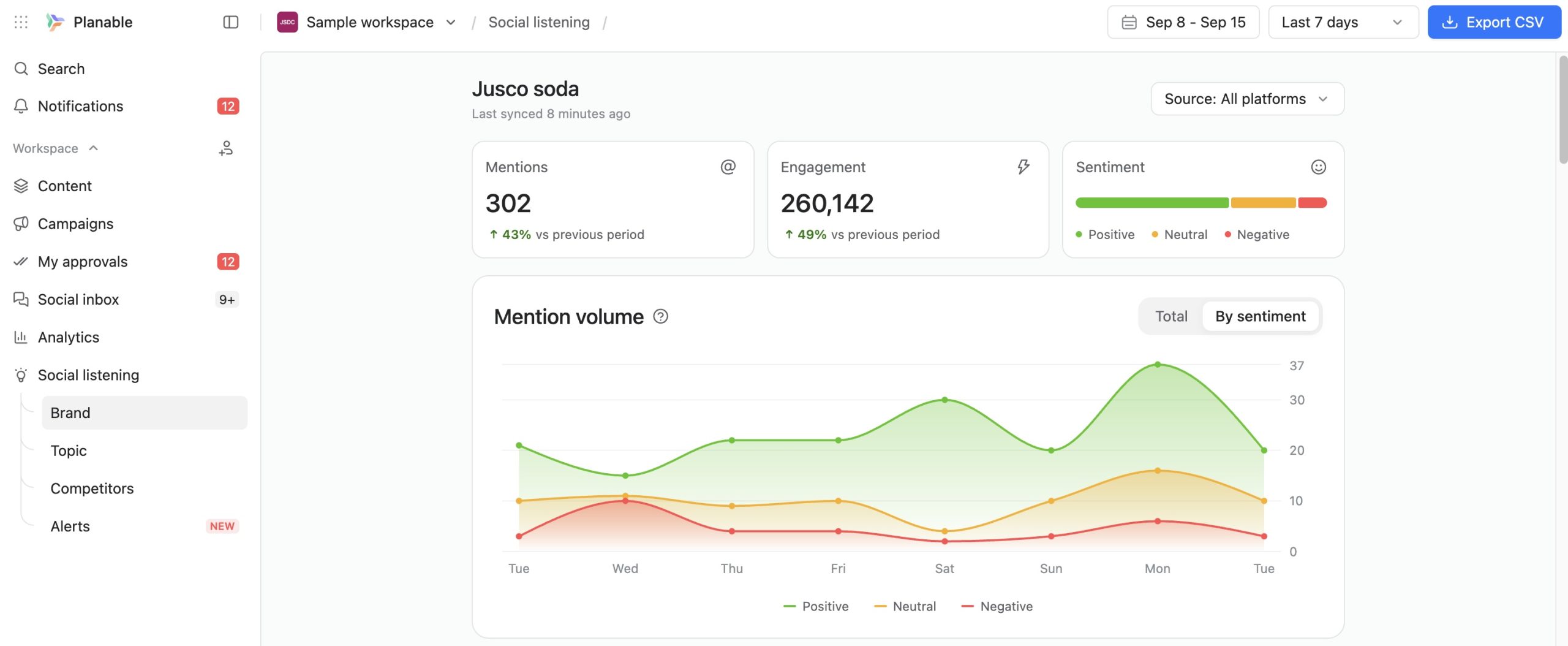
Brand mention report in Planable Social Listening, with sentiment attached to each mention
It isn’t a real-time feed.
Brand keywords refresh every 24 hours. Topic and competitor keywords refresh every seven days. Alert emails and Slack notifications are sent in one batch at 09:00 workspace time, with no desktop push at the time of writing.
Sentiment is attached to each mention, which gives you the input to measure brand sentiment across a longer period.
Third-party pages cited by AI systems: review when facts change
Some of the most important descriptions of your brand live on pages you don’t own.
Roundups, comparison pages, reviews, forum threads, and category pages can all shape the information environment around a brand. That overlaps with the broader question of how AI uses social media data.
We tested citability formatting as a lever on its own: adding definition paragraphs, restructuring sections, and bolting FAQ blocks onto existing pages.
The effect on mention rate came back inside the noise.
What we kept was the underlying refresh:
the information needs to be current and accurate;
the page needs to say something original rather than restate the top ten results;
the update needs to add value a reader would actually notice.
Structure helps a genuinely useful page become easier to understand and quote. Structure on top of stale content did not produce a change we could measure.
The other half of the job sits on pages other people own.
A stale claim on a consistently cited comparison page may matter more than a formatting change on your own site.
Ben Goodey, founder of the SEO consultancy Spicy Margarita, puts the priority this way:
“Cited listicles come and go. Prioritize the consistently cited sources over time.”
A worked example: how we monitor Planable’s brand across AI and the web
Here’s our own setup, so you can see what AI brand monitoring looks like in practice and how we use the data.
We track two things separately:
how Planable appears in AI-generated answers
what people and websites publish about Planable across social platforms and the open web
The two datasets answer different questions, but they are more useful when we review them together.
What we track
For AI visibility, Planable’s project in SE Ranking tracks 286 prompts across ChatGPT, Google AI Mode, Gemini, Google AI Overviews, and Perplexity in the US.
We group those prompts by topic cluster, from broad category questions to “alternatives” searches that match our comparison articles. Each prompt runs once a day on every engine, so a weekly reading gives us seven samples per prompt rather than a single snapshot.
For published mentions, we track Planable as a brand keyword in Planable Social Listening. That lets us review brand mentions, competitor comparisons, customer questions, sentiment, and recurring claims appearing across social platforms and the open web.
Track brand mentions and sentiment in one social listening dashboard
Together, those two streams tell us what AI systems are generating about Planable and what the wider web is publishing about the brand.
What the data can look like
On the AI side, SE Ranking measures mention presence, or the share of tracked prompts where an answer names Planable. It also measures link presence, or the share of answers that link to our website.
The figures below are illustrative rather than live Planable data. They show the type of pattern a weekly pull can reveal.
Engine
Mention presence
vs. prior week
Link presence
vs. prior week
Gemini
30%
−3 pp
15%
−5 pp
ChatGPT
20%
−2 pp
16%
−1 pp
Perplexity
14%
+1 pp
11%
0 pp
Google AI Mode
10%
−3 pp
3.5%
−3 pp
Google AI Overviews
4%
+1 pp
3%
+1 pp
Gemini
Mention presence
30%
vs. prior week
−3 pp
Link presence
15%
vs. prior week
−5 pp
ChatGPT
Mention presence
20%
vs. prior week
−2 pp
Link presence
16%
vs. prior week
−1 pp
Perplexity
Mention presence
14%
vs. prior week
+1 pp
Link presence
11%
vs. prior week
0 pp
Google AI Mode
Mention presence
10%
vs. prior week
−3 pp
Link presence
3.5%
vs. prior week
−3 pp
Google AI Overviews
Mention presence
4%
vs. prior week
+1 pp
Link presence
3%
vs. prior week
+1 pp
The same week can look very different by engine.
Gemini may mention Planable far more often than Google AI Mode. ChatGPT may mention and link to Planable at similar rates, while AI Mode may mention the brand without linking to it nearly as often.
That is why we do not reduce everything to one “AI visibility score.” A single average can hide the differences that actually tell us where to investigate.
On the social listening side, the data looks different.
Instead of prompt-level presence, we look for things such as:
a rise in brand mention volume
changes in sentiment
new competitor comparisons
recurring product claims
repeated customer questions
new articles, reviews, or forum discussions mentioning Planable
These signals give us context around how the brand is being described outside AI answers.
How we read the two datasets together
The value comes from comparing changes, not from treating either dataset as a verdict.
Suppose Planable’s mention presence drops by three percentage points on ChatGPT. By itself, that does not tell us much. Daily movement across a small prompt group can easily be larger than that.
So we ask:
Does the change persist?
Does it appear across related prompts?
Did anything change in the published conversation around the brand?
For example, if AI visibility drops while social listening also shows a new comparison article repeatedly framing Planable against a competitor, that gives us something concrete to investigate.
We do not assume that the article caused the AI change. We use it as a lead.
The reverse works too. If Planable Social Listening surfaces a new recurring claim or customer question, we can check our tracked prompts to see whether the same framing starts appearing in ChatGPT, Gemini, Perplexity, or Google’s AI experiences.
The reverse works too. If Planable Social Listening surfaces a new recurring claim or customer question, we can check our tracked prompts to see whether the same framing starts appearing in ChatGPT, Gemini, Perplexity, or Google’s AI experiences.
Mordy Oberstein, the Head of Brand at SE Ranking and Planable, ran exactly that check on Liquid IV the week Costco launched its Kirkland hydration mix. The negative mentions show up in social listening first. From there, he follows the thread into AI answers: Liquid IV’s net sentiment against Gatorade in SE Visible, then the AI Overview Google was already showing for the launch.
Tracing a negative mention spike from Planable Social Listening to AI-generated answers in SE Visible and Google AI Overviews
A practical weekly workflow
Every Monday, we review the latest AI visibility and brand mention data.
On the AI side, we look for changes in mentions, links, and key prompt groups. On the social listening side, we look for new conversations, sentiment shifts, competitor mentions, and recurring claims about Planable.
The goal is to answer three questions:
What changed?
Is the change appearing in more than one place?
Is there anything we should investigate or correct?
For example, our “Hootsuite alternatives” page might rank #1 on Google and appear as a leading source for an AI Overview, while Planable itself is not named in the generated answer.
At the same time, social listening might show that new comparison pages are discussing Planable in a different way or emphasizing competitors more heavily.
That combination gives us a clearer problem to investigate than either signal alone.
What this tells us
AI brand monitoring is not one metric.
AI visibility data tells us whether and how Planable appears in generated answers. Social listening tells us how Planable is being discussed across the wider web and social platforms.
Used together, they help us distinguish between a temporary fluctuation and a broader shift in how the brand is being represented.
That is the practical value of AI brand monitoring: not a single score, but a repeatable way to spot changes, add context, and decide what deserves attention.
Which AI brand monitoring tools should you consider?
AI brand monitoring tools generally cover two different types of visibility: what people publish about your brand across social platforms and the open web, and what AI systems say about your brand in generated answers.
The right tool depends on which of these questions you need to answer. Choose a social and web monitoring tool if you want to track public conversations and mentions. Choose an AI answer monitoring tool if you want to measure how your brand appears in AI-generated search results and responses.
Tool
What it monitors
AI answer tracking
Best fit
Planable
Brand, topic, and competitor mentions across social and web sources
No. AI visibility is surfaced separately through SE Ranking data
Teams monitoring what people publish about their brand
SE Visible
Brand presence and visibility inside AI search results
Yes
Teams measuring brand visibility in AI-generated answers
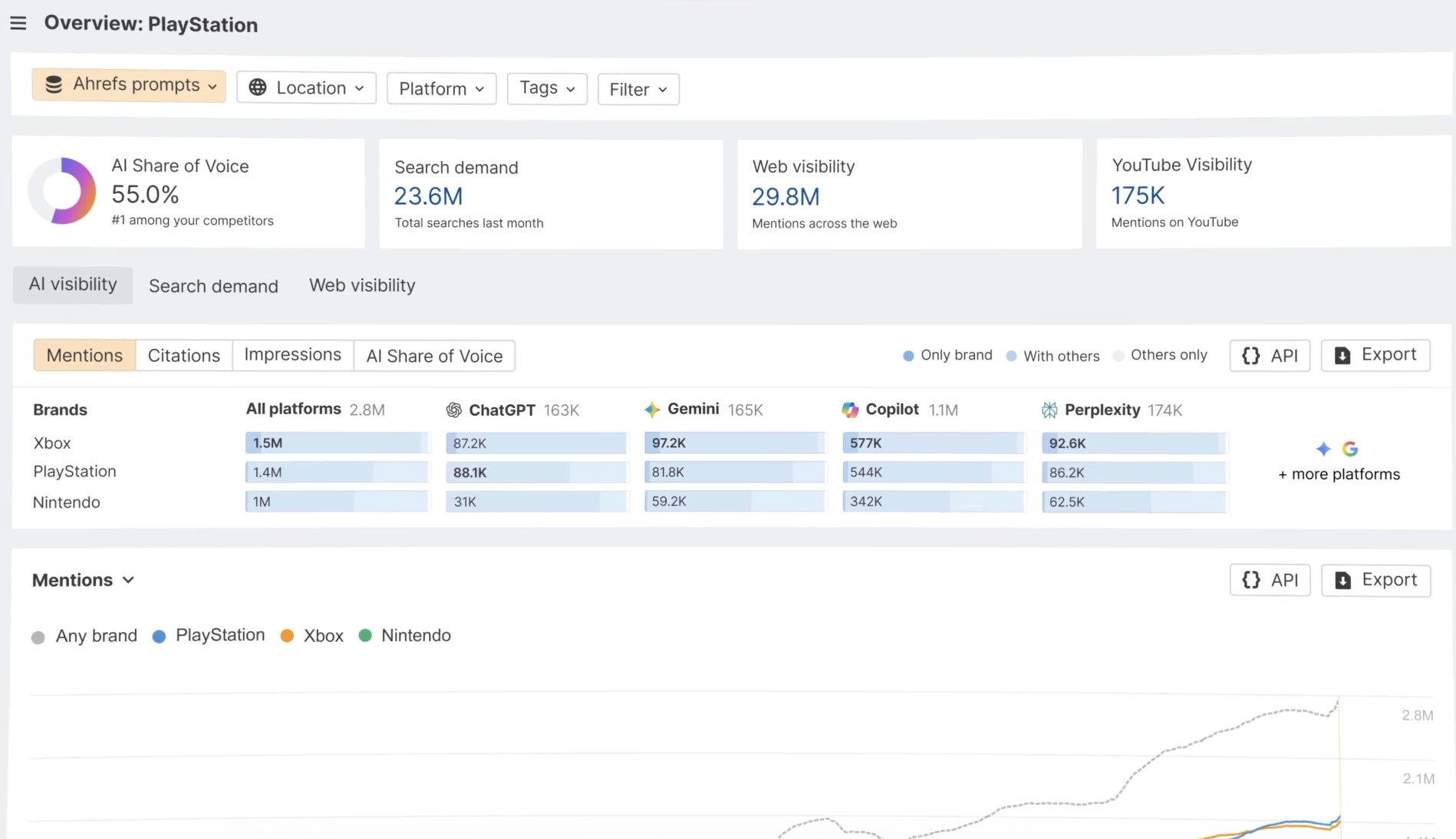
Ahrefs Brand Radar
Brand visibility across multiple AI answer tools
Yes
Teams already using Ahrefs for search and competitor research
Planable
What it monitors
Brand, topic, and competitor mentions across social and web sources
AI answer tracking
No. AI visibility is surfaced separately through SE Ranking data
Best fit
Teams monitoring what people publish about their brand
SE Visible
What it monitors
Brand presence and visibility inside AI search results
AI answer tracking
Yes
Best fit
Teams measuring brand visibility in AI-generated answers
Ahrefs Brand Radar
What it monitors
Brand visibility across multiple AI answer tools
AI answer tracking
Yes
Best fit
Teams already using Ahrefs for search and competitor research
1. Planable: social and web brand monitoring
Planable is a social media management tool that monitors brand, topic, and competitor mentions across eight social and web sources. It attaches sentiment to each mention and provides alerts when mention volume or sentiment changes.
It combines different data collection methods depending on the source. X and YouTube mentions are collected through platform APIs, five other social sources use search discovery and third-party scraping, and open-web mentions are found through search.
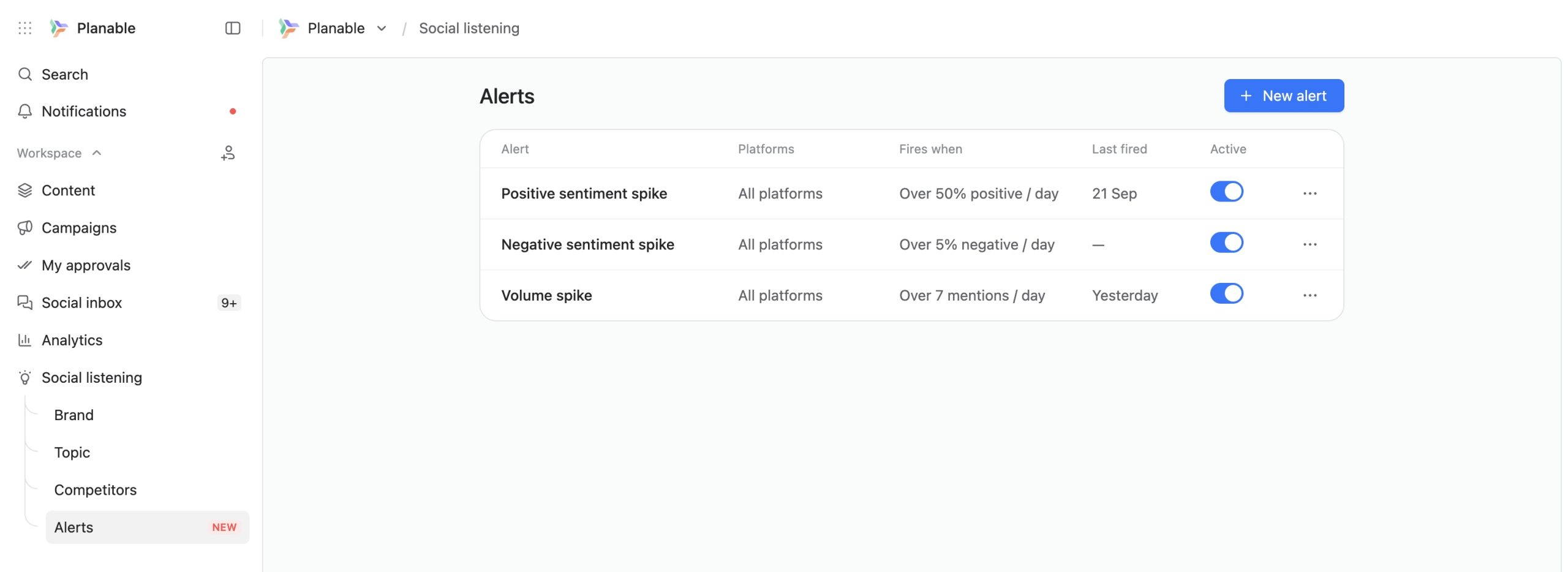
Alert setup in Planable Social Listening for changes in mention volume and sentiment
Best fit: Planable fits teams that primarily need to understand what people are publishing about their brand, competitors, or relevant topics across social platforms and the open web.
Main limitation: Its monitoring cadence means it is better suited to ongoing brand listening than use cases that require real-time mention tracking.
2. SE Visible: AI search visibility monitoring
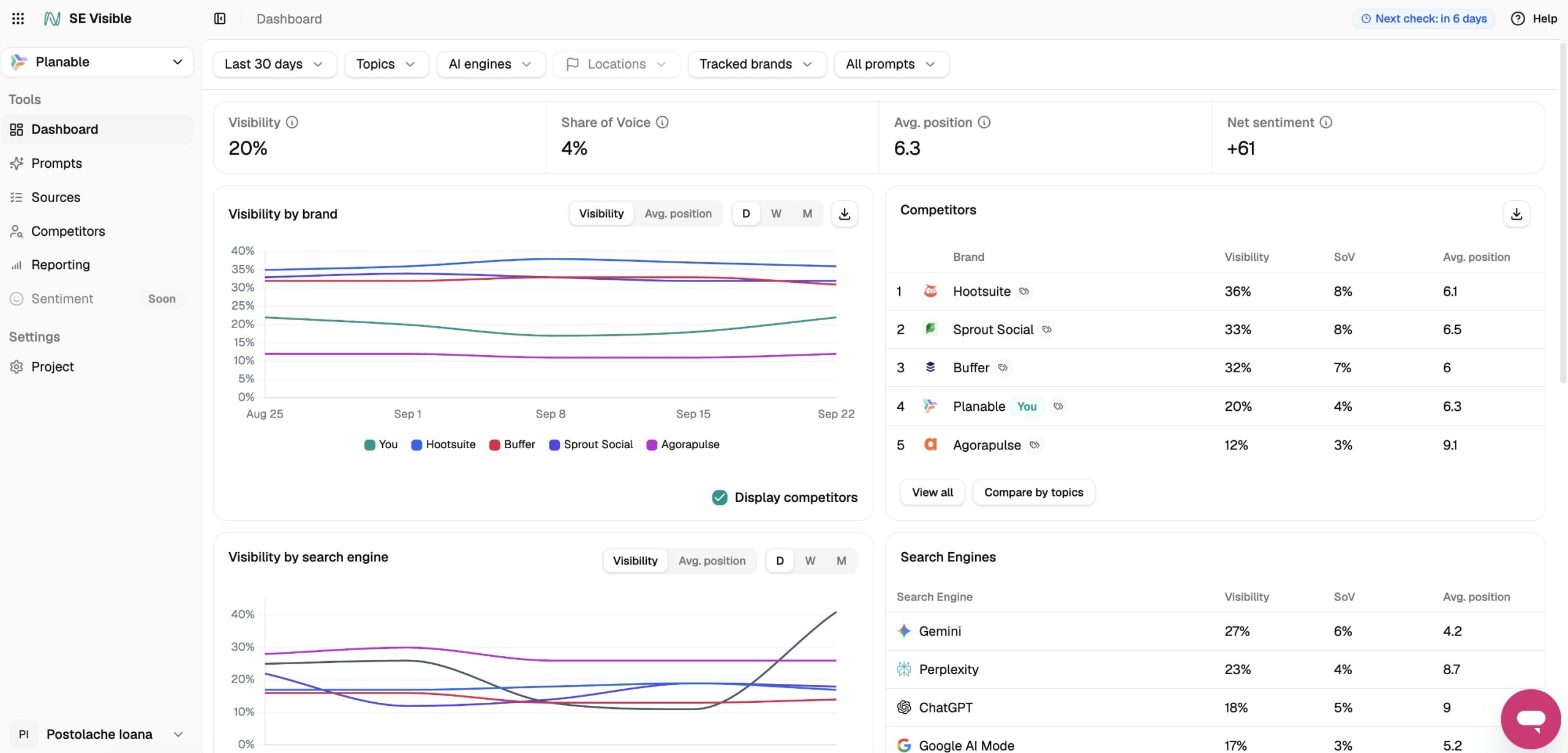
SE Visible monitors how brands appear in AI-generated answers across ChatGPT, Google AI Overviews, Google AI Mode, Gemini, and Perplexity. It tracks brand mentions, website citations, sentiment, and visibility compared with competitors.
It also shows which prompts mention your brand and which external sources AI engines cite in their answers. Teams can use this data to identify visibility gaps, compare performance across AI platforms, and track changes over time.
SE Visible dashboard showing AI visibility, rank, sentiment, and competitor performance
Best fit: SE Visible fits teams that want to track how often, where, and in what context their brand appears in AI-generated answers.
Main limitation: SE Visible currently tracks a defined set of five AI engines, so check that the platforms most relevant to your audience are included.
3. Ahrefs Brand Radar: AI visibility within the Ahrefs ecosystem
Ahrefs Brand Radar monitors how brands appear in AI-generated answers across six named AI tools. Teams can analyze both their own brand visibility and competitor visibility.
Its dataset includes more than 454 million search-backed prompts plus custom prompts. Google AI Overviews accounts for 311.8 million of those prompts, which means coverage is not distributed evenly across every AI surface.
Brand Radar report in Ahrefs, showing brand and competitor visibility in AI answers
Best fit: Ahrefs Brand Radar fits teams already using Ahrefs for SEO, search research, and competitor analysis that want to add AI visibility monitoring within the same suite.
Main limitation: The size of the overall prompt dataset should not be interpreted as equal coverage across AI platforms. Teams should look at coverage for the specific AI surfaces that matter to them.
How should you choose between Planable, SE Visible, and Ahrefs Brand Radar?
Choose based on the visibility layer you need to measure:
Choose Planable if you primarily want to monitor what people publish about your brand across social platforms and the open web.
Consider SE Visible if you primarily want to measure brand mentions, links, competitors, and sources inside AI-generated search experiences.
Consider Ahrefs Brand Radar if you want AI answer visibility data alongside an existing Ahrefs search and competitor research workflow.
These tools are not direct substitutes in every use case. Planable focuses primarily on human-published conversations and mentions, while SE Visible and Ahrefs Brand Radar focus on how brands appear inside AI-generated answers.
How to start monitoring your brand in AI this quarter
Here’s the call I’d make.
If you sell into a category where buyers describe their problem to an AI assistant, build a short prompt set and establish a baseline this quarter.
Start with five to ten questions tied to real buying situations. Run them across the AI surfaces that matter to your audience. Save the answers, mentions, competitor appearances, framing, and visible citations.
Then repeat the same process on a fixed schedule.
If buyers in your category don’t appear to research this way yet, you don’t need an elaborate monitoring program. A quarterly manual check across five or six important buying questions may be enough to see whether the surface is becoming relevant.
Either way, start before the method feels finished.
A rough baseline taken now will tell you more later than a cleaner baseline started only after something changes. One reading of these numbers means very little. Their value comes from the trend.
And when the trend does move, look outward as well as inward.
The claim that needs correcting may sit on a roundup, review, forum thread, or comparison page you don’t own. That’s why tracking what AI systems generate and tracking what gets published about your brand belong in the same monitoring strategy, even though they remain different measurement jobs.
Planable’s Social Listening covers the published-mention side of that work, while SE Visible covers the AI-answer side. Used together, they can help teams compare what people are publishing about a brand with how that brand is being represented inside AI-generated answers.
FAQs
What are the best AI brand monitoring tools?
It depends on what you want to monitor. Planable monitors published conversations, while SE Visible and Ahrefs Brand Radar monitor AI-answer visibility. Use a social listening tool for public brand mentions across social platforms and the web. Use an AI visibility tool for mentions inside AI-generated answers.
What is an AI monitoring system?
An AI monitoring system usually tracks the performance of a deployed AI model. For example, it can monitor model drift, inference quality, or performance degradation. AI brand monitoring is different because it tracks what AI systems say about a company, product, or brand.
Can ChatGPT do social listening?
Not by itself. ChatGPT can show you what one generated answer says about your brand at a specific moment, but it does not continuously collect public mentions across social platforms and the web. Use ChatGPT for spot checks and a social listening tool for ongoing monitoring.
How often should you monitor AI brand visibility?
Weekly is a practical starting point. Run the same prompt set across the same AI engines and compare the results over time. Treat a change as more meaningful when it persists across multiple checks and related prompts.
Ioana is a Senior SEO Specialist at Planable. She builds SEO and GEO strategies tied to product-led growth and tracks how the brand shows up across Google and AI answer engines. She has 5+ years of SEO experience across agency, consultancy and in-house roles. That includes technical SEO and SEO project management at Limitless Agency, and leading SEO as a partner at TherCore for ecommerce and lead-generation sites. At Planable she owns blog architecture, content refreshes, and builds AI automation workflows that scale content operations. She writes about AI search visibility, brand monitoring, and how SEO and social media can work together.






 Creation
 Scheduling
 Planning
 Social Inbox
 Collaboration
 Analytics
 Approval
 Social Listening