You're managing eight clients. Each has three to five social channels. You post three times a week per channel. That's between 72 and 120 pieces of content per month, just for one person to track, write, review, approve, and schedule. Now add a second client. And a...
Redesign For multi-location brands
all your locations, one content flow
For multi-brand companies
content collaboration at scale
For agencies
impress your clients and take on more
“The team loved it from the start. Planable helps us overview the entire marketing efforts.“
Competitor analysis is a practice almost everybody does, but not everyone really puts it down on paper properly.
SEOs, product teams, and social media marketers probably notice continuous shifts in a competitor’s product positioning, messaging, and general marketing strategy. But these details often remain decentralized, scattered across countless tabs and spreadsheets that teams across departments may have no clue about.
And you never know when a client wants to release a new product or expand to new markets and asks if their competition has already done so. To spare you from a scramble, this post walks you through how to conduct a methodical, repeatable competitive analysis in five easy steps.
As a bonus, I’ll also share a template and a few ChatGPT prompts I like to use when I run competitor checks on my own, that save me a lot of time.
What is a competitor analysis?
Competitor analysis is the process of identifying the companies competing for your customers and comparing their products, marketing, and customer feedback against your own.
Your scope and objectives are key differentiators between an analysis you’ll actually use and one you’ll forget in a folder. For example, an analysis built to figure out whether it’s worth bidding against an agency looks different from one made to plan next quarter’s content calendar.
That said, first pinpoint the exact purpose of your analysis, set up precise scopes and objectives, and the process will become much more straightforward while the insights you pull will be more practical.
Competitor analysis vs. competitive intelligence vs. market analysis
Competitor analysis sits between two other closely-related practices that often get used interchangeably.
Competitor analysis is a point-in-time comparison of named rivals against your own business, run when a decision needs evidence behind it.
Competitive intelligence is the ongoing version: a standing practice that gathers competitor information and routes it to the people who act on it.
Market analysis sizes the market or industry itself, and maps where demand shifts, with no particular focus on specific competitors.
The types of competitors teams should monitor
Competitors fall into three groups. A direct competitor sells a similar product to the same audience. An indirect competitor solves the same problem, but through a different method. An aspirational competitor serves a market you want but don’t hold yet, usually with more budget and a bigger audience.
For an agency, that usually looks like this:
Direct: companies that pitch similar offers, offer similar services, and target similar client bases.
Indirect: the in-house hire or the freelancer your prospect weighs against an agency.
Aspirational: the global network agency holding clients you want on your roster.
The company that takes your budget is rarely the one you benchmarked against.
One question sorts most companies: if you shut down tomorrow, where does your client’s budget go? Same solution to the same buyer is direct. A different solution to the same job is indirect. The aspirational names rarely surface in that answer, which is what makes them a positioning benchmark: you measure yourself against them long before you compete for the same deal.
The boundaries move. A freelancer with three retainers and a waitlist can become a direct competitor within a quarter.
Why is competitor analysis important
In short, competitive analytics gives you the insights you need to further grow your business. More specifically, competitor analysis helps you:
Spot market gaps. The audiences and pain points nobody in your industry serves yet are the easiest to capitalize on.
Improve positioning. If you can’t name the thing you do that your competitors don’t, your client can’t either.
Benchmark growth. A follower count means little until a rival’s number sits next to it.
What are the 5 steps of a competitive analysis
A competitive analysis involves five steps:
Step 1: identify and rank competitors
Step 2: compare products and pricing
Step 3: evaluate marketing and sales strategies
Step 4: analyze customer feedback
Step 5: conduct a SWOT analysis
Thoroughly document each step to create a competitive analysis you can share and act on with your team. You’ll learn about how to handle each step in more detail in the following sections.
Step 1: Identify and tier your competitors
List all your competitors, then rank them based on importance.
Source competitors from accounts your audience already follows; see who pops up in organic search results alongside you; check review sites, local listings, market research platforms, and so on. Ideally, you want to include around 10 to 15 competitors.
Next, figure out who your direct, indirect, and aspirational competition is, and categorize each competitor based on importance. Treating all your competitors as equals generally leads to decision paralysis and may cause your project to lack direction.
Here’s a tier list example:
Tier 1 (high-priority): Direct competitors who appear right next to you in organic search results, brand themselves as an alternative to your offerings, and whose target audience directly overlaps with yours.
Tier 2 (medium-priority): Direct competitors with smaller market shares who don’t pose any imminent threat to your company, or indirect competitors who target the same audiences as you and may challenge your business if potential product offering expansions overlap with yours.
Tier 3 (low-priority): Usually industry giants (aspirational competitors) that are almost impossible to outperform, but still are useful to identify how markets react to changes in their overall strategies.
Step 2: Compare their products and pricing
Compare their offer against yours, side by side.
Use their public pricing and product pages, and record what a buyer would actually see:
Entry price, and what pushes buyers to upgrade to the next pricing tier or premium versions of the same product
Product positioning: unique value proposition, the main features and benefits they choose to highlight to audiences
What’s missing, capped, sold as a paid add-on, and any other drawbacks: track customer feedback across review sites and social media here.
Then write one sentence on where their offer is genuinely stronger than yours, and where there are gaps to fill in. If nothing comes to mind, the research isn’t finished yet.
Pro tip: Use dated spreadsheets here. Pricing pages change quietly, and an out-of-date comparison table won’t make for a good look in front of clients, investors, or product managers.
Step 3: Evaluate their marketing and sales
Track how they win attention and how they generate conversions.
Subscribe to their newsletter, then analyze the email marketing sequences they send to you. See whether they push for a demo call, direct conversion, or try to offer value first through a promo code or other informative assets.
On socials, track when they post, how often they do it, the channels they post on, and what topic clusters they use, then put that beside your own social calendar. Also measure their engagement metrics to see whether their posting times, frequencies, and formats they use generate results.
Write down their unique value proposition word for word. That sentence explains how they position their entire business in front of their target audience, and can reveal exactly what makes their buyers tick.
Step 4: Analyze their customer feedback
Check their reviews for common complaints and pain points you can solve.
Use review sites and focus on three-star reviews: this is where feedback is usually most specific and objective. Try to identify patterns in drawbacks customers mention so you can capitalize on them directly.
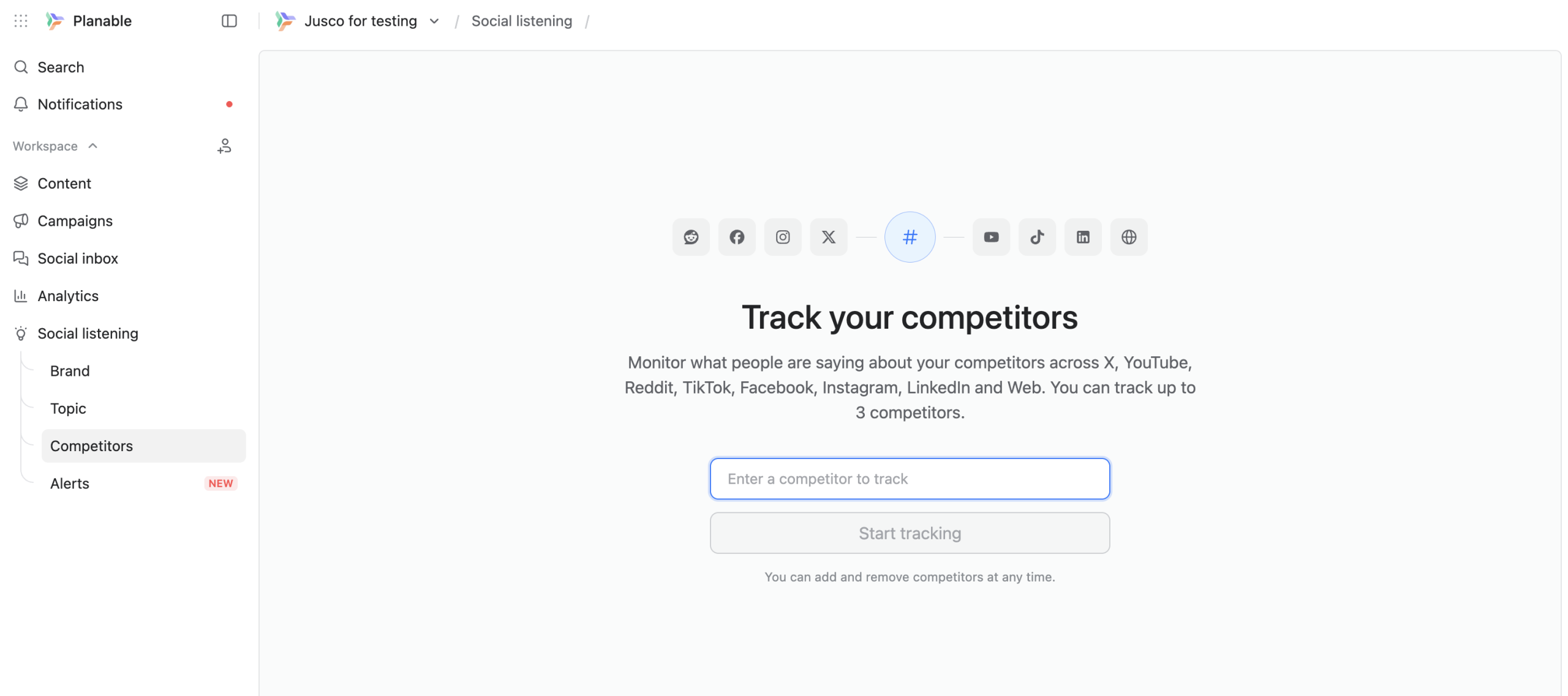
Also track competitor brand mentions across community forums and social networks. Ideally, you should use social tools. These compile competitor mentions across multiple channels and reveal key insights, like overall sentiment and share of voice.
For example, Planable’s social listening add-on reveals everything you need to know about your competition. It pulls competitor brand mentions from most major social networks (Reddit included), plus blog posts, news sites, newsletters, and forums.
Its AI features then categorize each brand mention based on sentiment (positive, negative, and neutral).
Planable Social Listening tracks brand and competitor mentions across social platforms and the web
Plus, the add-on is neatly embedded into the core platform. That means you see competitor-related drawbacks your target audience talks about at any given moment, then set up social posts to capitalize on them by highlighting your products or services, all within a single workflow.
Step 5: Run a SWOT analysis
Consolidate all findings into an actionable document.
SWOT analyses evaluate organizations (yours or your competitors’) two main areas:
Strengths and Weaknesses: Internal advantages and limitations. (e.g., strong product positioning, but limited scaling potential due to financial resources)
Opportunities and Threats: External risks or growth potential (e.g., a drop in demand around particular products, but a current market gap worth expanding on).
Organize SWOT matrices under 2×2 grids: two internal boxes for strengths and weaknesses, and two external ones for opportunities and threats. Run one SWOT analysis for each high-priority competitor, then one on yourself, so the comparison has a fixed point.
Once you’re done, you should have a good idea of where competitors currently outperform you, what you can do about it, and vice versa.
I would also recommend compiling all your SWOT analyses into a single, scored table to get the big picture on how the market currently stands and confirm who your top competitors are.
What does a competitor analysis matrix look like?
A competitor analysis matrix is a table with one competitor per row and one criterion per column: positioning, pricing, core features, channels, audience, customer sentiment, and the takeaway. Your own brand fills the first row, so every entry has a baseline beside it.
Every column has to force a decision. Pricing and features show where you’re undercut, sentiment shows why, and engagement figures mean nothing without your own social media benchmarks beside them.
Competitor
Positioning
Pricing
Core features
Channels
Audience
Customer sentiment
Takeaway
You
Direct competitor
Indirect competitor
Aspirational competitor
You
Positioning
Pricing
Core features
Channels
Audience
Customer sentiment
Takeaway
Direct competitor
Positioning
Pricing
Core features
Channels
Audience
Customer sentiment
Takeaway
Indirect competitor
Positioning
Pricing
Core features
Channels
Audience
Customer sentiment
Takeaway
Aspirational competitor
Positioning
Pricing
Core features
Channels
Audience
Customer sentiment
Takeaway
Which framework should you use?
There are four frameworks you can use. Here’s a brief rundown of each one:
SWOT: highlights strengths, weaknesses, opportunities, and threats (good for company-specific analyses).
Feature comparison matrix: compares features, benefits, and pricing between competing products in table formats (works for tracking individual products across multiple competitors).
Positioning map: compares brand/product positioning between multiple companies via a two-axis graph (simple method to visualize market-wide brand perception from a consumer’s perspective)
Porter’s five forces: gauges market stability based on bargaining power of suppliers and buyers, how easy it is for brand new businesses to break into the market, how likely it is for buyers to switch to a different product that solves the same needs.
Competitor analysis template
The illustrative scenario below belongs to a 12-person agency running social for a regional meal-kit brand, and its conclusion is that the winnable gap is weekday lunch-hour content.
Every number below is invented to show the shape of a finished matrix, not drawn from research or a client account.
Competitor
Positioning
Pricing
Core features
Channels
Audience
Customer sentiment
Takeaway
Your client
Chef-led, regional
$11/serving
12 recipes, flexible skip
Instagram, email
Home cooks 30-45
4.4/5, packaging praised
No lunch messaging
Direct (tier 1)
Cheapest weeknight box
$9/serving, subscription only
20 recipes, no skip
TikTok, creator spend
Budget families
3.9/5, delivery complaints
Buys reach, loses on service
Direct (tier 2)
No-commitment convenience
$12/serving, one-off boxes
8 recipes, no lock-in
Email-led, thin social
Busy professionals
4.5/5, flexibility praised
Owns the no-commitment buyer
Indirect (supermarket meal deals)
Everyday value
$7/meal
Fixed shelf range
In-store, retail media
Broad, non-subscriber
Not tracked
Caps the price ceiling
Aspirational
Celebrity chef, national
$16/serving
30 recipes, chef masterclasses
TV, TikTok, podcast spend
Aspirational urban 25-40
4.6/5, brand-led praise
Marks the premium end you price under
Your client
Positioning
Chef-led, regional
Pricing
$11/serving
Core features
12 recipes, flexible skip
Channels
Instagram, email
Audience
Home cooks 30-45
Customer sentiment
4.4/5, packaging praised
Takeaway
No lunch messaging
Direct (tier 1)
Positioning
Cheapest weeknight box
Pricing
$9/serving, subscription only
Core features
20 recipes, no skip
Channels
TikTok, creator spend
Audience
Budget families
Customer sentiment
3.9/5, delivery complaints
Takeaway
Buys reach, loses on service
Direct (tier 2)
Positioning
No-commitment convenience
Pricing
$12/serving, one-off boxes
Core features
8 recipes, no lock-in
Channels
Email-led, thin social
Audience
Busy professionals
Customer sentiment
4.5/5, flexibility praised
Takeaway
Owns the no-commitment buyer
Indirect (supermarket meal deals)
Positioning
Everyday value
Pricing
$7/meal
Core features
Fixed shelf range
Channels
In-store, retail media
Audience
Broad, non-subscriber
Customer sentiment
Not tracked
Takeaway
Caps the price ceiling
Aspirational
Positioning
Celebrity chef, national
Pricing
$16/serving
Core features
30 recipes, chef masterclasses
Channels
TV, TikTok, podcast spend
Audience
Aspirational urban 25-40
Customer sentiment
4.6/5, brand-led praise
Takeaway
Marks the premium end you price under
Summing up the table: both direct rivals already hold a position, and the supermarket row caps what a mass buyer will pay. The aspirational box outspends everyone on brand and still sells dinner, at a price your client can’t match. Weekday lunch is the one occasion nobody in the table claims. That’s the line for next quarter’s plan.
How do you do a competitor analysis on social media?
Pick three to five competitors, pull at least 30 recent posts from each account, and compare them on three things you can see from the outside:
Share of voice: how much of the category conversation each brand owns, counted as its mentions against every tracked competitor’s in the same period.
Engagement against a platform baseline: each competitor’s engagement rate checked against the norm for that platform, not against the other platforms.
Publishing pattern: how often they post and which formats they keep coming back to.
To set the baseline, Planable analyzed about 26,000 posts published by its customers between October 2025 and September 2026. Measured by followers, the median engagement rate was:
Platform
Median engagement rate
LinkedIn
0.59%
TikTok
0.52%
Instagram
0.36%
Facebook
0.19%
LinkedIn
Median engagement rate
0.59%
TikTok
Median engagement rate
0.52%
Instagram
Median engagement rate
0.36%
Facebook
Median engagement rate
0.19%
So a competitor at 0.5% is beating the norm on Instagram but falling short on LinkedIn.
Each network counts engagement its own way (LinkedIn and Facebook include clicks, TikTok counts likes, comments and shares), so each figure is a baseline for its own channel. Pull at least 30 posts per competitor before you trust an average. One viral post skews it.
ChatGPT is best used for the first draft of a competitor analysis: turning scattered public positioning into a structured table you then verify yourself.
OpenAI’s own workplace-usage analysis puts research and information gathering among the four dominant ChatGPT work tasks in a user’s first 90 days. Run these in one thread, so each answer feeds the next.
1. Build and tier the list
Prompt to use:
List 10 companies competing with [your company: one line on what you sell] for [customer segment]. Split them into direct, indirect and aspirational, with one line of reasoning each.
What to watch: it over-weights the best-known names. Prune it against your own sales calls.
2. Pull positioning and pricing
Prompt to use:
For [competitor], summarize their homepage and pricing page: who they say it's for, the claims they lead with, and each price tier. Give a source URL per line.
What to watch: pricing and plan names go stale fastest.
3. Fill the matrix and find the gaps
Prompt to use:
Compare [your company] with [competitors 1-3] on positioning, pricing, target customer and posting cadence. Return a markdown table, then three positioning gaps none of them claim.
What to watch: the table is usable; the gap list needs your judgment.
What to check before you trust the output
Three things break most often, so check them before the deck:
Pricing and plan names. Check every number against the vendor’s live pricing page.
Feature claims. A model will describe a feature a competitor removed two years ago, with total confidence.
Recency. A repositioning from last quarter may not be in the training data.
One hard rule: An AI engine’s output. Always double-check claims by doing your own research. If you can’t find the resources AIs compiled the output from, it’s best to drop the claim altogether in most cases.
Competitor visibility is starting to be measured inside AI answers as well as in search results and social feeds. AI search visibility, how often a brand gets named in a generated answer, has no agreed metric yet. Logging which competitors surface in these prompts gives you a baseline for when one arrives.
How often should you update your competitor analysis?
For most teams, a quarterly competitor analysis is a practical baseline. Treat competitor analysis as a recurring review rather than a one-off research project.
Quarterly reviews balance depth and frequency. Running a full analysis every week can create unnecessary work when little has changed, while waiting too long can make it easier to miss shifts in competitor performance, positioning, or strategy.
Crayon’s State of Competitive Intelligence also highlights the importance of running competitive intelligence as an ongoing program. According to the report, programs with tracked KPIs and an executive sponsor report revenue impact 88% of the time, compared with 29% of programs without those elements.
What should you do between quarterly competitor reviews?
Between full reviews, focus on competitor tracking rather than repeating the research process.
A competitor tracking tool should monitor the same public metrics on a consistent schedule and preserve historical data. That makes it easier to identify changes over time without rebuilding your competitor snapshot from scratch.
The distinction is simple:
Competitor analysis explains what changed, why it matters, and what you should investigate further.
Competitor tracking monitors selected metrics continuously so you can see when something changes.
How Planable supports ongoing competitor tracking
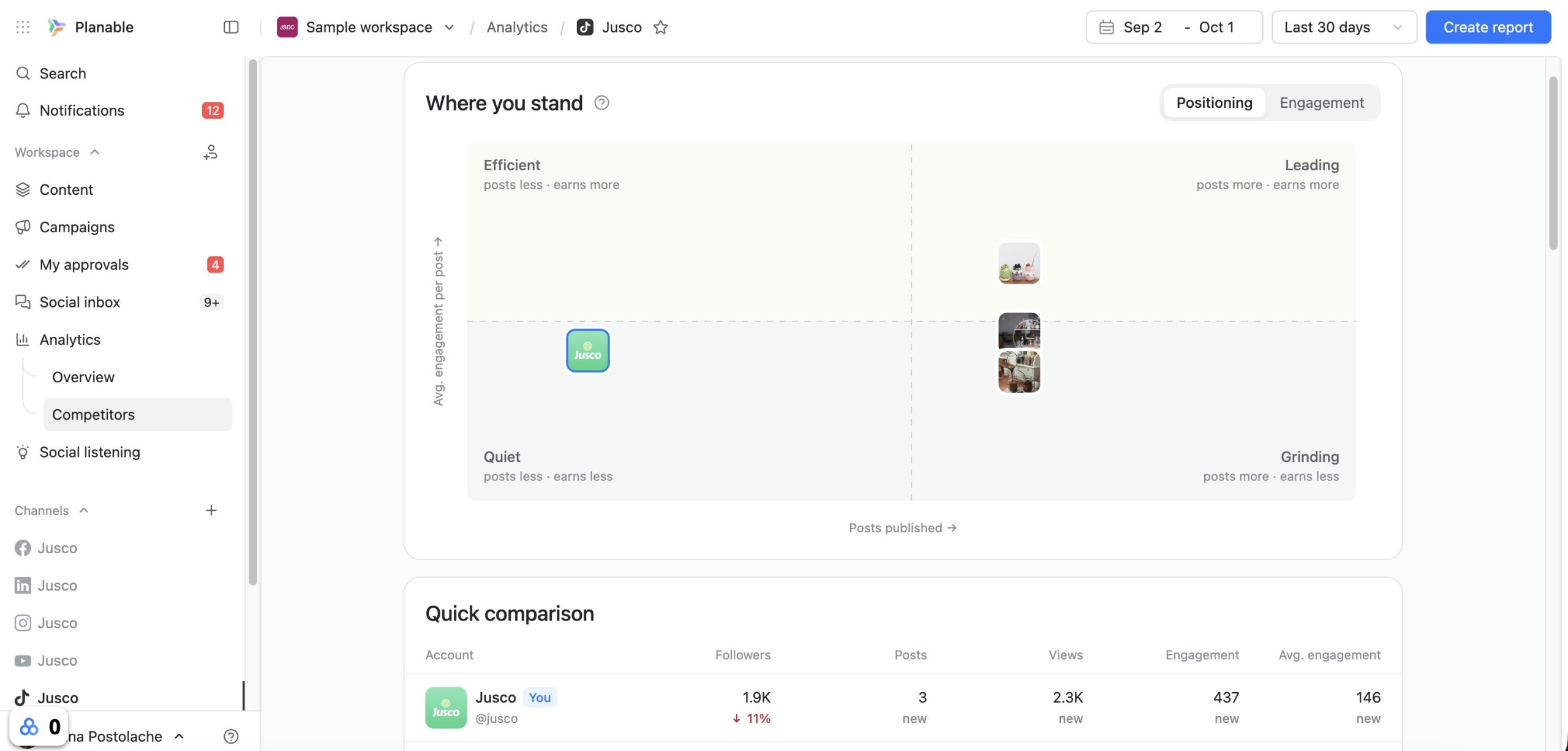
Planable’s Competitor Analytics is built for the tracking side of that workflow. It’s a Competitors tab inside Planable Analytics where you can compare a competitor’s followers, posting activity and average engagement against your own, follow how those numbers change over time, and see each competitor’s best-performing posts.
Competitor Analytics in Planable: your page’s followers, posts and engagement next to each tracked competitor
It works for Facebook Pages, Instagram professional accounts, YouTube channels, TikTok accounts and LinkedIn company pages. You can track up to five competitors per page, and Planable can suggest similar pages so you don’t have to search for each one. Data comes from each platform’s public data and refreshes once a day.
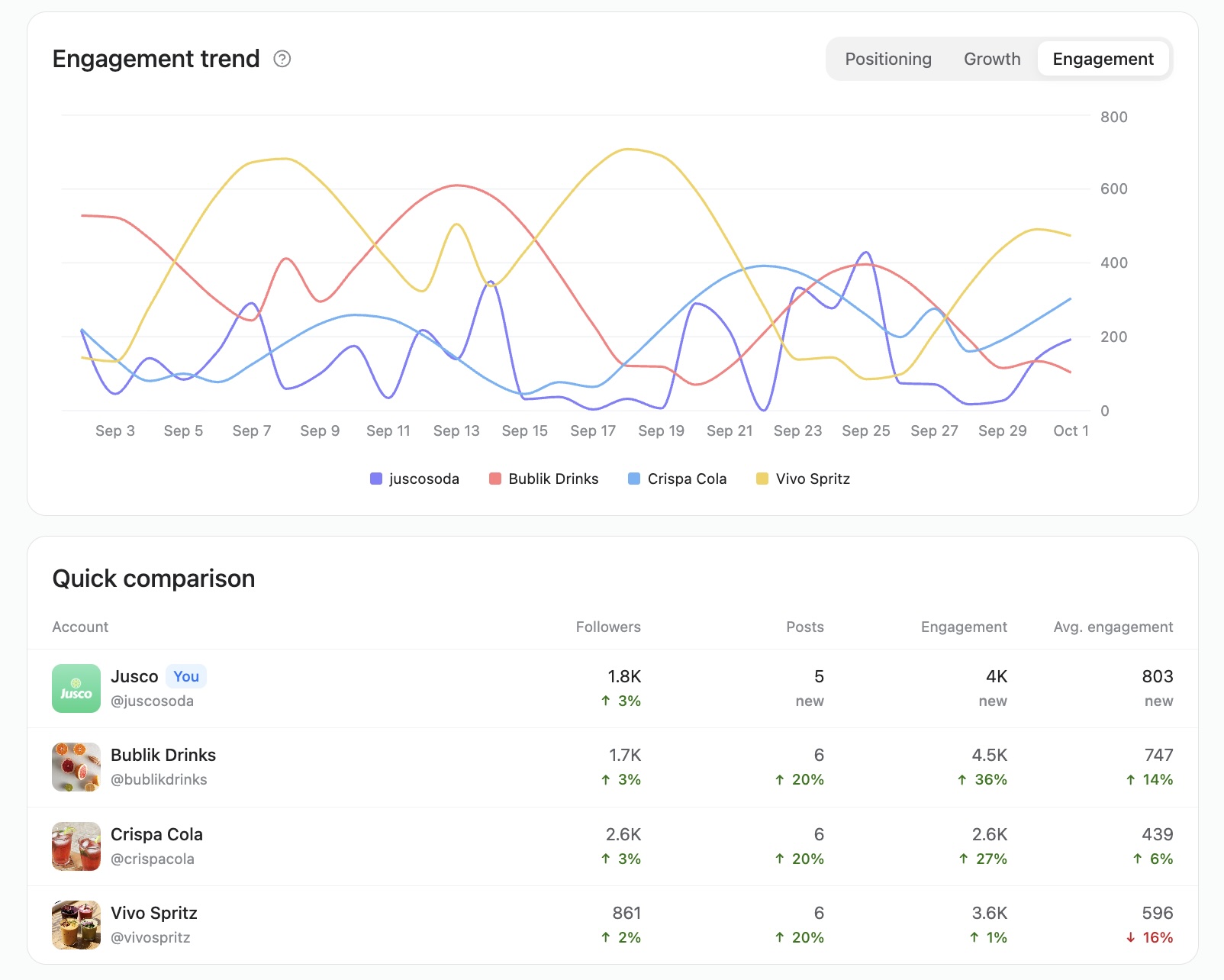
On top of the comparison table, you get a positioning matrix, growth and engagement trends, a content-mix breakdown and a word cloud of the terms competitors use most. You can export everything as a CSV or turn it into a competitor report to share as a PDF or a public link.
Positioning matrix and engagement trends in Planable’s Competitor Analytics, exportable as CSV or a shareable report
Competitor Analytics comes with the Analytics add-on, which costs $14 per workspace per month or $140 per year.
That makes Planable competitor analytics a good fit for keeping an eye on changes between your deeper quarterly reviews, but it doesn’t replace a full competitor analysis.
Competitor analysis FAQs
What is competitor analysis in marketing?
Competitor analysis in marketing is the practice of comparing how rival brands win attention: what they claim in their positioning, and how consistently they show up to say it. The marketing version narrows the general discipline down to demand generation. You’re studying the offer someone else puts in front of your buyer, and the language they wrap around it.
What is competitor benchmarking?
Competitor benchmarking is measuring your own numbers against a named competitor’s on the same metric, over the same window, so a result has context. Competitor analysis is the wider study of how a rival operates. Benchmarking is the measurement layer inside it, and it only works when both sides are counted the same way.
How do you write and present a competitor analysis report?
A competitor analysis report should lead with the recommendation and keep the matrix behind it as evidence. One page is usually enough: what changed since the last review, and the single decision you want signed off. Stakeholders read it the way they read a social media report, so borrow the structure they already know.
What to do with your competitor analysis
If this is your first analysis, pick one decision it has to serve this quarter, like a positioning line you’re about to defend in a pitch. Fill the matrix against that, and stop there.
If you already have one sitting in a deck from last spring, don’t rebuild it. Re-pull the same columns with today’s numbers and read what moved. The distance between versions is the finding.
Keeping it current is the part that quietly stops happening. If your social channels already live in Planable, competitor analytics in the Competitors tab under Analytics tracks up to five profiles per page, with their follower and engagement numbers next to your own, refreshed once a day.
Monica leads product marketing at Planable. She owns go-to-market for new features and shapes how Planable fits into the broader SE Ranking product family. She joined in 2023 as Planable's first product marketer, built the function from scratch, and now runs the team's competitive intelligence program. With a background in product management and Romania's startup scene (How To Web, MVP Academy), she writes about competitor analysis, product launches and marketing workflows from the builder's side. Before Planable, she spent almost five years managing Orange Fab Romania, Orange's startup acceleration program, where she supported 40 startups and helped generate over €2.2M in commercial value.








 Creation
 Scheduling
 Planning
 Social Inbox
 Collaboration
 Analytics
 Approval
 Social Listening