Looking for perfect Coschedule alternatives and feeling lost in options? You and many other social marketers, too. The market is full of social media automation tools, each somewhat different. Luckily, I dug into the topic, so you don't have to! I’ve rounded up 10...
Redesign For multi-location brands
all your locations, one content flow
For multi-brand companies
content collaboration at scale
For agencies
impress your clients and take on more
“The team loved it from the start. Planable helps us overview the entire marketing efforts.“
Your client wants to know what people are saying about their brand. But your social media report covers only the performance of published posts, leaving out brand mentions, competitor conversations, and audience sentiment.
Social media intelligence closes that gap by turning public conversations into actionable insights. It helps agencies and teams identify emerging issues, understand competitors, and make informed decisions about content, customer communication, and brand positioning.
The key is a repeatable workflow that connects listening insights to content planning, client approvals, and measurable outcomes.
What is social media intelligence?
Social media intelligence is the process of collecting, analyzing, and interpreting social media conversations to make informed marketing and business decisions. It combines social monitoring, audience sentiment, competitor research, and content performance data to identify what a brand should do next.
For example, imagine several customers complain about delivery times across social platforms.
Monitoring: Identify an increase in delivery-related mentions.
Listening: Determine whether complaints reflect a recurring issue and which audiences are affected.
Intelligence: Recommend a delivery FAQ update, assign an owner, and schedule an approved social post addressing common questions.
The final step is what makes the information actionable.
A useful social media intelligence finding should answer three questions: What changed? Why does it matter? What should the team do about it?
For agencies, this creates a stronger client reporting model. Instead of reporting only reach and engagement, teams can demonstrate how audience and competitor intelligence influenced the content strategy.
What’s the difference between social media monitoring, social listening, and social media intelligence?
Social monitoring tracks conversations, social listening interprets them, and social media intelligence turns the findings into decisions. These activities are connected, but they serve different purposes.
Social listening and social media intelligence are therefore not competing approaches. Listening provides evidence that intelligence teams use to make decisions.
When does a team need social media intelligence?
The right setup depends on the complexity of the accounts, the importance of competitor research, and the decisions clients expect.
As a practical starting point:
Small teams managing 1–4 accounts: Basic monitoring and analytics may be enough when clients mainly need publishing performance and comment management.
Agencies managing 5 or more clients: A structured listening process becomes more useful as manual review becomes harder to maintain.
Teams facing competitor or reputation questions: Social listening is valuable regardless of account count.
Teams regularly changing strategy based on findings: A formal intelligence workflow helps document decisions, owners, and results.
These account ranges are operational guidelines, not universal requirements. One client facing a reputation issue may need more sophisticated listening than an agency managing several straightforward accounts.
The deciding factor is whether the team needs to understand conversations beyond its owned social pages and act on them consistently.
Why is social media intelligence important for brands and agencies?
Social conversation now travels into search. In a study by SE Ranking, around half of all Google searches (50.3%) included at least one social media platform among the top 10 organic results. In Google’s AI Overviews, at least one social site appeared for 20% of queries, and in AI Mode that figure rose to 36%.
A Reddit thread or a YouTube comment section becomes part of the client’s search presence as a result. A complaint left unanswered under a client’s post can be the page a buyer reads before they ever reach the client’s website.
Consumers also lend those platforms real credibility. In a Gartner consumer survey, 61% of surveyed consumers identified YouTube as trustworthy for accurate information, with Reddit at 47% and Instagram at 32%. Those are the same places where unhappy customers and curious prospects post first.
Claudia Ratterman, Director Analyst in Gartner’s Marketing practice, drew the conclusion for marketers:
“Marketers must recognize that credibility is now a core currency in the social and search ecosystem.”
A client’s reputation is being written in comment threads and community posts on platforms consumers rate as trustworthy, and the monthly report never looks at them.
If your report covers only the posts you published, the client can fairly ask what they’re paying you to watch.
What business decisions can social media intelligence improve?
For brands and agencies, social media intelligence supports several practical decisions:
Content strategy: Identify recurring questions, complaints, and topics worth addressing.
Competitor positioning: Understand what audiences value about competing brands.
Reputation management: Detect recurring negative themes and decide when a response is needed.
Customer communication: Clarify confusing product information or policies.
Campaign planning: Compare audience response across channels and content formats.
Client reporting: Show which findings resulted in published content or other actions.
The value comes from connecting evidence to a decision.
A rise in negative sentiment may justify further investigation, but it does not automatically mean the team should publish a response. The mentions need to be reviewed for relevance, context, and whether they represent a broader pattern.
How do you build a social media intelligence workflow?
A social media intelligence workflow has four steps: define business questions, collect relevant data, review patterns, and document actions.
Each step should have a clear output and an accountable owner. This prevents listening insights from remaining unused in dashboards.
Step 1: Define the questions social intelligence must answer
Start with three to five questions for each client.
Questions should be specific enough to guide what the team tracks and what it reports.
Examples include:
Which competitor content formats are receiving the strongest engagement this quarter?
What complaints are appearing repeatedly across social conversations?
How is the audience responding to our latest product launch?
Which product questions are customers asking that our content doesn’t answer?
Where are customers discussing our brand compared with competitors?
Agree on these questions during onboarding or a monthly client review.
They become the basis for keyword selection, competitive analysis, and reporting.
Avoid vague research goals such as “understand brand perception” without specifying the products, audiences, competitors, or issues involved.
Output: A list of agreed business questions that each intelligence report will address.
Step 2: Collect data from owned channels, competitors, and public conversations
Social media intelligence works best when data comes from three complementary sources.
Data source
What to track
What it helps answer
Owned social accounts
Engagement, post results, comments, audience response
How is our content performing?
Competitor accounts
Publishing frequency, engagement, content formats
What are competitors publishing and how do audiences respond?
What are people saying outside our owned channels?
Select platforms based on the audience, not simply the number of available networks.
A B2B software company may prioritize LinkedIn, Reddit, and industry discussions. A restaurant group may find more relevant conversations on Instagram, Google Business Profile, TikTok, and local community platforms.
How can Planable help collect social media intelligence?
Planable provides two complementary capabilities:
1. Social Listening monitors public mentions of a brand name or selected keywords across seven social sources: X, YouTube, Reddit, TikTok, Facebook, Instagram, LinkedIn, plus the wider web.
Each workspace supports:
1 brand keyword (plus up to 3 aliases)
3 topic keywords
3 competitor keywords
Social Listening’s Competitors view in Planable: mention volume against three tracked competitors, plus a quadrant plotting mentions against net sentiment
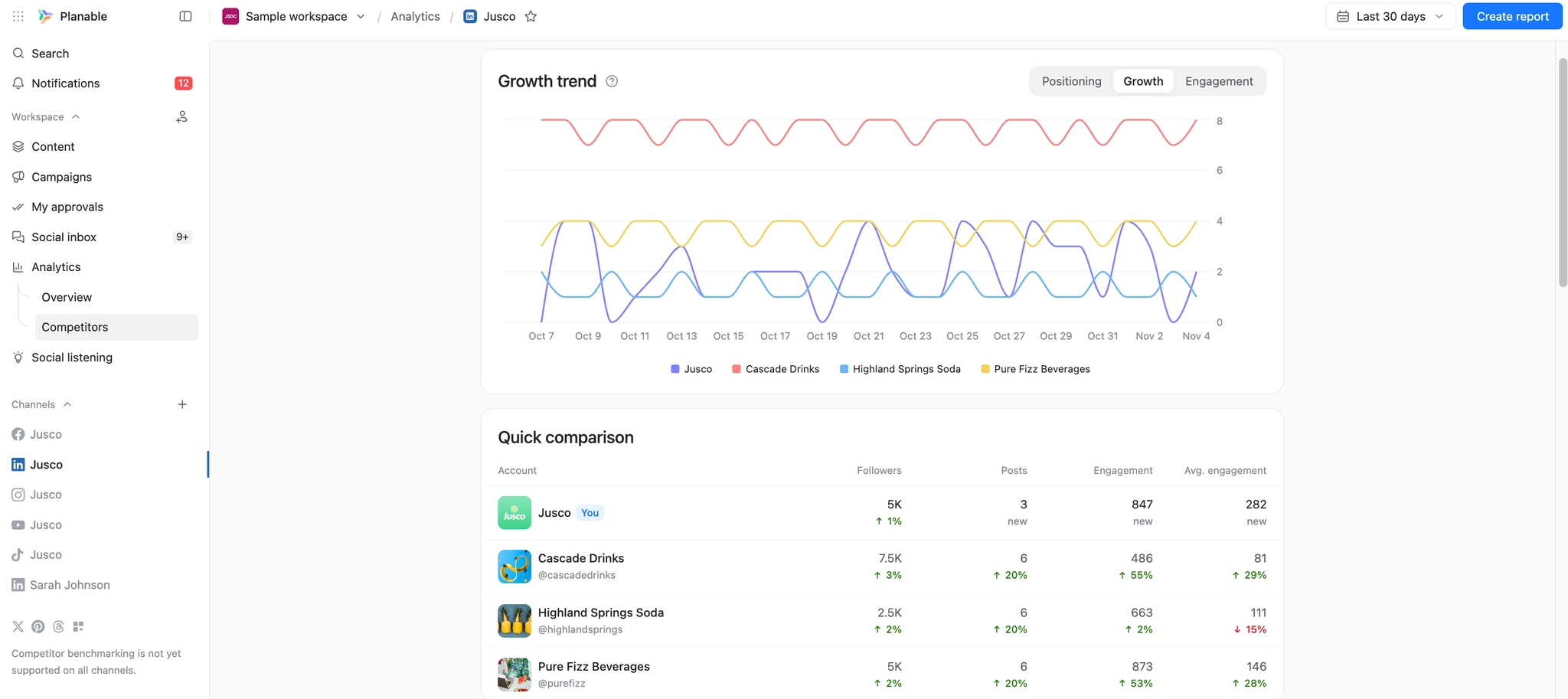
2. Competitor Analytics, available through Planable’s Analytics add-on, compares public competitor profiles across Instagram, Facebook, YouTube, TikTok, and LinkedIn. It supports tracking up to five competitors per page, with daily data refreshes.
Competitor Analytics in Planable: growth trend and a follower, post and engagement comparison with tracked competitor pages
The distinction matters: Social Listening measures conversations about brands and topics, while Competitor Analytics measures how competitor social pages perform.
Together with owned-account analytics, these provide the evidence needed for a broader intelligence workflow.
Output: A defined set of sources, keywords, and competitors linked to the client’s business questions.
Step 3: Review findings and assign responsibility
Collecting data doesn’t automatically produce useful intelligence.
Teams need a regular process for reviewing mentions, identifying recurring themes, and determining which issues require action.
A practical cadence is:
Daily monitoring: The account manager reviews alerts, checks individual mentions, and escalates urgent issues.
Weekly analysis: The social lead reviews recurring themes, competitor activity, and audience questions.
Monthly reporting: The strategist summarizes changes, decisions, and completed actions for the client.
In the weekly review, examine three keyword groups.
Competitor mentions highlight features, experiences, or messaging audiences value elsewhere.
Topic mentions reveal broader questions and trends that may create content opportunities.
Review underlying posts before treating a sentiment label or engagement spike as a meaningful pattern. One highly active thread may not represent wider audience opinion.
In Planable, Social Listening includes volume and sentiment alerts for the brand keyword. Teams can set thresholds and restrict alerts to relevant platforms.
Because alerts are batched rather than immediate, this configuration suits scheduled analysis more than urgent crisis detection.
Output: A shortlist of validated findings, each with a proposed response or monitoring decision.
Step 4: Turn findings into documented decisions
A decision log connects intelligence to execution. Each finding should record what was observed, the recommended action, the owner, the due date, and how the result will be assessed.
Finding
Social action
Website action
Owner
Due date
Repeated questions about weekend bookings
Publish an Instagram explainer
Update booking FAQ
Social lead
Thursday
Confusion about a product feature
Create a product demonstration
Clarify feature documentation
Content lead
Next sprint
Interest in a competitor’s comparison format
Test a relevant comparison post
Review existing comparison content
Strategist
Next content cycle
Repeated questions about weekend bookings
Social action
Publish an Instagram explainer
Website action
Update booking FAQ
Owner
Social lead
Due date
Thursday
Confusion about a product feature
Social action
Create a product demonstration
Website action
Clarify feature documentation
Owner
Content lead
Due date
Next sprint
Interest in a competitor’s comparison format
Social action
Test a relevant comparison post
Website action
Review existing comparison content
Owner
Strategist
Due date
Next content cycle
These are illustrative workflow examples, not documented client results.
For website-related actions, determine whether the appropriate response is to create, update, expand, repurpose, or leave existing content unchanged.
Before commissioning a new page, review existing content, relevant search queries, competing pages, and the questions AI-generated answers already address.
Not every finding deserves immediate publication. Low-confidence observations can remain on a watch list until more evidence appears.
Output: A decision log that connects social insights to content, ownership, approval, and follow-up measurement.
How do you turn social media intelligence into content?
Turn social media intelligence into content by selecting a validated audience need, choosing an appropriate format, assigning an owner, and securing approval before publication.
The critical step is moving from a finding to a scheduled deliverable.
Consider a hypothetical restaurant group that receives increasing complaints about weekend wait times across multiple locations.
The workflow could look like this:
Detect: A sentiment alert identifies an increase in negative mentions.
Validate: The account manager reviews posts and confirms that several independent customers describe a similar issue.
Decide: The social lead recommends content explaining an existing weekend booking option.
Plan: The team assigns the content to a calendar slot and gives the copywriter a deadline.
Approve: The client confirms that the booking information is accurate before publication.
Measure: The team reviews subsequent mentions to assess whether confusion or complaints changed.
This sequence connects audience evidence directly to the publishing workflow.
How do you automate the weekly review with Claude?
The slowest part of the weekly review is the reading: going through the feed, spotting the pattern, then checking whether anyone searches for it. Planable’s Weekly Content Opportunity Radar is a Claude skill that does that research before the meeting starts. It needs Social Listening and an SE Ranking account, both connected to Claude.
Every week, the Radar:
Pulls the signals from Social Listening: recurring complaints, repeated questions and topics that are gaining momentum.
Checks demand in SE Ranking: related search queries, their volume and which way they’re trending.
Checks AI answers to see whether your brand is cited and named, and where the engines source their answers.
Scores and ranks up to three opportunities, each with a brief and a decision: create, expand, refresh, repurpose or skip.
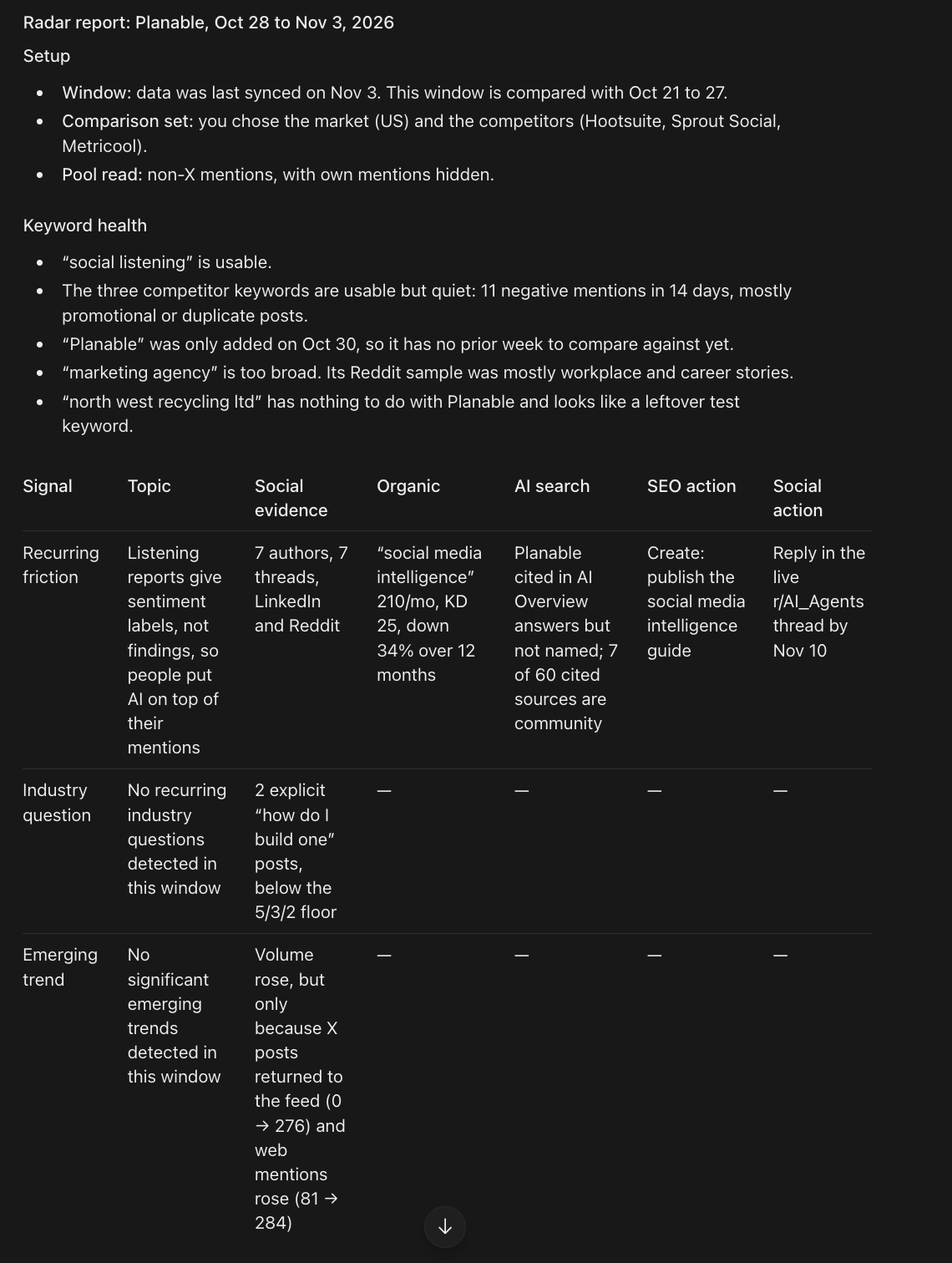
I ran the Radar on Planable’s own workspace in early November 2026, and the top opportunity it found was the topic of this guide. Seven people, in seven separate threads on LinkedIn and Reddit, described the same problem in different words: their listening reports hand them sentiment labels instead of findings, so they’re wiring AI on top of their mentions to get to a decision.
The Weekly Content Opportunity Radar’s report on Planable’s own workspace, Oct 28 to Nov 3, 2026, with search demand, AI citations and the recommended actions
Here’s how that finding landed in our decision log:
Finding
On social
On the website
Why it’s worth doing
Owner
Due
Listening reports give teams labels, not findings
Practitioner reply in a live Reddit thread about building a listening agent
Create: publish a guide to social media intelligence
7 independent authors; “social media intelligence” draws about 210 US searches a month at difficulty 25; AI Overviews cite Planable pages on the topic but name other vendors
Social lead (reply), content lead (guide)
Reply within a week, before the thread goes cold; guide in the next content cycle
Listening reports give teams labels, not findings
On social
Practitioner reply in a live Reddit thread about building a listening agent
On the website
Create: publish a guide to social media intelligence
Why it’s worth doing
7 independent authors; “social media intelligence” draws about 210 US searches a month at difficulty 25; AI Overviews cite Planable pages on the topic but name other vendors
Owner
Social lead (reply), content lead (guide)
Due
Reply within a week, before the thread goes cold; guide in the next content cycle
What surprised me most was what the Radar refused to call. Mention volume for “social listening” jumped that week, which would normally read as a trend. The Radar traced the jump to X posts returning to the feed and said the underlying conversation hadn’t grown. It also flagged that search demand for this topic has fallen by about a third over the past year. Both caveats made it into the report instead of being smoothed over.
The Radar proposes and the team decides. I still read the posts behind each finding before anything takes a calendar slot, and in a client workspace, the client still approves the post in Planable before it’s scheduled. What changes is the starting point: the weekly review opens with a ranked list instead of a blank feed.
How does Planable connect listening to content approval?
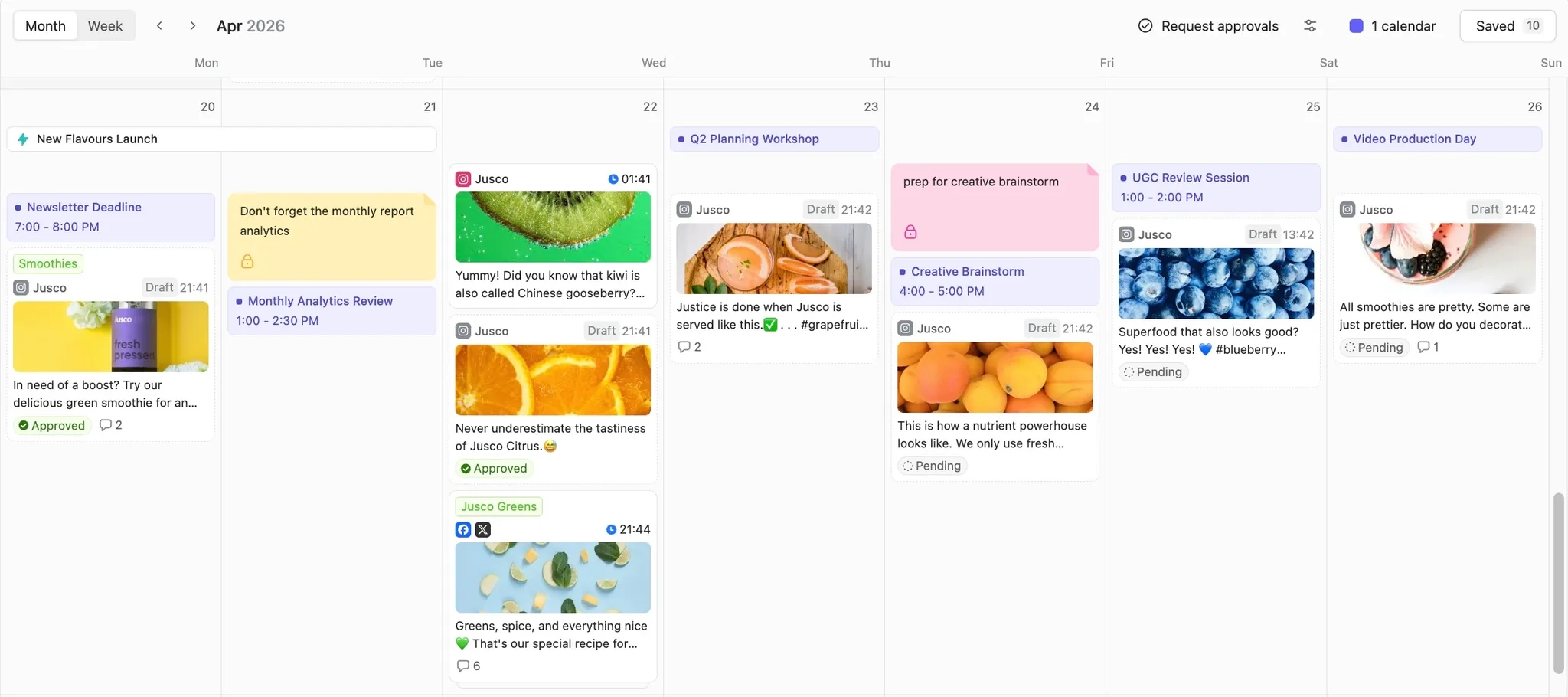
Planable’s content calendar lets teams create notes on specific dates to capture findings and content ideas.
Calendar notes support up to 160 characters, use six preset colors, and can be converted into post drafts.
Planable’s content calendar, where color-coded notes sit next to scheduled posts, drafts and their approval status
Teams can then draft, review, and approve the content within the same workspace.
When required approval is enabled, at least one approver must sign off before a post is scheduled or published. If the client is configured as an approver, the workflow provides a checkpoint for factual or brand-sensitive claims.
This matters because listening-driven content often addresses product details, customer concerns, or service policies that need verification.
Keeping the finding, draft, and approval connected also makes it easier to show clients how insights influenced published work.
Which social media intelligence metrics should you track?
The most useful social media intelligence metrics measure audience conversation, competitor position, and how findings translate into decisions.
Mention volume and sentiment are important, but they become more useful when compared over time and linked to an action.
A brand’s share of tracked conversation compared with competitors
How teams use it
Assess relative conversation visibility
Sentiment distribution
What it measures
Proportion of positive, neutral, and negative mentions
How teams use it
Identify shifts in audience perception
Mention volume
What it measures
Number of tracked brand or topic mentions
How teams use it
Detect unusual changes in conversation activity
Competitor engagement
What it measures
Audience interaction with competitors’ content
How teams use it
Identify formats worth evaluating
Decisions implemented
What it measures
Actions completed based on intelligence findings
How teams use it
Demonstrate operational use of insights
Alert relevance
What it measures
Proportion of alerts that merit investigation or action
How teams use it
Refine alert thresholds
Time to approved content
What it measures
Time between validated finding and approved post
How teams use it
Identify workflow delays
Social referral traffic
What it measures
Visits originating from social platforms
How teams use it
Understand traffic contributions
Which metrics belong in client reports?
Prioritize metrics that support business decisions:
Share of voice against tracked competitors
Changes in audience sentiment
Important conversation themes
Competitor performance patterns
Actions completed in response to findings
Relevant content or traffic outcomes
Operational metrics such as alert relevance and approval turnaround time can remain internal unless they help explain a bottleneck or service improvement.
How should sentiment analysis be interpreted?
Sentiment analysis classifies conversations as positive, neutral, or negative. It can help identify changes in audience perception, but automated classification isn’t always accurate. Sarcasm, humor, mixed opinions, and context-dependent language can produce misleading labels.
Planable’s Social Listening classifies individual mentions by sentiment and allows manual adjustments.
Filtering mentions by positive, neutral or negative sentiment in Planable Social Listening, with each mention’s label adjustable
Review unusual or high-impact mentions before using sentiment statistics in a client presentation.
Share of voice also needs context. Its meaning depends on which competitors, keywords, platforms, and time periods are included. A larger share of conversation is not automatically evidence of stronger reputation or commercial performance.
Which social media intelligence setup fits your team?
The choice depends on three factors: the depth of listening required, how quickly the team needs new information, and whether insights must connect directly to content production.
Varies, including faster monitoring where supported
Content collaboration
Built into an integrated workflow
May require separate publishing tools
Listening depth
Depends on available sources and keyword limits
Often broader, depending on vendor and plan
Main limitation
Less suitable for intensive, time-critical monitoring
May introduce additional tools and workflow handoffs
Best suited for
Integrated social management platform
Agencies and content teams
Dedicated listening suite
Research, reputation, and crisis-focused teams
Primary strength
Integrated social management platform
Connect findings to planning and approval
Dedicated listening suite
Deeper listening and research capabilities
Typical analysis cycle
Integrated social management platform
Daily or weekly
Dedicated listening suite
Varies, including faster monitoring where supported
Content collaboration
Integrated social management platform
Built into an integrated workflow
Dedicated listening suite
May require separate publishing tools
Listening depth
Integrated social management platform
Depends on available sources and keyword limits
Dedicated listening suite
Often broader, depending on vendor and plan
Main limitation
Integrated social management platform
Less suitable for intensive, time-critical monitoring
Dedicated listening suite
May introduce additional tools and workflow handoffs
When is Planable a good fit?
Planable is a practical option for agencies and multi-brand teams that want to connect listening insights with content planning, collaboration, and client approval.
It is particularly suited to questions such as:
Which audience complaint should we address next?
What are people saying about our competitors?
Which topic deserves an explainer?
How can we turn a listening finding into an approved post?
The main advantage is the connection between gathering insights and producing content, rather than maximum listening depth.
How much does Planable’s social media intelligence setup cost?
The supplied pricing details are:
Feature
Monthly pricing
Annual pricing
Social Listening add-on
$99 per workspace
$990 per workspace
Analytics add-on, including Competitor Analytics
$14 per workspace
$140 per workspace
Social Listening add-on
Monthly pricing
$99 per workspace
Annual pricing
$990 per workspace
Analytics add-on, including Competitor Analytics
Monthly pricing
$14 per workspace
Annual pricing
$140 per workspace
Social Listening has a 30-day free trial and is purchased separately from Analytics.
The pricing model is per workspace with unlimited users.
For agencies, workspace-based billing means listening can be enabled only for clients who need it. Clients requiring owned-account analytics alone don’t necessarily need the listening add-on.
What are Planable’s listening limitations?
Planable’s listening data is not real-time.
Brand and competitor keywords refresh every 24 hours.
Topic keywords refresh every seven days.
Alerts are available on the brand keyword and evaluate the previous day’s mentions. They appear in Planable right away. Email and Slack notifications are never sent overnight: anything triggered before 09:00 workspace time is delivered at 09:00.
These limitations matter for teams handling urgent brand events. Planable supports recurring intelligence reviews and content decisions, but it shouldn’t replace a dedicated crisis-monitoring system.
When should you choose a specialist listening platform?
Choose a dedicated listening suite when the team needs capabilities such as:
Faster detection of time-sensitive reputation issues
Broader source coverage
Longer historical datasets
Large-scale conversation research
More advanced filtering and analysis
Availability varies by vendor and plan, so compare actual coverage, latency, data retention, and cost rather than assuming every specialist platform offers the same capabilities.
For agencies managing different client needs, a hybrid setup may be appropriate: integrated listening for routine content workflows and specialist monitoring for high-risk accounts.
What are common social media intelligence mistakes?
The most common mistake is collecting conversation data without turning it into a useful decision. Other problems can weaken the quality of findings or make reports misleading.
Tracking too many keywords without a purpose
Large mention feeds become difficult to review when no one knows which business questions the keywords support.
Better approach: Prioritize terms linked to specific client questions. Remove keywords that consistently generate irrelevant results.
Confusing owned content performance with public conversation
A post’s engagement doesn’t measure what audiences are saying about the brand across other channels.
Better approach: Separate owned-account analytics from external mentions. Planable’s Hide own mentions option can help exclude content from connected owned pages.
Treating sentiment labels as definitive
Automated sentiment scoring can misinterpret sarcasm, context, and mixed opinions.
Better approach: Review important mentions manually and report the themes behind sentiment changes.
Reporting conversation volume without context
A spike may come from a campaign, news story, controversy, or publishing activity.
Better approach: Compare the change with its baseline, investigate the underlying mentions, and explain what action is warranted.
Leaving insights disconnected from the content calendar
A finding that remains in a spreadsheet or Slack thread may never affect what the team publishes.
Better approach: Assign an owner, approval requirement, and calendar date to findings selected for action.
Treating public social data as unrestricted
Public availability doesn’t eliminate privacy, copyright, contractual, or platform-policy considerations.
Better approach: Follow applicable laws and platform terms, use aggregate patterns where possible, and minimize unnecessary exposure of individual users’ information.
Social media intelligence FAQs
Is social media intelligence the same as social media analytics?
No. Social media analytics focuses primarily on how owned social accounts and published content perform. Social media intelligence adds public conversations, competitor information, and audience sentiment, then uses that evidence to guide decisions.
Is social media intelligence the same as social listening?
Not exactly. Social listening identifies and interprets conversations about brands, competitors, and topics. Social media intelligence uses those findings, alongside other evidence, to recommend actions and evaluate their results.
What is share of voice in social media intelligence?
Share of voice is the percentage of tracked conversation associated with a brand relative to the brands included in a comparison. It helps teams understand relative visibility, but results depend on the selected keywords, sources, competitors, and measurement period.
Can small businesses use social media intelligence?
Yes. Small businesses can begin by monitoring recurring customer questions, relevant mentions, and a few competitors. Advanced tools aren’t required to start. A simple review and decision log can provide value when findings regularly influence communication or content.
Can social media intelligence work in real time?
Some listening platforms offer faster monitoring, but data availability and alert latency vary. Social media intelligence can support rapid decisions when suitable data is available, as well as weekly and monthly strategy cycles. Planable’s stated refresh intervals make it better suited to scheduled reviews than immediate crisis detection.
What tools are needed for social media intelligence?
A basic setup needs social analytics, mention monitoring, competitor research, a process for interpreting findings, and a place to track decisions.
An integrated platform such as Planable can connect listening insights with content planning and approval. More specialized research or crisis-monitoring needs may require dedicated listening software.
How should agencies start using social media intelligence?
Start with one client, one business question, and a repeatable review process.
Choose a client who has recently asked about competitor activity, audience sentiment, or an unexplained change in performance.
Define what the team needs to learn, configure the relevant sources, and review findings weekly. Turn meaningful insights into approved actions and document the results in the next client report.
If no client currently needs broader conversation intelligence, continue with monitoring and analytics until there is a decision that requires additional data.
For teams that want listening connected directly to content planning, Planable offers Social Listening alongside its calendar and approval workflow.
George is Senior Content Marketing Manager at Planable, where he's rebuilding the content function around AI. His automation workflows handle research, competitor tracking, reporting and first drafts, with brand-voice guardrails and a human approval step on every output. He also tracks how Planable shows up in ChatGPT, Perplexity and other AI answers. He has 8+ years in social media, brand building, graphic design, including social and influencer strategy for Planable, Brico Depot Romania and Ivatherm. That's the hands-on experience behind his writing on social media workflows, managing multiple accounts and agency operations.






 Creation
 Scheduling
 Planning
 Social Inbox
 Collaboration
 Analytics
 Approval
 Social Listening