Planning your content is essential for any marketing team: it helps publish consistently, always keep track of what’s what, and streamline your content workflow to know who’s responsible for that last-mile approval. If you're on the hunt for game-changing content...
Redesign For multi-location brands
all your locations, one content flow
For multi-brand companies
content collaboration at scale
For agencies
impress your clients and take on more
“The team loved it from the start. Planable helps us overview the entire marketing efforts.“
Do you keep posting videos without seeing an increase in conversions? A solid TikTok marketing strategy can help with that. The comment to cart pipeline is real and 68% of users say brands should use the comment section to better understand their audience, but a lot of marketers don’t have a strategic approach to community management or their overall presence on the platform.
A strategy is crucial for reaching your specific target audience, and if you use a TikTok scheduler to plan your video content, your marketing efforts become even more focused.
I’m Jade Tambini aka B2B Jade: marketing consultant, TikToker, podcaster, and founder of B2B Breakthrough Academy. My marketing strategy course helps B2B brands generate results and the people behind them enjoy their jobs again.
I’m going to walk you through the steps of creating and implementing a TikTok strategy, and I’m including insights from my chat with Laura Little, TikTok Shop & TikTok Live Partner.
Why you need a TikTok marketing strategy
The TikTok algorithm rewards engagement. Even if you have a sizeable follower count, a strategy helps you engage consistently.
You develop a clear brand voice. Once you know what tone and persona each post aligns with, everything is a little easier, including editing.
You connect with niche communities or younger audiences. And build long-lasting, authentic connections with these groups.
You make informed decisions when optimizing. You’ve got clear TikTok metrics to rely on instead of throwing stuff at the wall and seeing what sticks.
There’s less wasted energy all around. Your efforts become more focused, more aligned with business objectives, and more likely to lead to conversions.
What is a TikTok marketing strategy?
A TikTok marketing strategy is a clear, specific plan for creating and publishing TikTok content. It’s geared towards achieving specific business goals on this platform and focuses on reaching and engaging a specific target audience.
It includes everything from defining objectives and content pillars to performance tracking and optimizing your output of short-form video. It clarifies how a brand with cultivate organic visibility. Ultimately, it comes down to purposefully building meaningful connections through consistent engagement.
Core steps to building your TikTok marketing strategy
Some of the steps of creating a strategy for your TikTok account mirror steps that also apply to digital marketing in general. You already know this. You’re an experienced marketer and I genuinely doubt you need me to sell you on items like the importance of getting to know your target audience deeply.
So here’s the deal. I’ll list these classic steps briefly as a refresher, then concentrate on insights that are especially relevant for how things work within the TikTok app. Here we go:
Set clear, measurable goals
Research your target audience
Research your competitors
Optimize your TikTok account for branding (username, profile picture, bio, clickable link, pinned videos)
1. Get really comfortable with deconstructing trends
I’ll bet you’ve heard a million times about the importance of using trends to your advantage. But this works so much better when you understand why things go viral.
Do they tap into a shared cultural anxiety? Do they expose a psychological bias? Digging into these reasons helps you decide if they’re relevant for your brand, audience, tone of voice, and overall goals.
Go deeper on concepts like:
The background effect: Your audience pays more attention to content that matches what they’re already feeling, thinking, or experiencing.
Anchoring: The first frame you give someone shapes how they interpret everything that follows – setting a benchmark for value, time, or effort.
The reciprocity effect: People are more likely to engage when you offer something valuable first, even if it’s small, like entertainment, clarity, or recognition.
The Zeigarnik effect: Our brains hate unfinished business. When you leave room for a little tension, curiosity, or an open loop, people are drawn to close it. Don’t fall into clickbait, though! Keep things reasonable and deliver on what you promise.
You can find out more about the practical applications of these concepts plus a heap of useful exercises in our Psychology of engagement piece.
2. Select your tools for implementing TikTok strategies
My marketing strategy is very simple and I only use a handful of tools, in terms of both hardware and software.
I do most things by filming on my Sony ZV-E10 camera and Shure MV7 mic. Then I edit inside Descript, and I tend to add my captions inside the platforms, as it often feels more native.
I do recommend Planable for TikTok scheduling and management. This just keeps everything together!
3. Before filming, pass your content calendar ideas through this checklist
At the end of the day, TikTok, more than any of the other social media platforms, is an entertainment service. It’s powered by the “moment”, whether that’s music (see Lily Allen) or the Miss Universe pageant. How could we forget “FRAANCE”?
TikTok viewers care about honest moments and like joining in. They don’t worry about polished visuals, and they pay close attention to what they watch.
Laura’s personal checklist always includes these questions:
Are we in the moment?
Are we being authentic?
Are we being creative?
Are we entertaining?
4. Integrate TikTok effectively into a full-funnel marketing strategy
Once you move past early goals like getting noticed or sparking interest, you have to focus on turning viewers into customers and guiding them along the way. Plenty of brands share useful content, but it doesn’t always push people to take the next step.
When you can subtly include converting sentences like “Some of the ways we’ve helped clients with this include” or “We do have a tool you can try out which we’ve linked in our profile” this turns already helpful content into something that gets people to commit to action. Capturing borrowed audiences and turning them into an owned audience is the important first step!
Then you have to cultivate a solid nurture process. For me, that looks like a 30-day email nurture sequence followed by relevant outreach, only if they take certain steps, such as downloading my guide that helps them decide if they want to work with me.
5. Balance content made by TikTok influencers with brand-created content for long-term growth
I personally see these as complementary approaches. You’ll want to have your own content to build the brand over time, and when it makes sense, pay relevant personalities to get your message out to their audiences in the same way you’d pay for ads.
Influencer marketing has the added benefit that people can do a good job for your brand if they’re skilled and their audience really trusts them. Their recommendation goes a long way for your brand trust factor.
I would also say that building a solid brand account is the most important thing, but TikTok campaigns with influencers can do wonders for boosting brand awareness and engagement.
Common challenges with marketing on TikTok
As a TikTok strategist and founder, I help marketers create strategies that get results. I see the same pitfalls again and again, so I want to show you how to move past them.
1. Cultivating authenticity and communities beyond views
No one can predict how the landscape (and the TikTok algorithm) will change, so my advice is to be as authentic and relaxed as possible. Also, be strategic, don’t just chase metrics.
Think about the top 10 questions customers ask you that you are really good at answering. Answer those questions in the same way you would when a prospect is sitting in front of you in a meeting.
Keep on and on about the same core things from multiple angles; refresh the approach, but don’t stray away. This will be really good for long-term search.
For example, most of my videos are about “how to make a simple marketing strategy” or “how to stop being on the marketing task wheel” and in my tiny corner of TikTok, it’s what my audience knows me for. There’s no jumping around; the strategy is solid, repetitive, and sturdy.
2. Unfortunate video editing and lack of hooks
Not getting to the point is a problem I see so often. The hook is unbelievably important for short-form video. I saw a post the other day and it sounded like this: “So, ummm, the thing I was thinking about the other day, was just really, about how, we, as marketers, actually make things – well – kind of difficult for ourselves, you know…” and it kept going and going. Not sure where exactly, I tuned out.
To keep users engaged, I start my videos very intentionally with “These are the biggest reasons marketers aren’t getting sales leads” or something like that. My TikTok audience knows what it’s getting, right away.
3. Keeping up with fast-moving trends
Another big problem with TikTok content is when it lacks direction and is struggling to keep up with viral trends in a way that just ends up looking like a lack of focus. Once again, be strategic. Answer to this questions:
What one thing do you want your audience to get about you?
Where do you want them to place you in their mind?
How is what you’re saying a reason they should buy from you and not someone else?
If you do jump on a trend, make sure it’s extremely relevant for your TikTok business and aligned with your voice.
4. Managing content approval workflows at scale
Approvals make for one of the most notorious bottlenecks when managing a TikTok business account. Using a scheduling tool that lets you build custom workflows helps a lot, especially with the option of automatically adding approved TikTok videos to the publishing queue.
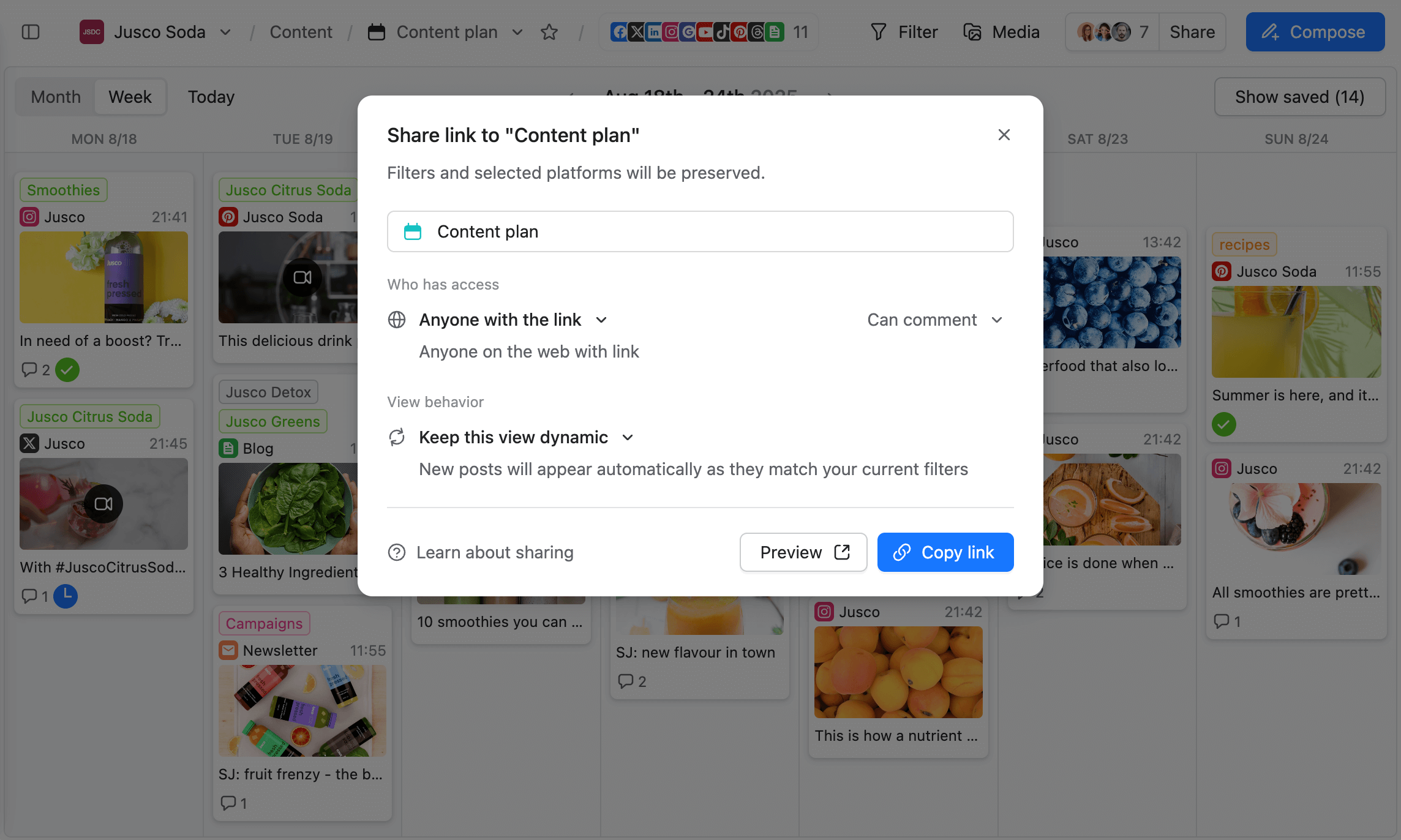
The more clients I add to my roster, the more I appreciate the Planable feature that lets me send guest view links. People in orgs with different structures can all get access quickly, and I’m not setting up new credentials (or troubleshooting login issues).
Planable sharing view with link settings for external access to a dynamic content plan.
5. Measuring ROI
Proving the impact of your work to stakeholders is no small feat. A combo of TikTok’s built-in analytics tools and the reporting available in one of the aforementioned tools will get the job done.
Here’s something I hear often:
I feel like I’m constantly being told to prove marketing’s ROI, but lots of what I do can’t be directly measured.
If you’re struggling with this, you’re definitely not alone.
Instead of trying to prove ROI on every small thing, focus on showing progress toward outcomes clients care about:
Are sales conversations getting easier because prospects are more educated?
Are deals closing faster because prospects already understand your value?
Are you losing to competitors less on price because differentiation is clearer?
These are real indicators of marketing impact, even if you can’t draw a straight line from a specific blog post to a closed deal.
6. Challenges depending on business size
Here are some of the most common friction points I see people struggling with when they handle marketing on TikTok for multiple clients:
Evaluation Points
Freelancers
Agencies
Adaptability and scope
They have more breathing room to adapt quickly to changes. But if those changes
involve a sudden increase in project scope, they might not have the capacity
to accommodate it.
They have the capacity to take on a significantly increased workload, but
changes in workflow structure can take longer to implement.
Expertise and innovation
They can be exceptionally astute at things like cultivating a specific tone,
generating fresh ideas, using unique video styles, or harnessing data.
They can also be well-rounded generalists. But there are limits to what a
single person can accomplish, and sometimes clients can have unrealistic
expectations (like fitting six jobs into one).
They cultivate a wide mix of specialties in their teams, giving them processing
power and diverse knowledge. But bureaucracy and clunky approval processes
can stifle innovative ideas before they have a chance to flourish.
Reporting and budgets
Reasonable budgets for up-and-coming brands are easier to come by, but often
without access to complex analytics tools.
They often provide very detailed reporting powered by enterprise-level software,
but this comes with larger operational costs and fees.
Adaptability and scope
Freelancers: They have more breathing room to adapt quickly to
changes, but may not handle sudden increases in scope.
Agencies: They can take on heavier workloads, though workflow
changes take longer to roll out.
Expertise and innovation
Freelancers: Strong creative instincts and flexibility, but
limited by being one person.
Agencies: Broad teams and varied expertise, but innovation may
be slowed by internal processes.
Reporting and budgets
Freelancers: Budget-friendly but without advanced analytics tools.
Agencies: Strong reporting but higher operational costs.
How Planable helps you execute your TikTok marketing strategy
Planable helps you run the whole TikTok workflow, post to 8 other social media platforms, and handle content creation for almost any written content (newsletters, blogs, press releases, etc.).
It’s built for no-fuss collaboration. From first draft to final approval, every stage happens in one shared space, cutting out the confusion of scattered feedback, lost versions, and slow approvals.
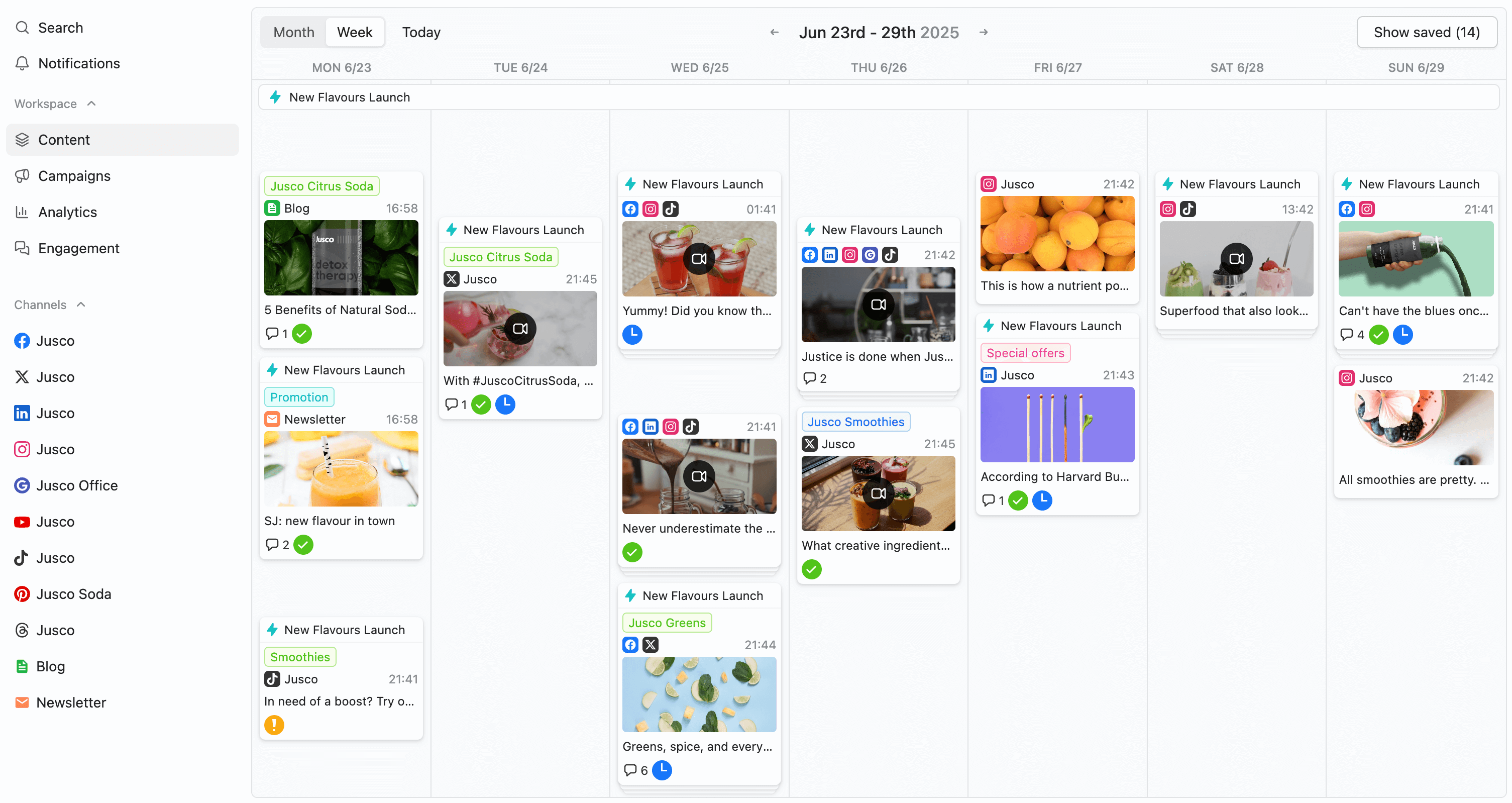
Planable weekly calendar showing scheduled posts for a product launch campaign across channels.
Here’s a formula I use for content creation. I call it “Inspiration-Hook-Entertainment-Bonus” or “The 4-Step Method“. To me, the first step is a crucial one. Consider this example.
Let’s say an agency working for three clients uses Planable to draft 30 TikTok video ideas per month, get client feedback in one place, schedule posting, tag KPIs, and export a performance summary. The first bit with the 30 ideas is one that (understandably) feels like a lot of pressure.
What I do is that I always have a shared document where I’m constantly squirreling away ideas.
Some of them can be insights from long-form content. Some are data-based revelations I saw in a report. Some are golden nuggets of wisdom my marketing bestie throws around over coffee. Some are formats I see a brand from a different niche using that spark something in my mind like “I could put my own spin on this”. Either way, when I sit down to generate ideas, I’m never starting from scratch.
I distill the most promising of these into hooks, and we’re off. I collaborate with my team to flesh out the best way to deliver on hooks in a way that’s entertaining even when educational. We add a freebie (that can also convert) at the end. The content is ready to be seen by the client.
Once external and internal approvals are all gathered in Planable, the content gets scheduled automatically.
Planable features that make the process painless:
Centralized content calendar (for TikTok and other platforms)
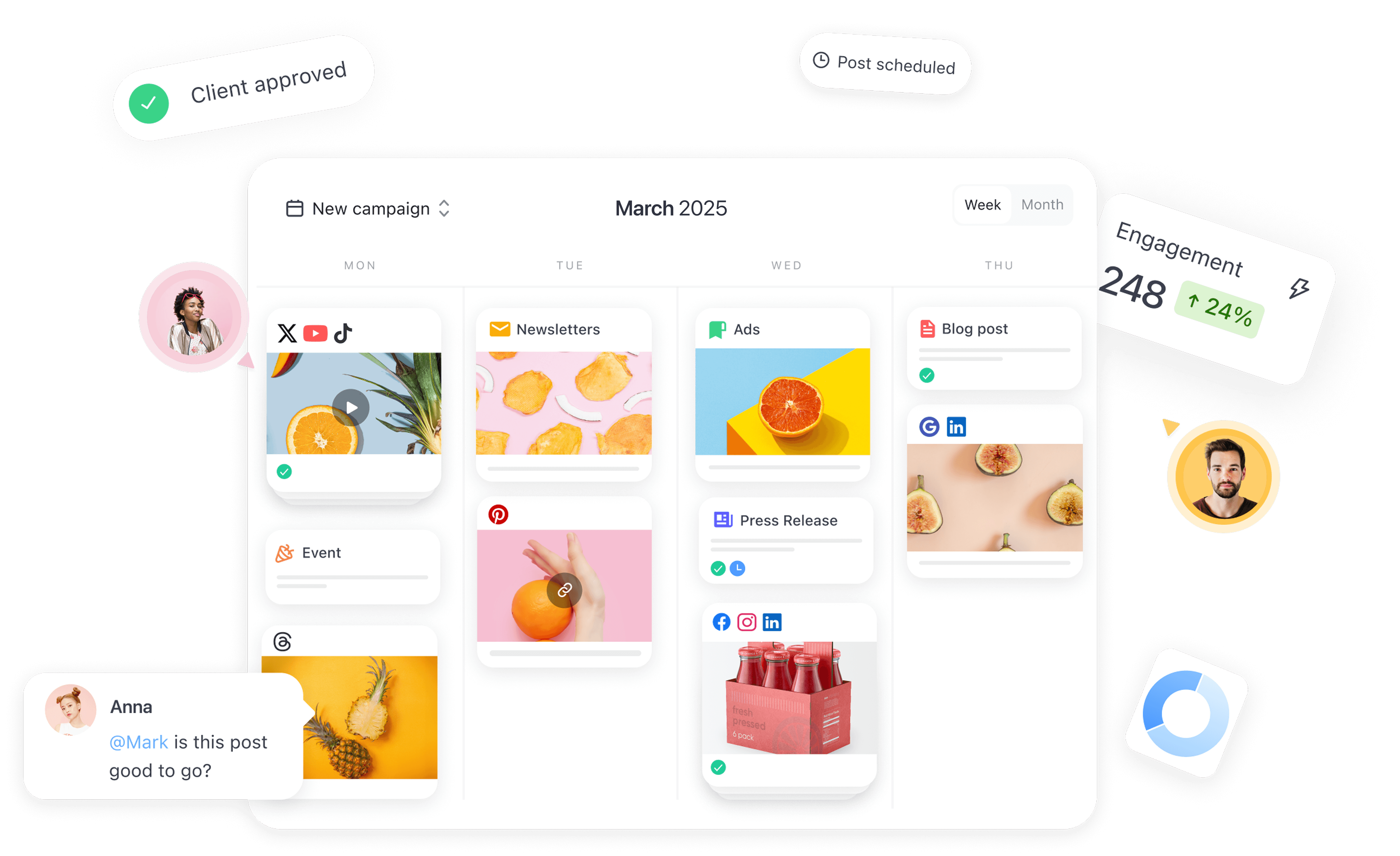
Planable calendar view showing scheduled posts, team feedback, approvals, and engagement insights.
Real‑time collaboration and feedback (comments on drafts, version history)
Simply posting: It involves guesswork and time-consuming experiments
Posting strategically: It’s data-driven and its impact is trackable over time
Results come from a combination of applying digital marketing principles you’re familiar with from other social media channels and getting to know the specificities of TikTok users’ experience on the app.
Best practices for creating content for TikTok strategically
I asked Laura Little, as well as the Fractional CMO for e-commerce brands, how B2B or niche brands can genuinely succeed on TikTok. She said:
This app has room for everyone. No niche is too strange or small. The machine learning and ecosystem are light-years ahead of any other social media platform.
1. Incorporate going live into your organic content strategy
Laura continues: One essential habit that helps B2B or niche brands genuinely succeed on TikTok is to GO LIVE. This particular social media network makes it incredibly easy for both brands and people.
Through live entertainment, you can introduce your product or service to global audiences since the algorithm will know exactly who to surface it to. TikTok Live works very well as a top-of-funnel organic brand awareness tool and as a bottom-of-funnel conversion tool.
2. For now, the hashtag debate is settled
I also asked Laura whether she still adds hashtags to her TikTok videos, and to expand on the verdict. She was adamant:
Yes! TikTok actively suggests hashtags for creators to use, and recommends their search tool for search insights, which include hashtags. For that reason, I still use them.
Her approach aligns with what Jon‑Stephen Stansel explored in our hashtag debate piece: hashtags aren’t dead, but their overall impact has changed. Using them strategically can still help your content get discovered.
3. Get really good at “normal talk”
This is a crucial operational shift for social media managers. If you want to make things work on TikTok, you have to become skilled at “normal talk”. This means helping the person being filmed talk as they would to a person sitting next to them, without all the baggage and formalities we associate with making video content.
People tend to clam up and act differently. If you can get your subject matter expert to loosen up and have a chill conversation with you, while you have the camera and mic on, this makes a huge difference. Then you go into areas that would be relevant to your target customers, and later on edit things down to get the golden nuggets.
This is harder than most folks expect, a very specific skill, and a way to cultivate highly engaged audiences. People who win on TikTok make it look easy.
TikTok marketing strategy: your next steps
Crafting a strong TikTok marketing strategy puts a structure in place. This structure helps you create engaging content, build scalable workflows, and highlight social media metrics that prove the value of all the work you’re putting in.
If you’re not sure where to start, try this: audit your current TikTok presence. Then choose one goal and one content pillar to focus on for the following week. And schedule next month’s content calendar in Planable.
Planable simplfies planning, collaboration, and publishing for your TikTok business account. Try it for free and watch your social team work with flair and accuracy.
Jade Tambini is the founder of B2B Breakthrough Academy, where she helps marketing managers step off the task wheel and build simple marketing strategies their leaders love. With 50k followers on TikTok, she’s built her business by sharing straight-talking B2B marketing advice that cuts through the noise. Jade’s known for making strategy simple, practical, and accessible – no jargon, no fluff, just what works in the real world of B2B marketing.







 Create
 Schedule
 Plan
Plan Engage
 Collaborate
 Analyze
 Approve