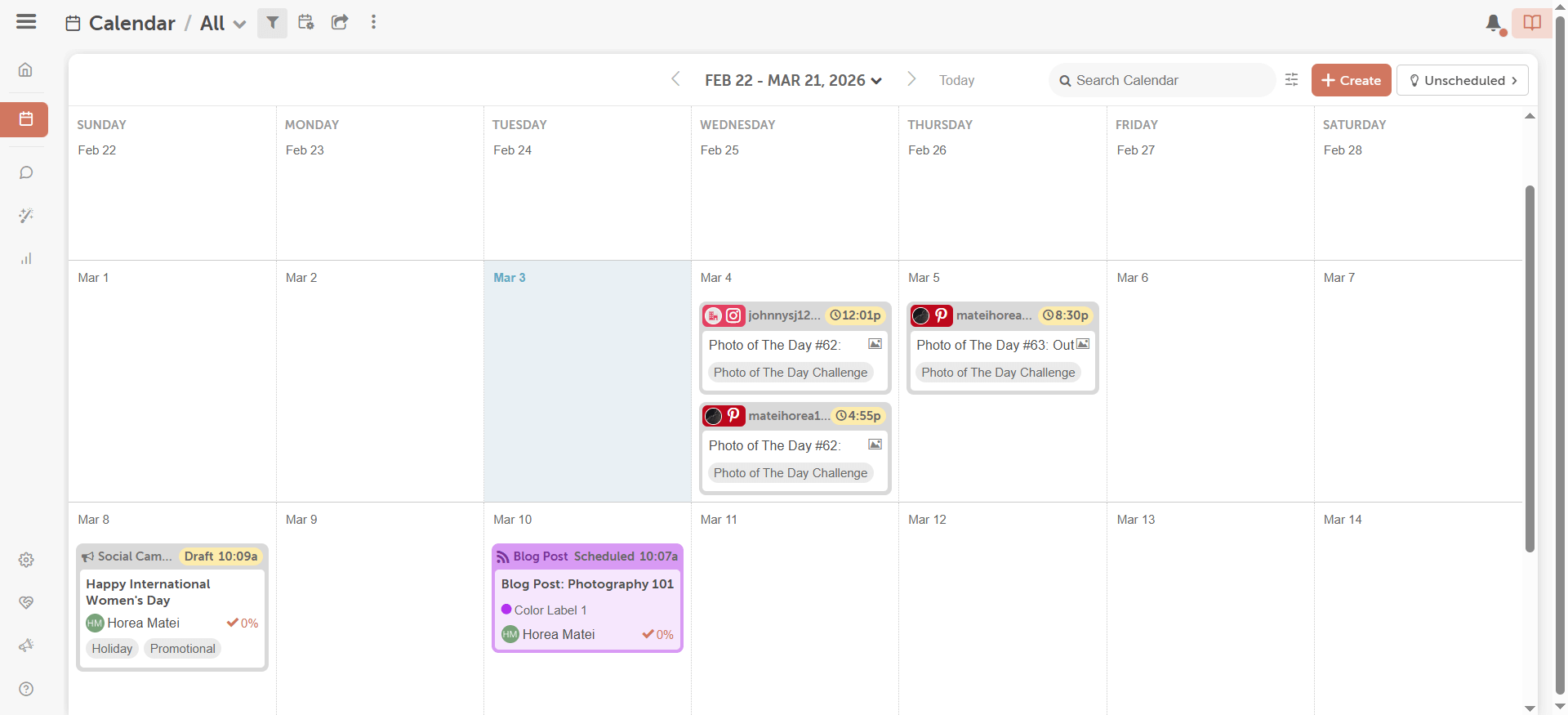
Social media scheduling is only one part of a team's workflow. You also need to keep content organized, collect feedback, get approvals, and make sure the right version goes live. That's where choosing between Buffer and Later gets interesting. Both tools help you...
Redesign For multi-location brands
all your locations, one content flow
For multi-brand companies
content collaboration at scale
For agencies
impress your clients and take on more
“The team loved it from the start. Planable helps us overview the entire marketing efforts.“
In my testing, almost every scheduler handles the first ten posts well. The friction starts later: a calendar that slows down past 100 posts a month, a client who wants to approve a draft without creating an account, and a platform connection that quietly drops the night before a launch.
I’ve spent more than seven years writing about and testing social media tools, and I know where scheduling breaks as a team grows: feedback scattered across email and Slack, approvals that still need someone to press publish, and pricing that doubles the moment you add a fourth user.
For this guide, I connected the same six accounts to 14 schedulers and ran one workflow end to end: calendar, draft, feedback, approval, publish. I evaluated each platform on five things: the calendar at volume, approvals, connection stability, pricing as you scale, and the mobile app.
Quick picks:
Best for approval workflows and agencies: Planable, with multi-tier approvals and external reviewers on workspace pricing
Best for enterprise inbox and monitoring: Hootsuite, with Streams for mentions, comments and DMs across accounts
Best for listening and publishing in one platform: Sprout Social
Best simple, low-cost queue: Buffer, with a free plan for 3 channels
Best for visual Instagram and TikTok planning: Later
How I tested 14 social media schedulers
I tested 14 schedulers, connecting the same six accounts to each and running one workflow end to end: calendar, draft, feedback, approval, publish.
I scored each tool on five criteria:
Calendar at volume: does it stay usable at 100+ posts a month across several accounts?
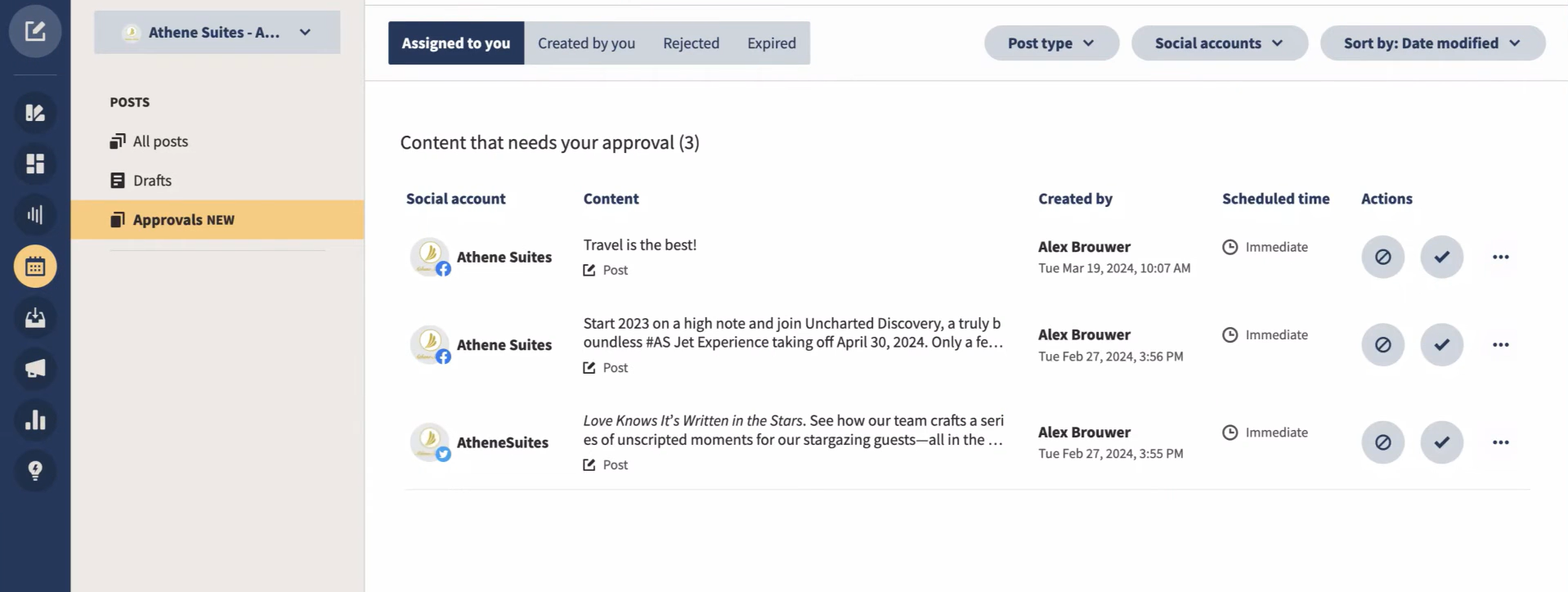
Approvals: can a manager or client review, comment and approve, and does the post publish on its own once approved? This is the part I tested hardest, because it’s where scheduling tools break for teams that manage multiple clients.
Connection stability: do platform connections hold, or do they need re-authenticating?
Pricing as you scale: what happens to the bill when you add accounts, seats or clients?
Mobile: how much of the workflow, approvals included, works from the app?
Planable is our product. It is on this list because approval workflows are what it was built for, and I have held it to the same criteria as everything else.
Social media scheduling tools at a glance
Here’s how all 14 tools compare at a glance:
Tool
Best for
Starting price
Free plan
Approval workflows
Planable
Agencies and multi-client teams
$39/workspace/month ($33 billed annually)
Yes (first 50 posts, no time limit)
Yes, multi-tier
Hootsuite
Enterprise brand teams
$99/user/month
No (free trial)
Yes
Sprout Social
Enterprise listening + publishing
$199/seat/month
No (30-day trial)
Yes
Buffer
Small teams with simple scheduling needs
$5/channel/month
Yes (3 channels, 10 posts each)
Basic
CoSchedule
Solo marketers
$29/user/month billed annually
Yes (1 profile, 15 scheduled posts)
No
Later
Creators and visual-first brands
$18.75/month billed annually (1 user)
No (14-day trial)
No
Zoho Social
Data-focused in-house teams
$10/month billed annually
Yes (1 brand, 6 channels, 1 user)
Basic
Agorapulse
Community managers
$79/user/month
No (30-day trial)
Yes
Sendible
Medium-sized agencies
$35/month
No (14-day trial)
Basic
Statusbrew
Consumer brands with moderation needs
$69/month
No (14-day trial)
Yes
Loomly
Small in-house teams
$49/month
No (15-day trial)
Basic
HubSpot
HubSpot Marketing Hub users
€792/month (Marketing Hub Pro, 3 seats)
No
No
SocialBee
Solopreneurs and personal brands
$24/month
No (14-day trial)
No
Metricool
Organic + paid social in one tool
$20/month
Yes (1 brand, 20 posts/month)
No
Planable
Best for
Agencies and multi-client teams
Starting price
$39/workspace/month ($33 billed annually)
Free plan
Yes (first 50 posts, no time limit)
Approval workflows
Yes, multi-tier
Hootsuite
Best for
Enterprise brand teams
Starting price
$99/user/month
Free plan
No (free trial)
Approval workflows
Yes
Sprout Social
Best for
Enterprise listening + publishing
Starting price
$199/seat/month
Free plan
No (30-day trial)
Approval workflows
Yes
Buffer
Best for
Small teams with simple scheduling needs
Starting price
$5/channel/month
Free plan
Yes (3 channels, 10 posts each)
Approval workflows
Basic
CoSchedule
Best for
Solo marketers
Starting price
$29/user/month billed annually
Free plan
Yes (1 profile, 15 scheduled posts)
Approval workflows
No
Later
Best for
Creators and visual-first brands
Starting price
$18.75/month billed annually (1 user)
Free plan
No (14-day trial)
Approval workflows
No
Zoho Social
Best for
Data-focused in-house teams
Starting price
$10/month billed annually
Free plan
Yes (1 brand, 6 channels, 1 user)
Approval workflows
Basic
Agorapulse
Best for
Community managers
Starting price
$79/user/month
Free plan
No (30-day trial)
Approval workflows
Yes
Sendible
Best for
Medium-sized agencies
Starting price
$35/month
Free plan
No (14-day trial)
Approval workflows
Basic
Statusbrew
Best for
Consumer brands with moderation needs
Starting price
$69/month
Free plan
No (14-day trial)
Approval workflows
Yes
Loomly
Best for
Small in-house teams
Starting price
$49/month
Free plan
No (15-day trial)
Approval workflows
Basic
HubSpot
Best for
HubSpot Marketing Hub users
Starting price
€792/month (Marketing Hub Pro, 3 seats)
Free plan
No
Approval workflows
No
SocialBee
Best for
Solopreneurs and personal brands
Starting price
$24/month
Free plan
No (14-day trial)
Approval workflows
No
Metricool
Best for
Organic + paid social in one tool
Starting price
$20/month
Free plan
Yes (1 brand, 20 posts/month)
Approval workflows
No
What is a social media scheduler?
A social media scheduler is a tool that lets you plan, preview and automatically publish posts to several social networks from one calendar, so each post goes live at a set date and time without anyone online. A social media management tool does that plus the work around it: a shared inbox for comments and DMs, social listening, analytics, and approval workflows. Most tools on this list started as schedulers and grew into management platforms.
14 best social media scheduling tools for 2026
94% of social media marketers now use AI in their workflows, according to HubSpot’s 2026 Social Media Marketing Report. The tools below reflect that: AI captions, repurposing and best time to post suggestions are standard now, so I focused on what still separates them, which is how they handle volume, approvals and pricing as a team grows.
1. Planable: for approval workflows and multi-client teams
Best for: agencies and multi-client teams
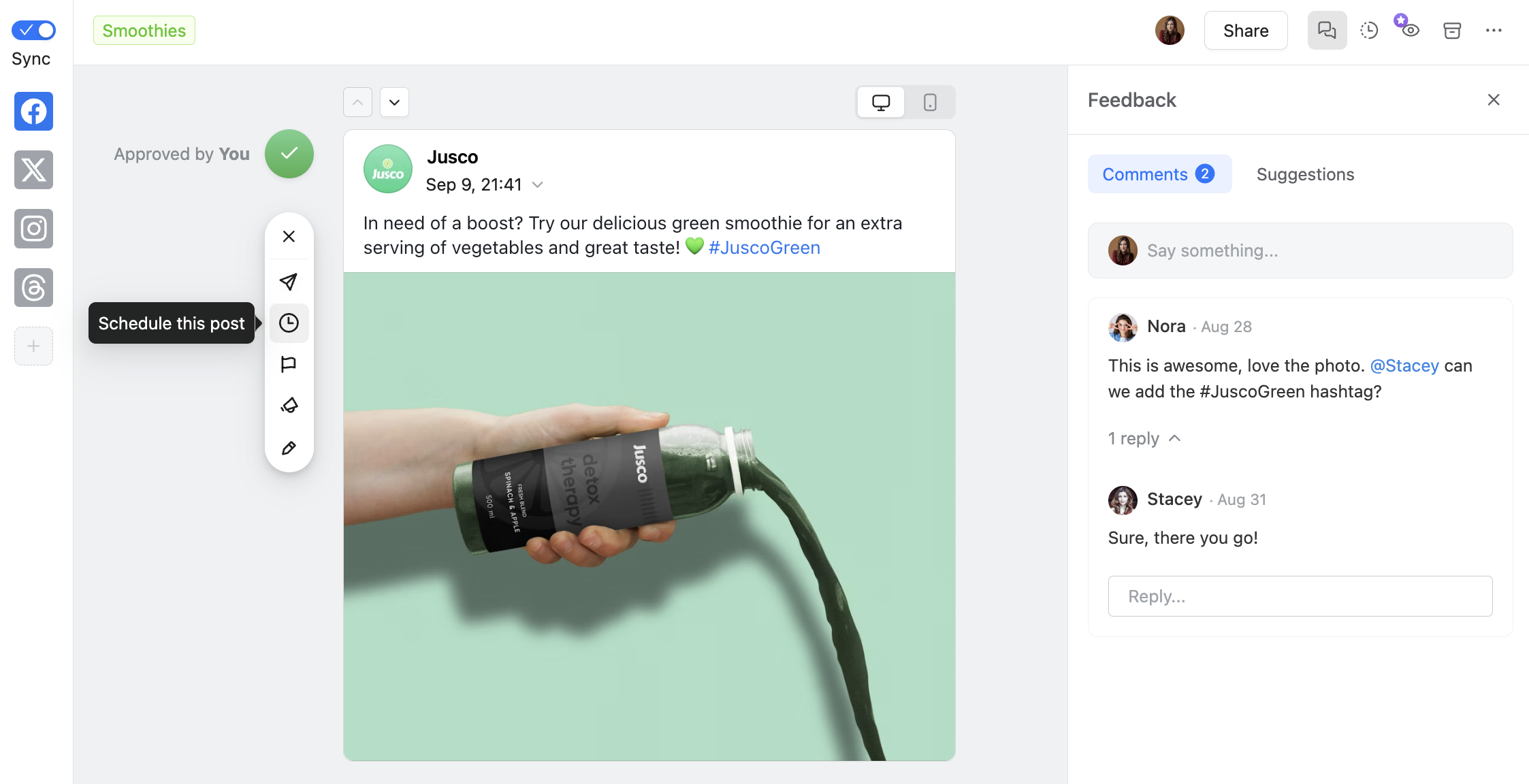
Why I picked it:Approvals are where Planable scored highest. Clients and managers review each post in a feed preview that shows how it will look on the platform, leave comments next to it, and approve in tiers, and approved posts publish on schedule. It lost points for solo use: if nobody else signs off on your posts, you’re paying for a workflow you won’t use.
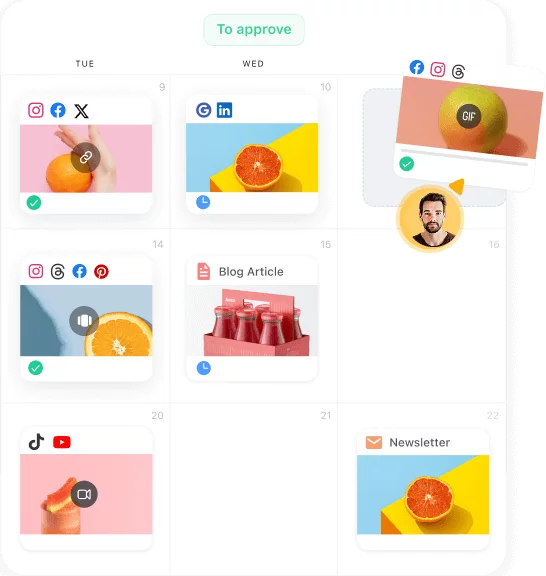
Planable is a social media management tool centered on the planning-to-approval workflow: teams draft, comment, and approve posts in one view, without switching to email threads or separate feedback tools.
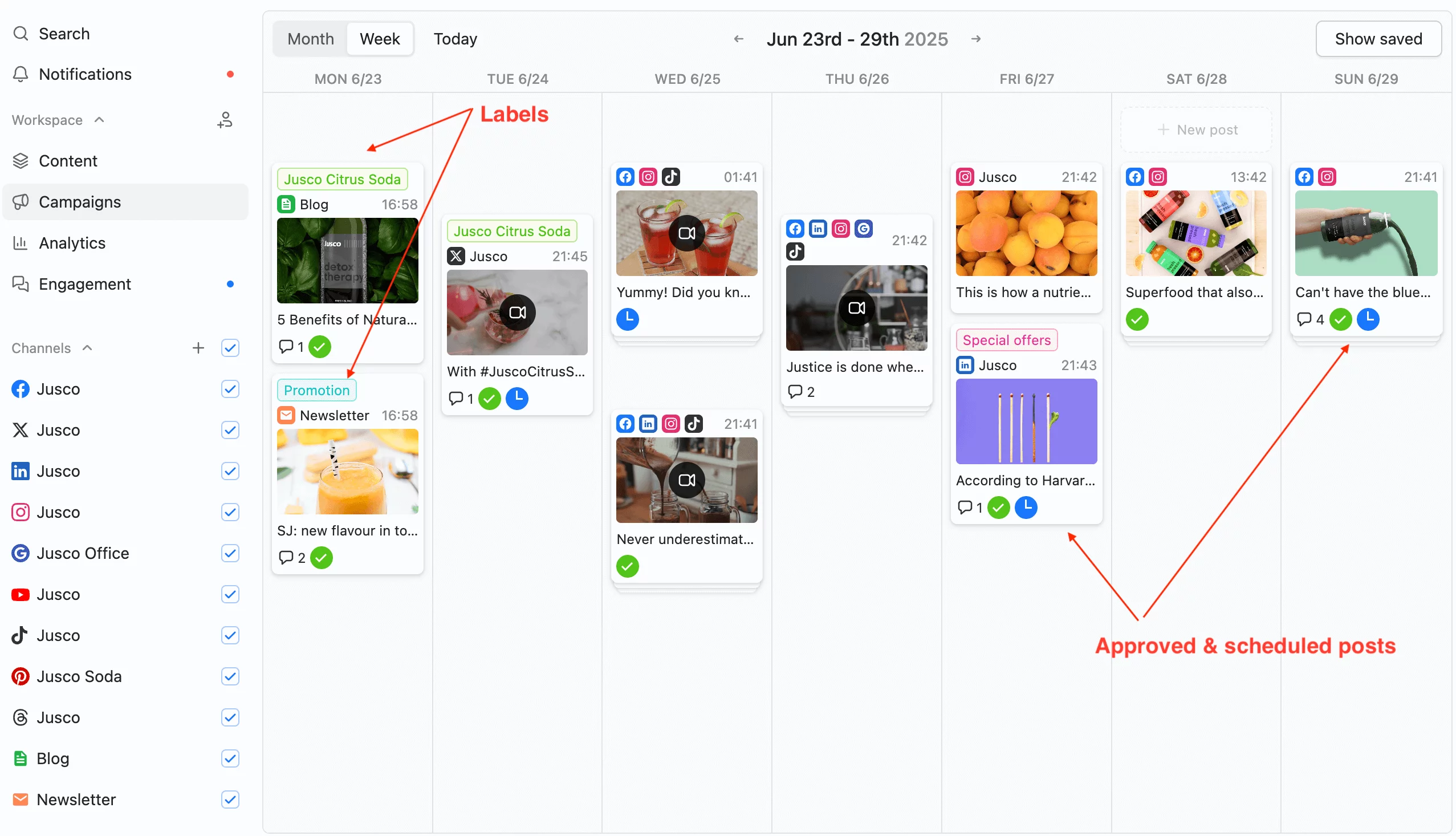
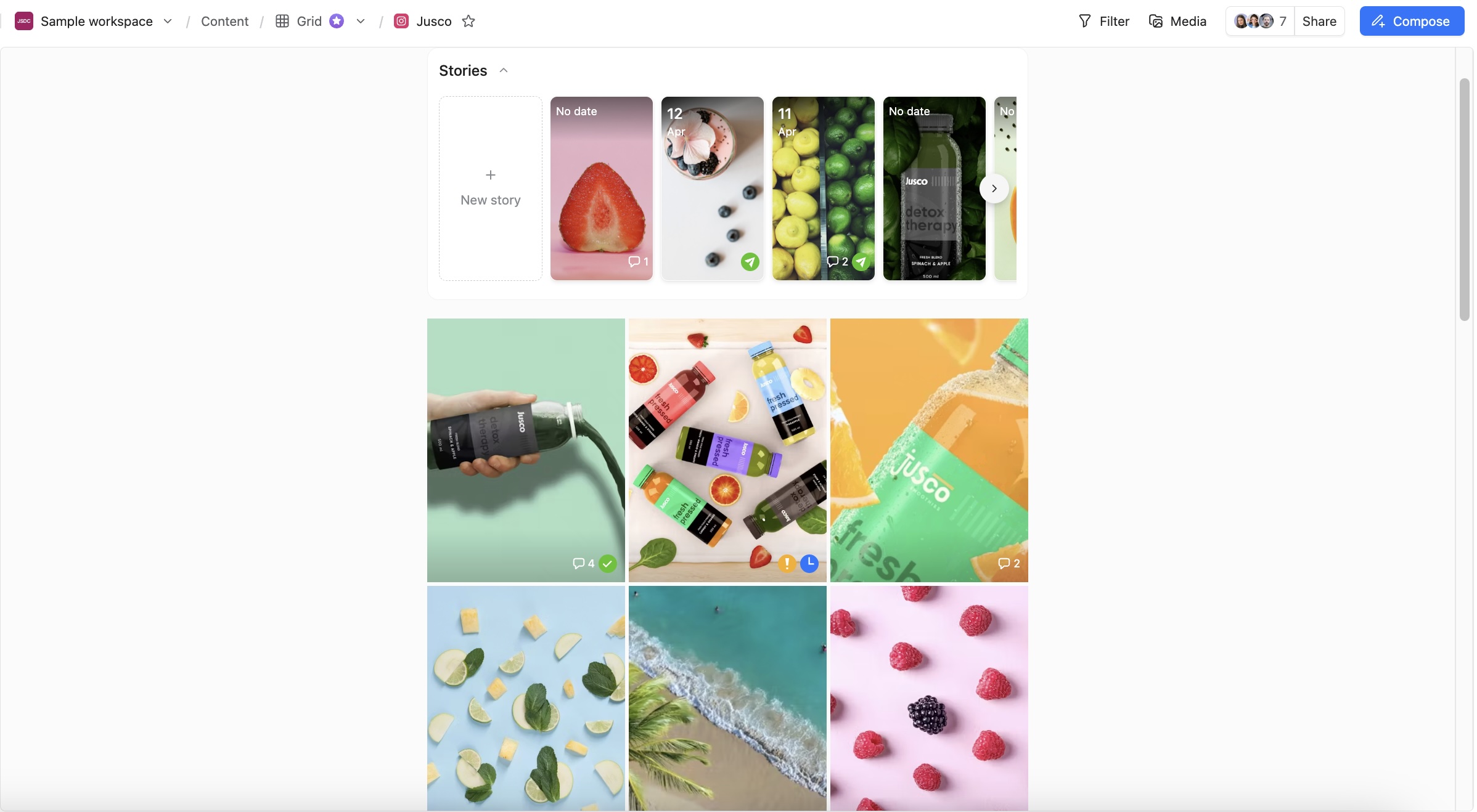
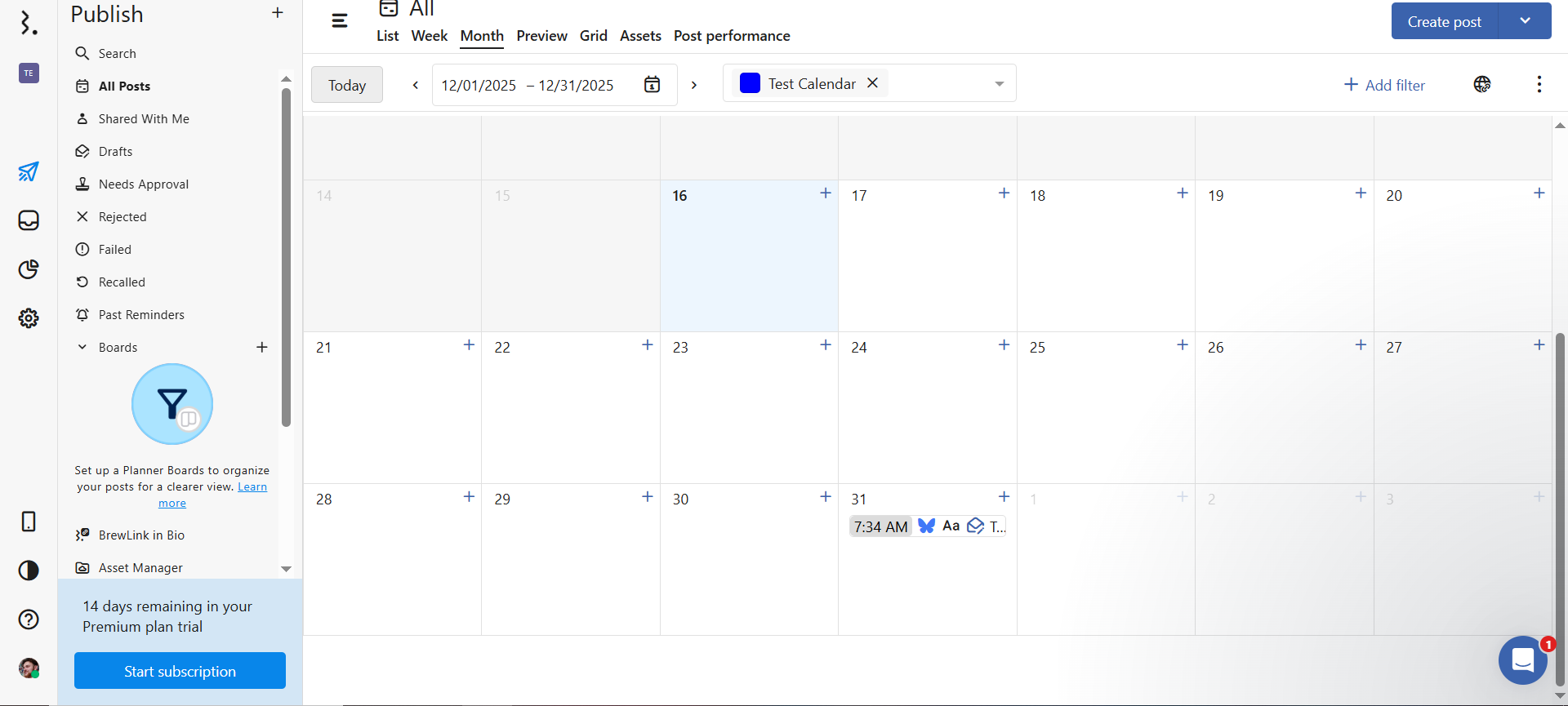
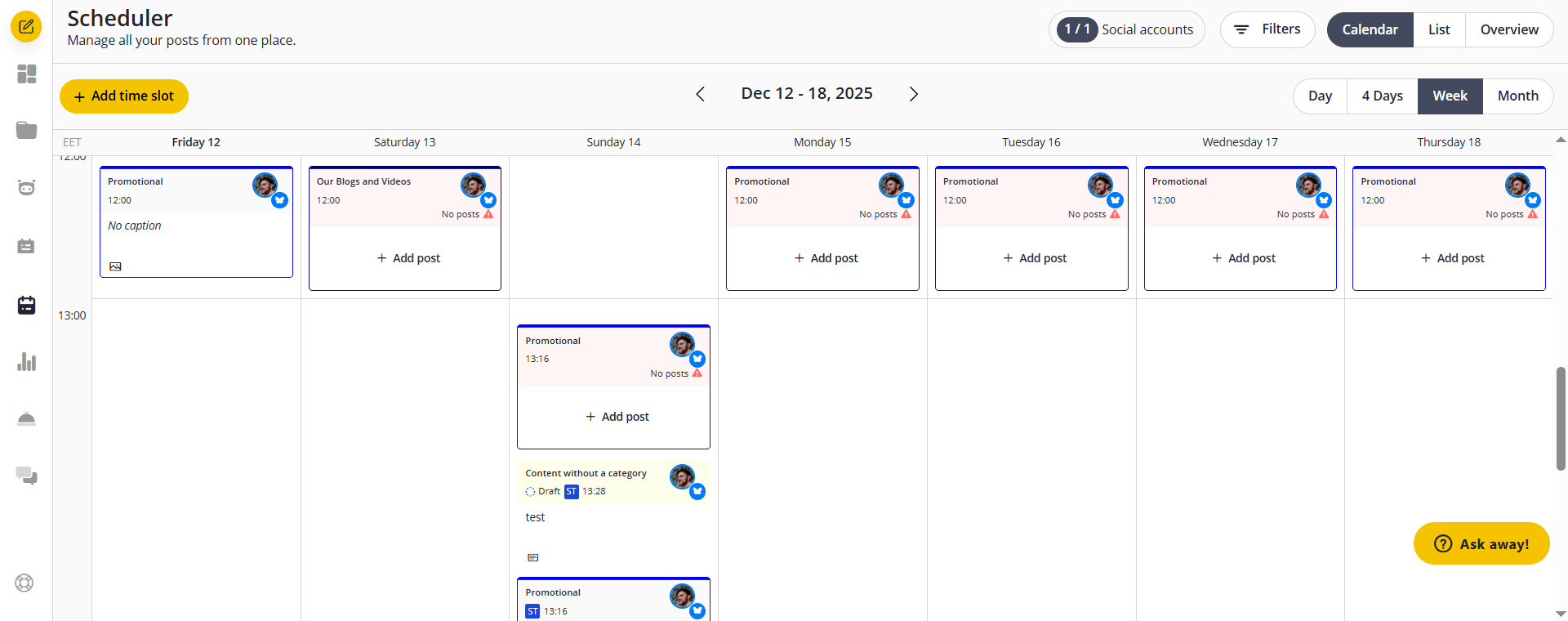
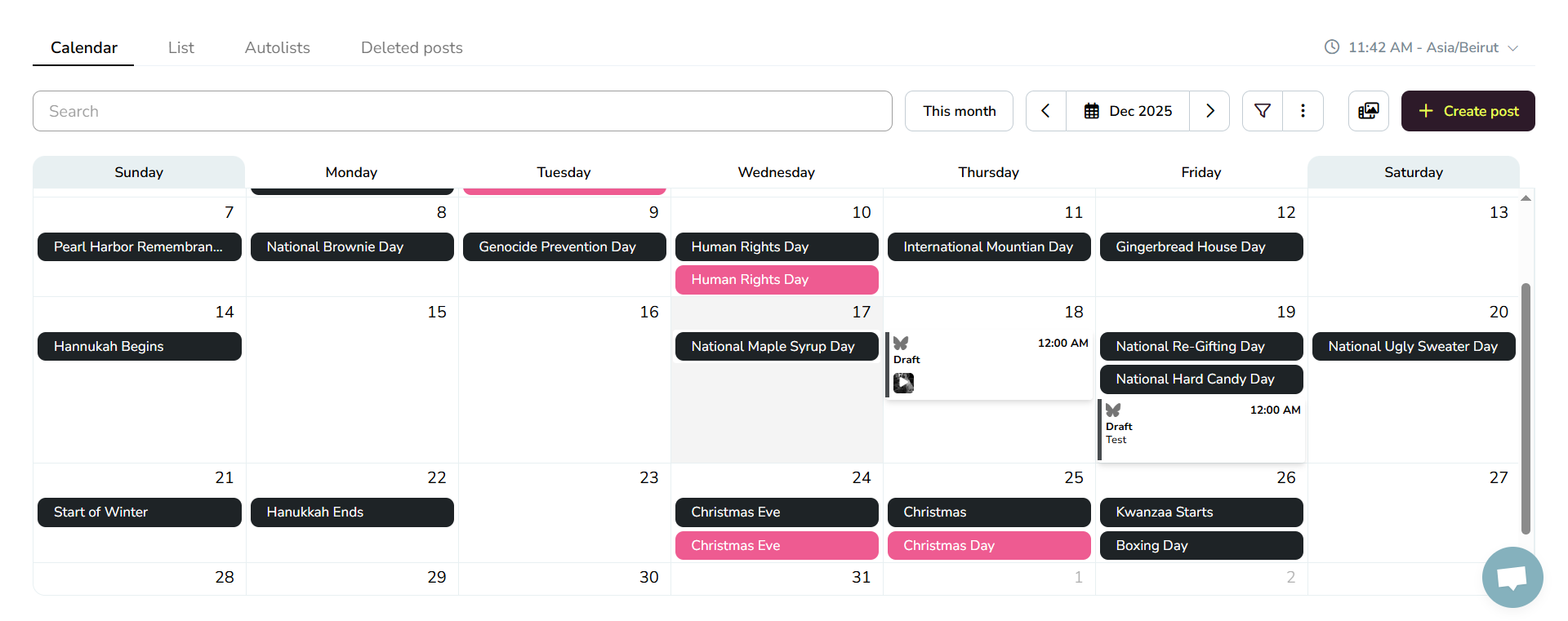
Its social content calendar offers four view modes: grid, feed, calendar, and list. Teams can switch between high-level planning in the calendar view and granular post detail in the feed view.
The Universal Content feature supports written content like blogs, newsletters, and press releases, managed alongside social posts in the same workspace.
Visual content calendar with drag-and-drop for easily rescheduling and reordering across platforms
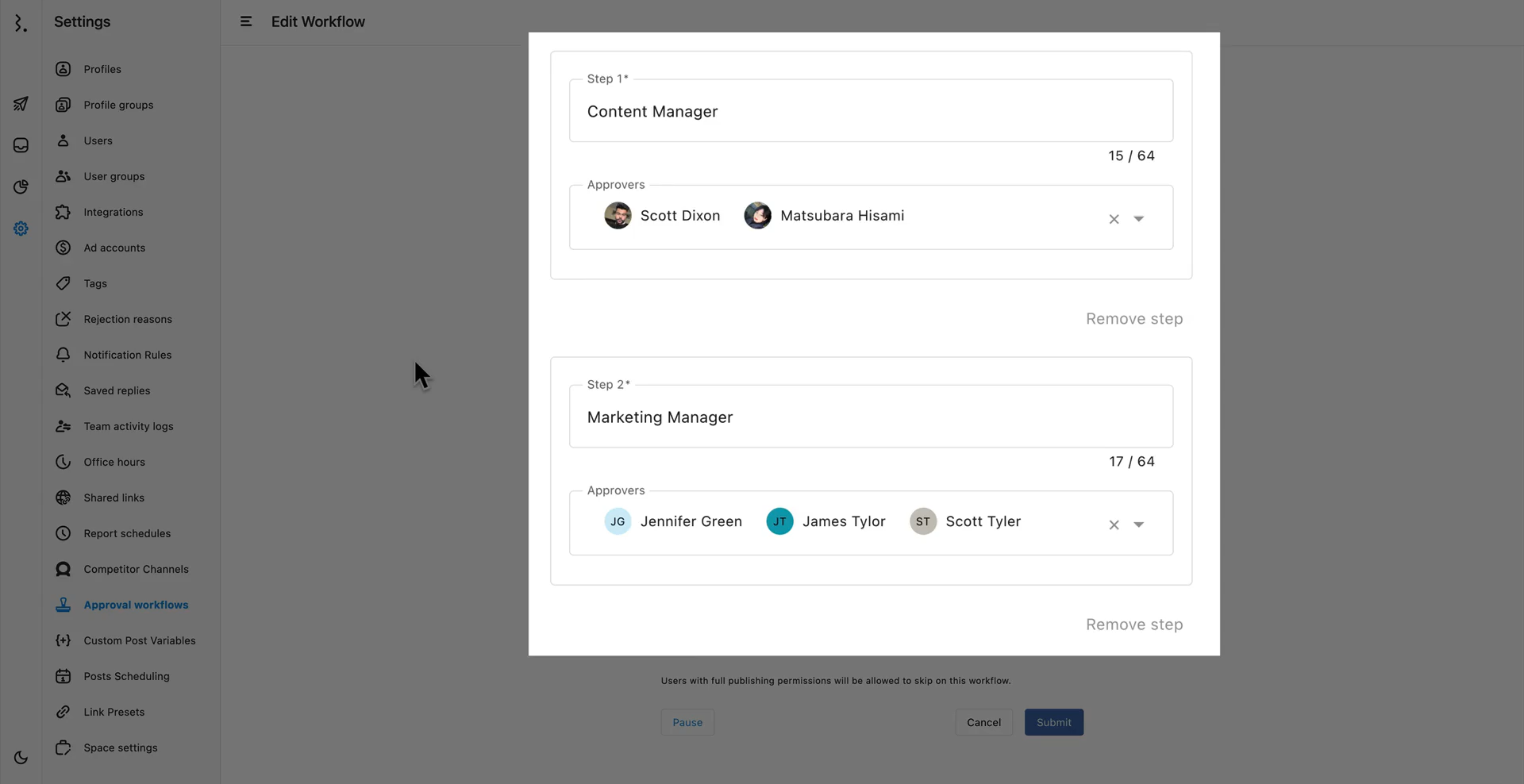
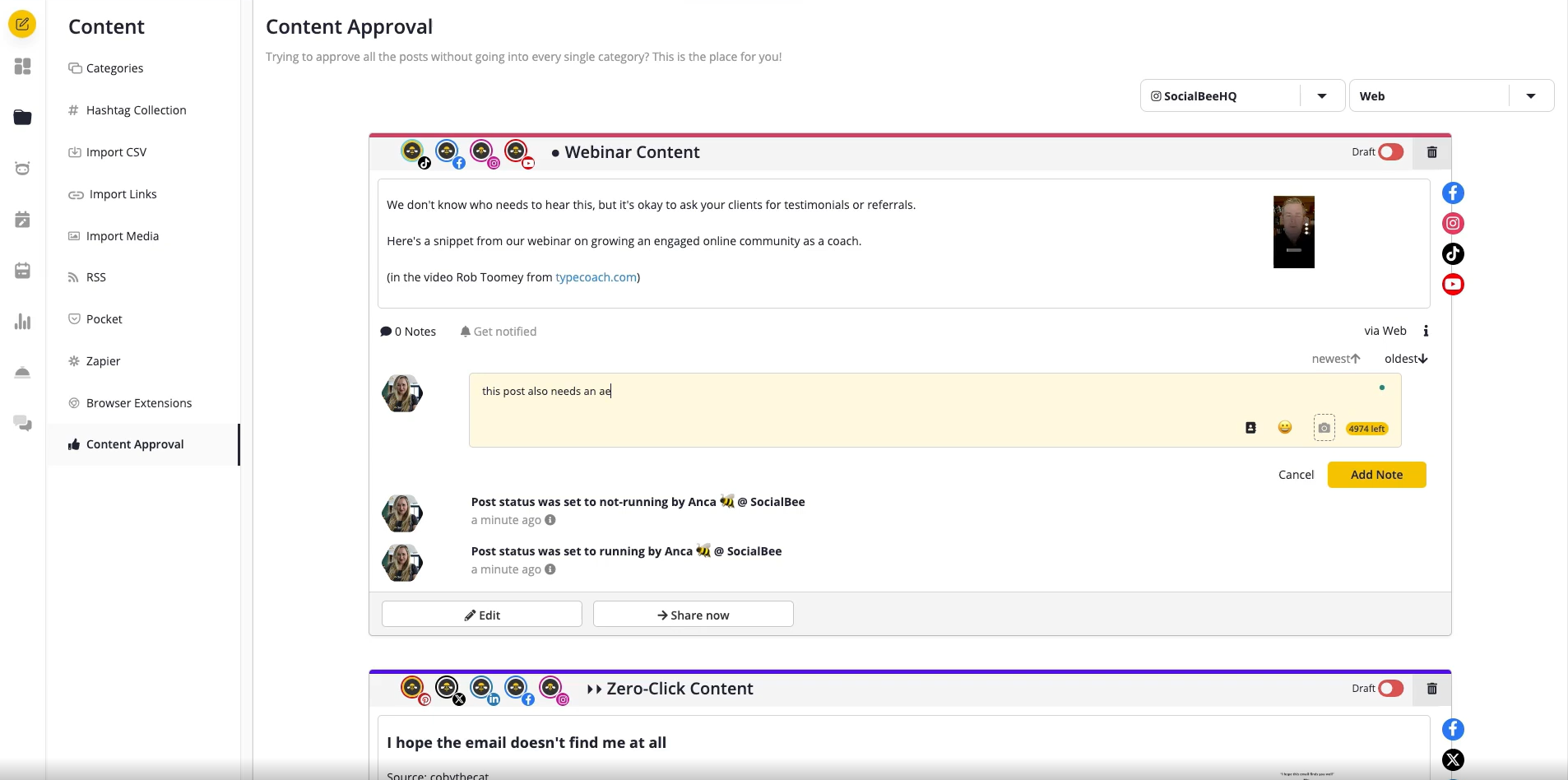
Custom approval workflows: configure multi-tier approvals (creative → brand → client), with required sign-offs before a post is published
Bulk scheduling: import or duplicate multiple posts simultaneously across campaigns
Cross-channel analytics: Track performance, growth metrics, and campaign results across platforms without logging into native analytics for each channel. Clean and customizable reporting views make it faster to pull insights and share results with stakeholders.
Competitive intelligence: The Competitor Analytics tab lets teams track up to five rival brand profiles, benchmarking post frequency, engagement, and growth directly against their own pages.
You can also manage Planable posts through its MCP connector. Connect Planable to a compatible AI assistant to create or update drafts, set scheduling details, add labels, and manage content without working entirely inside the Planable interface. Posts created through MCP still follow your existing approval and publishing workflow.
Integrations: Planable integrates with 9 social media platforms: Instagram, Facebook, LinkedIn, TikTok, Youtube, X, Google Business Profile, Threads, and Pinterest.
Pricing: Planable’s free trial covers your first 50 posts with no time limit. Paid plans are Basic at $39/workspace/month ($33 billed annually) for 60 posts, Pro at $49 billed annually for 150 posts, and custom-priced Enterprise, all with unlimited users. Pricing scales by workspace, not by seat, which keeps costs predictable as you add clients.
Pros
Cons
Multi-tier approvals, with external reviewers who don’t need an account
More workflow than a solo creator needs
Workspace pricing with unlimited users, so costs don’t climb per seat
Analytics is a paid add-on: $14/workspace/month, or $12 billed annually
Four calendar views (grid, feed, calendar, list) for planning and post-level detail
Pros
Multi-tier approvals, with external reviewers who don’t need an account
Workspace pricing with unlimited users, so costs don’t climb per seat
Four calendar views (grid, feed, calendar, list) for planning and post-level detail
Cons
More workflow than a solo creator needs
Analytics is a paid add-on: $14/workspace/month, or $12 billed annually
2. Hootsuite: for enterprise dashboards and social inbox management
Best for: enterprise brand teams
Why I picked it:Hootsuite earned its place on the monitoring side: Streams keep mentions, comments and messages from every connected account in one view, so a busy team can respond fast. It lost points on the calendar, which works but looks dated next to newer tools, and on per-user pricing.
Hootsuite is a market pioneer in social media management and it allows users to manage their online presence from a single dashboard.
The interface provides an in-depth breakdown of marketing activities. It enables you to respond quickly to mentions with the help of a social inbox feature.
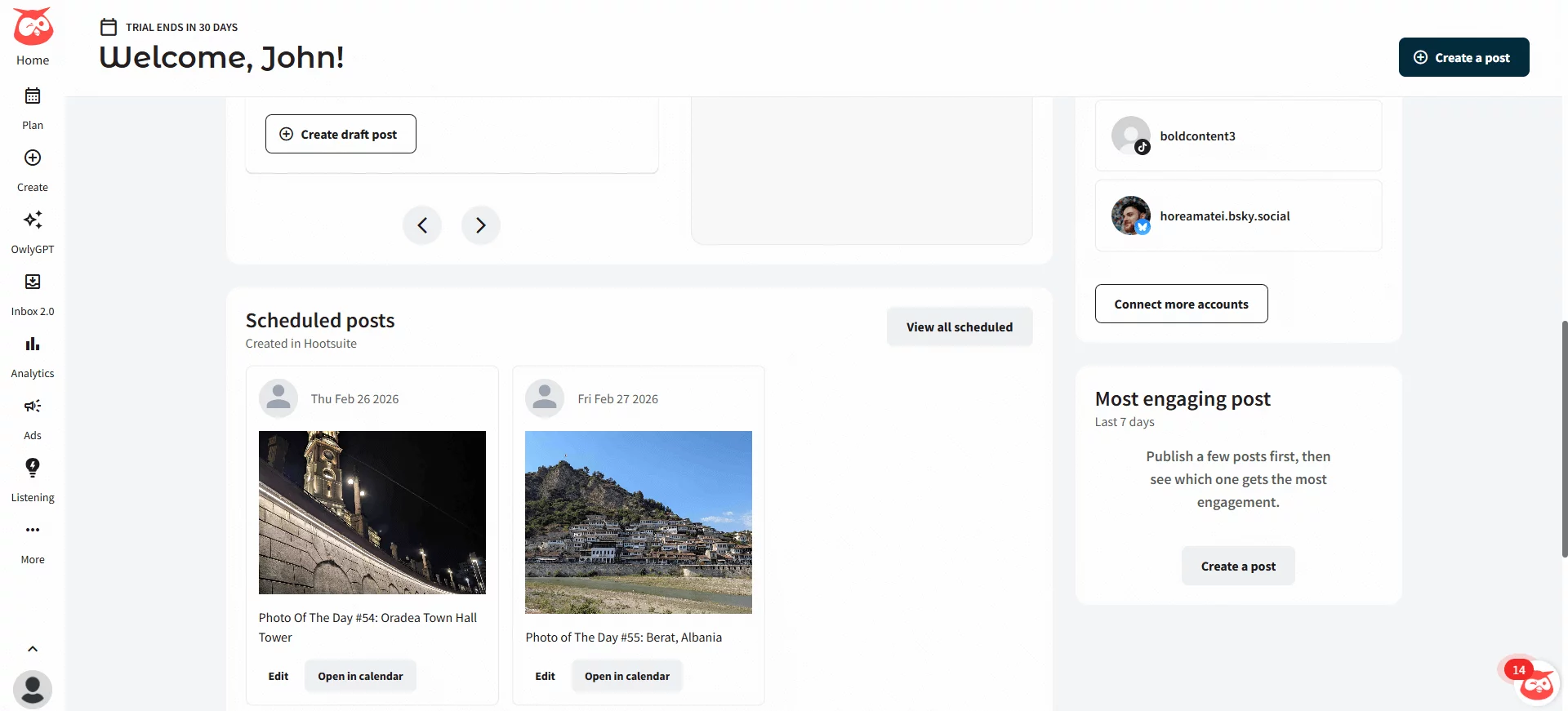
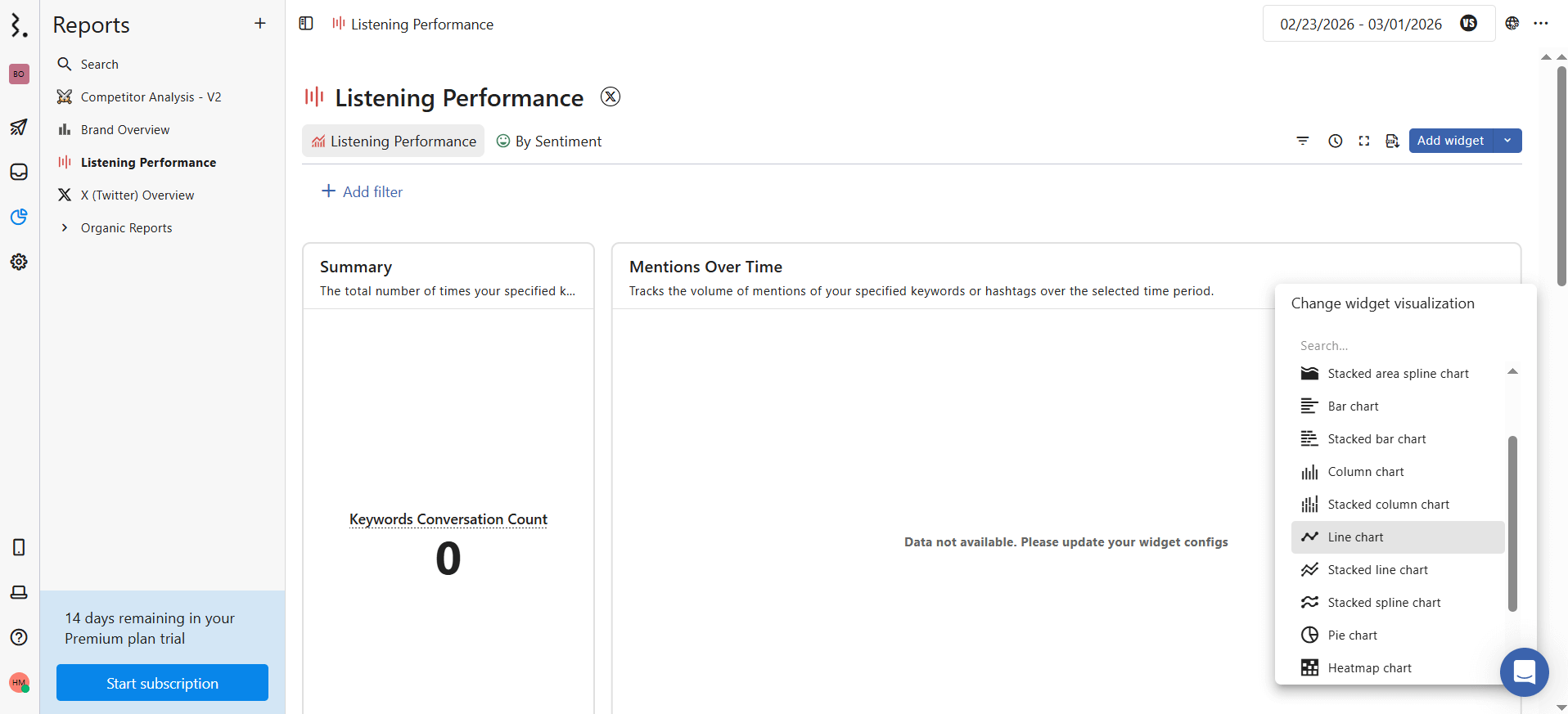
Its social media calendar is not the most modern-looking, but it gives teams a comprehensive overview of posts planned across multiple platforms.
Hootsuite’s newest update, OwlyAI, helps avoid writer’s block and generate new relevant ideas for social media posts to fill in the gaps in the social media calendar.
Hootsuite standout features
Recommendations on hashtags and the best time to publish posts for peak engagement.
Batch scheduling across all your accounts and direct publishing.
Streams let you monitor real-time social activity, messages, mentions, and conversations across platforms.
Pricing: Hootsuite has a free trial period and three paid plans starting from $99/user/month.
Pros
Cons
Streams for real-time monitoring across platforms
Starts at $99/user/month, which climbs fast for teams
Batch scheduling and direct publishing across all accounts
Complex interface and limited mobile features
OwlyAI for post ideas when the calendar has gaps
Occasional reliability issues
Pros
Streams for real-time monitoring across platforms
Batch scheduling and direct publishing across all accounts
OwlyAI for post ideas when the calendar has gaps
Cons
Starts at $99/user/month, which climbs fast for teams
Complex interface and limited mobile features
Occasional reliability issues
3. Sprout Social: for enterprise teams consolidating listening and publishing
Best for: enterprise brands with research teams
Why I picked it: Sprout Social is the most complete platform here for teams that want listening, analytics and publishing under one contract. The calendar handles bulk planning across profiles and campaigns, and the reports go deep, competitor analysis included. It lost points on price and on how quickly a new user finds their way around the scheduler.
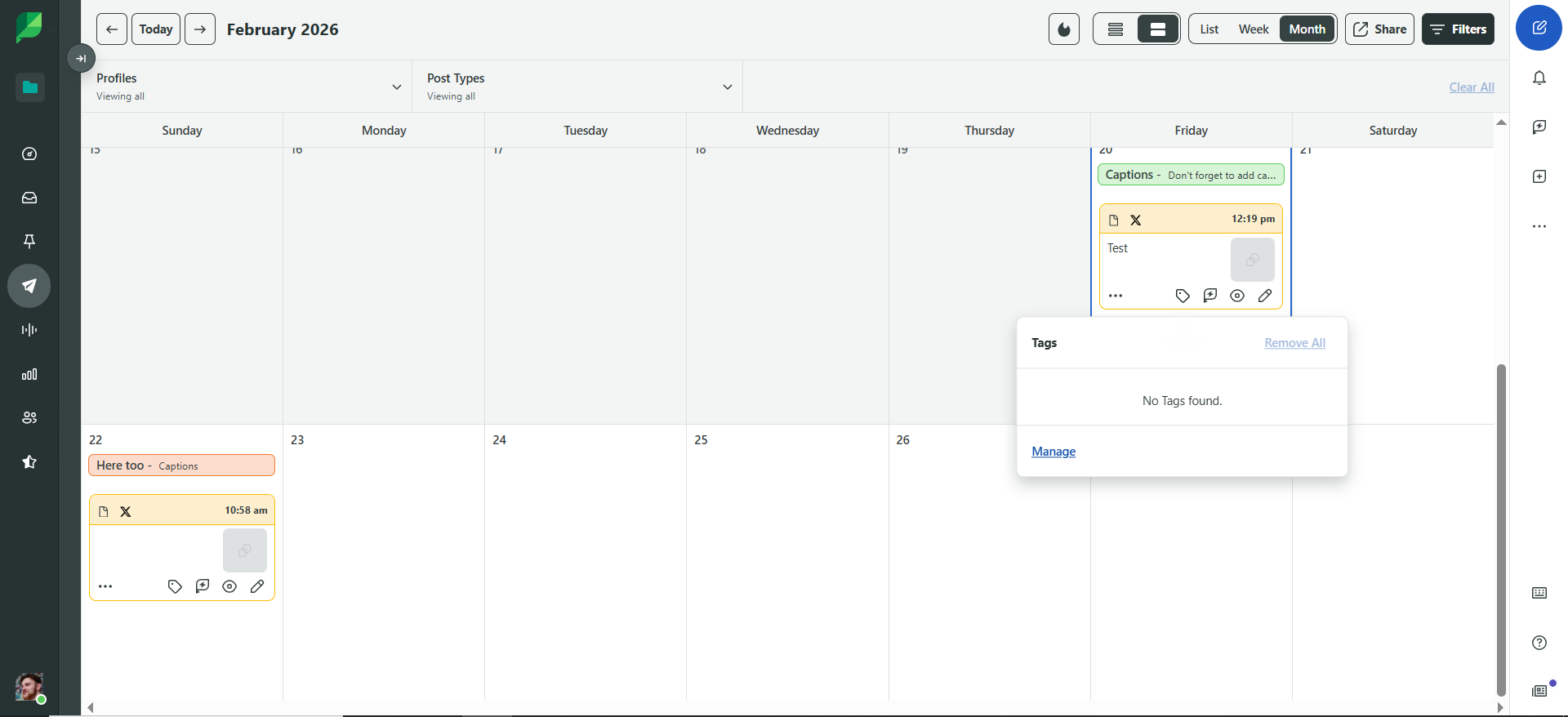
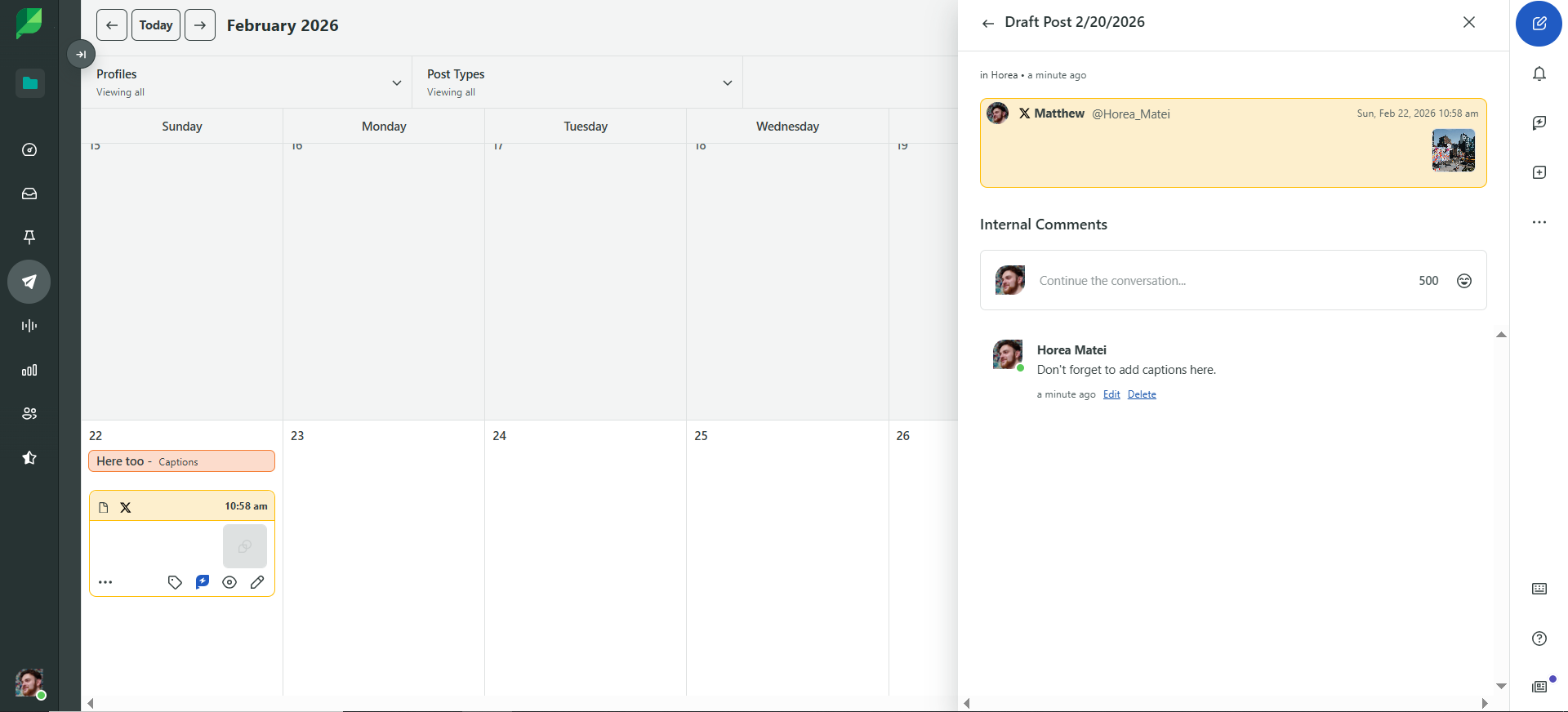
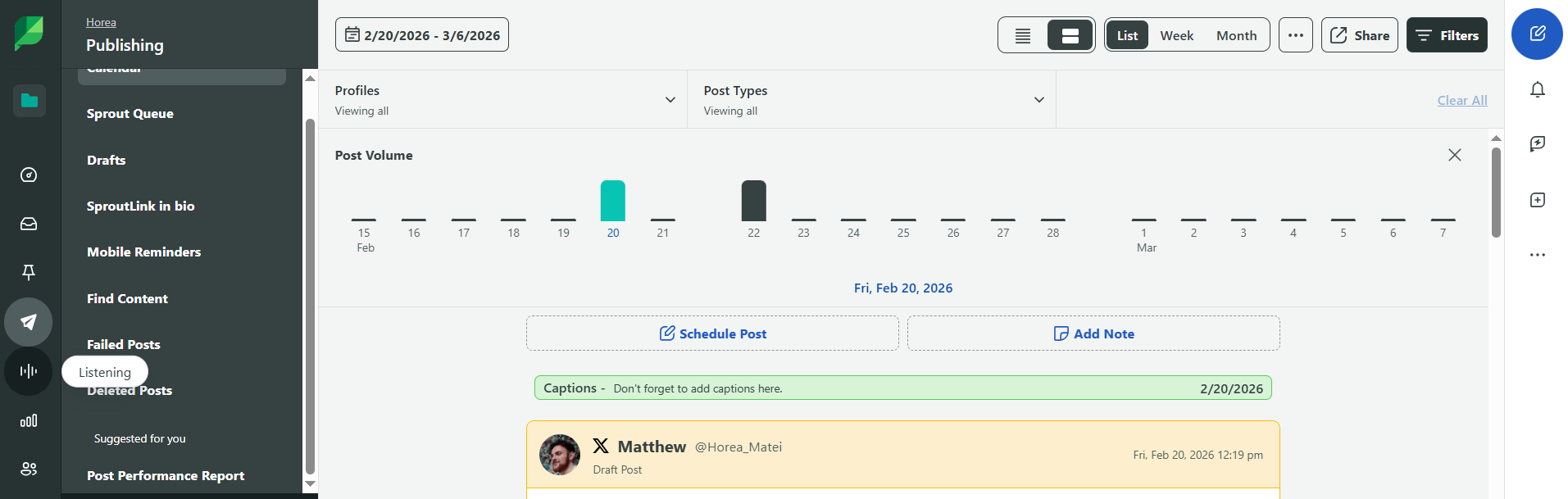
Sprout Social is an enterprise social media management platform that consolidates scheduling, listening, analytics, inbox management, and employee advocacy into one system.
Their scheduler handles bulk planning across multiple accounts with a visual calendar designed for high-volume workflows. Batch scheduling, cross-platform campaign management, and centralized publishing controls reduce the tool-switching that fragments workflows at scale.
Interactive content calendar where teams can draft posts, access the media asset library, and organize posts across profiles and campaigns.
In-depth social analytics on campaigns, content performance, and competitor analysis.
Social listening to monitor brand mentions and create relevant content.
Integrations: Instagram, Facebook, X/Twitter, LinkedIn, Pinterest, TikTok, YouTube, WhatsApp, Facebook Messenger, and Google Business Profile.
Pricing: The platform has a free 30-day trial period, and its paid plans start at $199/seat/month, with five social profiles included.
Pros
Cons
Listening, analytics, inbox and publishing in one system
$199/seat/month, which adds up quickly for larger teams
Calendar with a built-in media asset library
Scheduler is less intuitive than visual-first tools
Deep reporting, including competitor analysis
Pros
Listening, analytics, inbox and publishing in one system
Calendar with a built-in media asset library
Deep reporting, including competitor analysis
Cons
$199/seat/month, which adds up quickly for larger teams
Scheduler is less intuitive than visual-first tools
4. Buffer: for simple queue-based scheduling and audience growth
Best for: small teams with simple scheduling needs
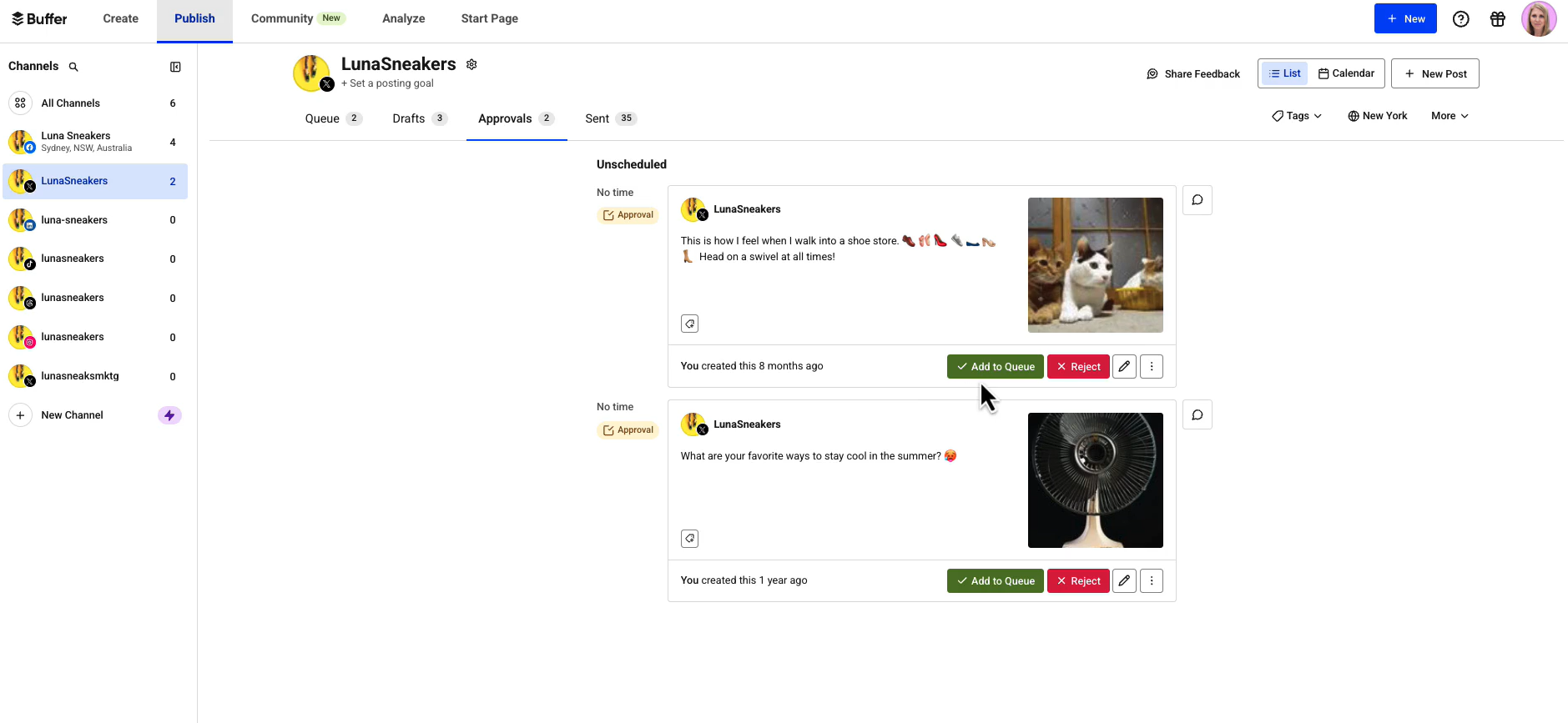
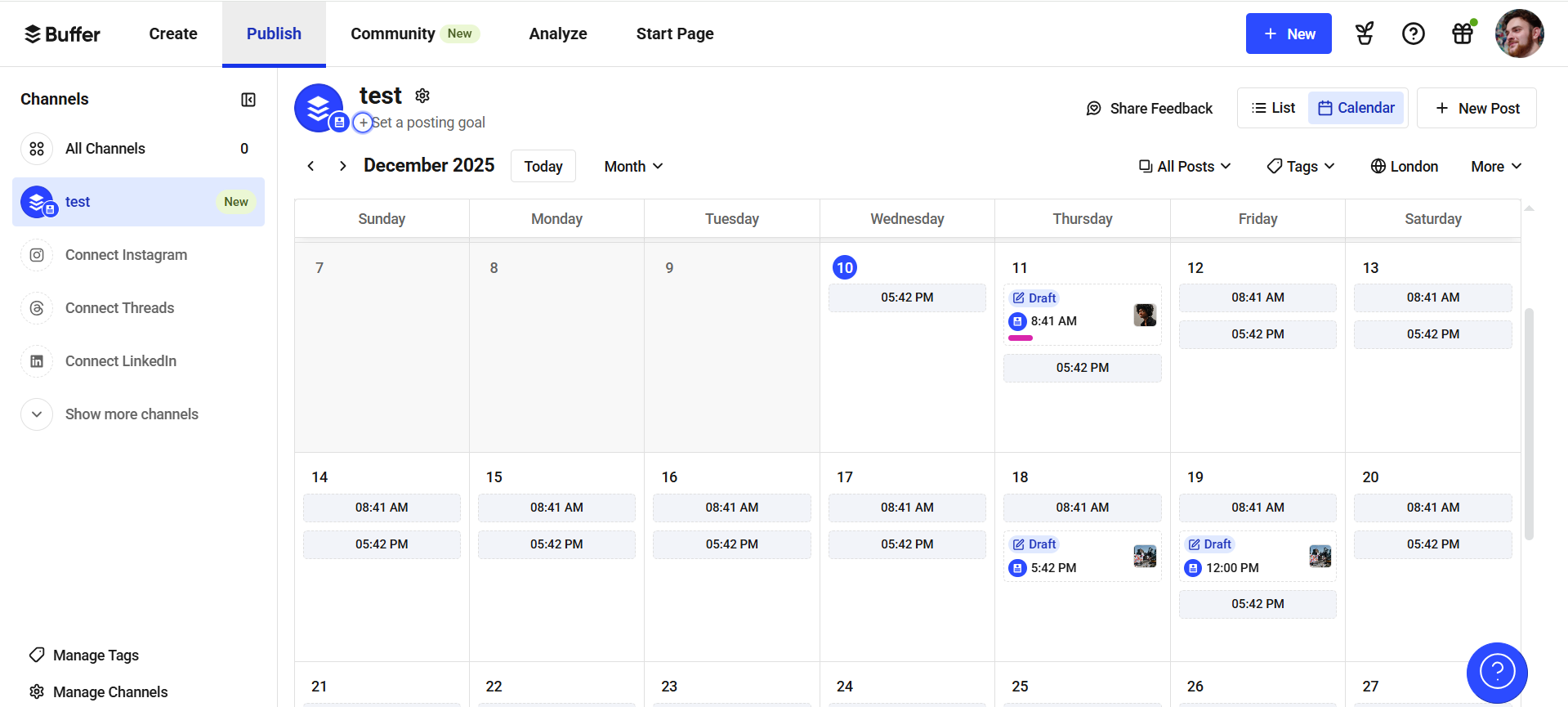
Why I picked it: Buffer is the simplest setup on this list: connect your channels, fill the queue, and posts go out at the times you set. Per-channel editing lets the same post carry a different caption on Instagram and Facebook. It lost points as the team grew, because the bill rises with every channel and approvals stay basic.
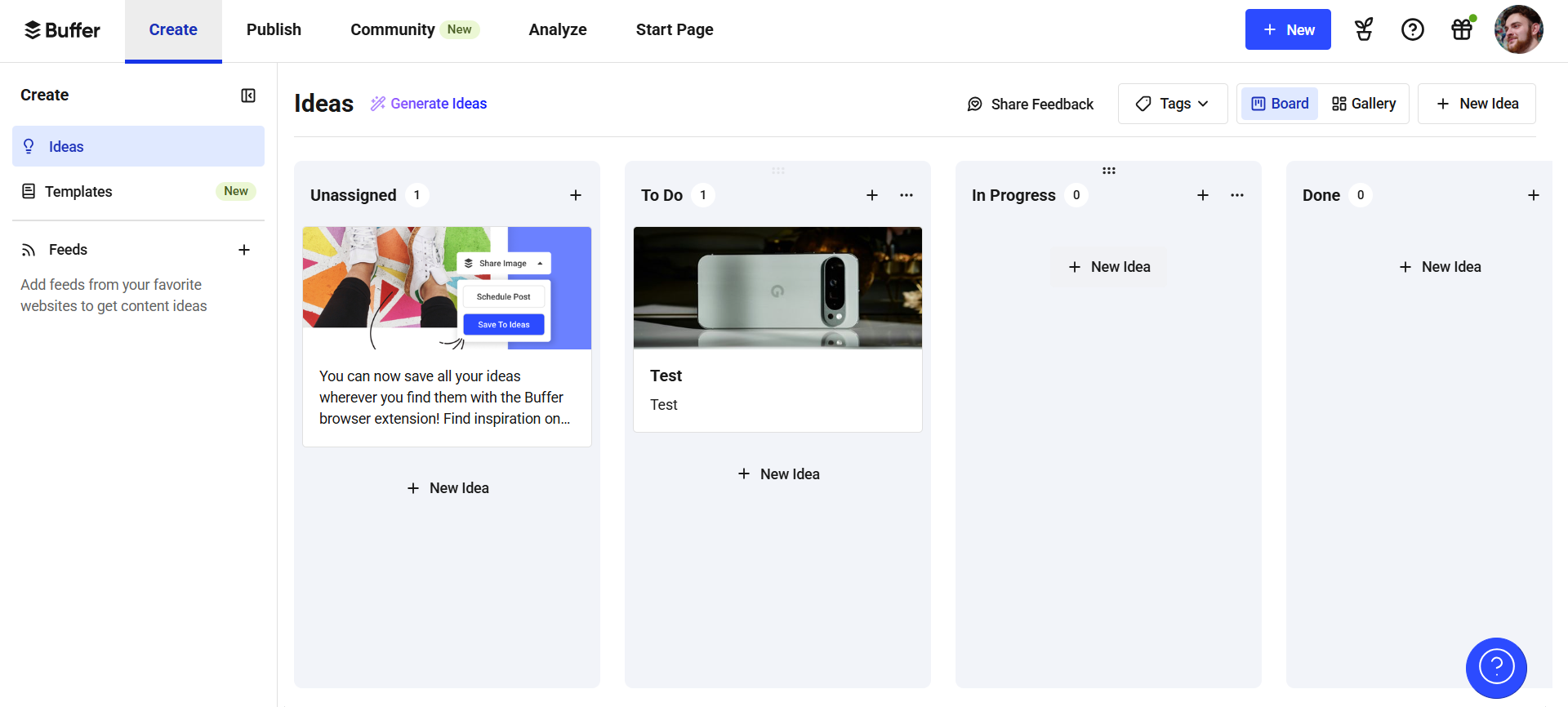
Buffer is designed to optimize social media publishing and scheduling. The platform strongly emphasizes building an organic audience, with its key features like social inbox and comments sentiment analysis reflecting this approach.
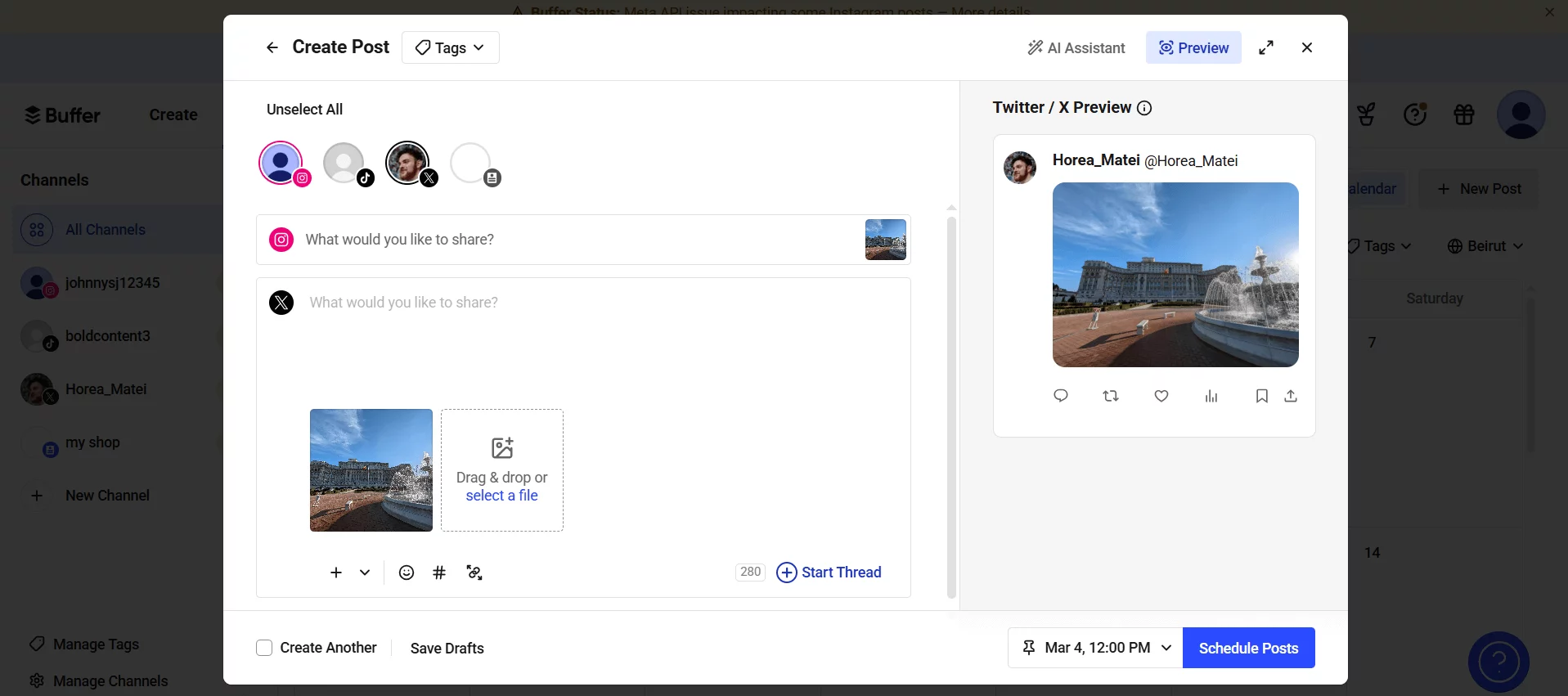
The post planner allows tailoring content for each social media platform, so your Instagram posts can have different captions than Facebook ones. You can schedule content automatically or choose your own custom time for posting.
Collaboration tools, including different roles and permissions, approvals, and team drafting to stay on the same page.
Account management for handling multiple brands from one platform.
Integrations: Instagram, Facebook, LinkedIn, TikTok, Google Business Profile, Pinterest, X, and Mastodon.
Pricing: Buffer’s free plan covers up to 3 channels with 10 scheduled posts per channel. Paid plans are Essentials at $5/month per channel and Team at $10/month per channel.
Pros
Cons
Free plan for up to 3 channels
Per-channel pricing adds up as you add platforms
Per-channel caption edits and previews
Approvals are basic compared to agency-focused tools
AI assistant for ideas and repurposing
Pros
Free plan for up to 3 channels
Per-channel caption edits and previews
AI assistant for ideas and repurposing
Cons
Per-channel pricing adds up as you add platforms
Approvals are basic compared to agency-focused tools
5. CoSchedule: for marketing calendar planning and evergreen re-queuing
Best for: solo marketers
Why I picked it: CoSchedule makes sense when social is one part of a wider marketing calendar. ReQueue fills gaps in the schedule with evergreen posts automatically, and the Top Content report makes the best-performing formats easy to spot. It lost points as a pure scheduler: collaboration and templates sit behind the paid plan.
CoSchedule is a project management tool that prioritizes efficient workflows for all marketing activities, including the brand’s social media schedule.
It offers a marketing calendar to help social media professionals streamline content curation across social channels and save time scheduling content.
CoSchedule marketing calendar dashboard
CoSchedule’s marketing calendar is more of a post planner than a full-scale social media tool. Users can schedule one-time social media posts or create a social campaign consisting of several messages.
It also has analytical tools to track social media campaigns, like the Top Content report. This report gathers content that gained the most engagement on one page, making it easy for social marketers to identify the top-performing formats.
CoSchedule standout features
Best Time Scheduling tool to schedule posts with confidence for maximum reach.
ReQueue Bucket automatically reshares your evergreen content across platforms when there’s a gap in the social media schedule.
Social media optimizer to adapt your caption to different social platforms.
Integrations: Facebook, Instagram, LinkedIn, X, WordPress, Mailchimp, and other marketing platforms.
Pricing: CoSchedule’s free plan schedules up to 15 posts at a time on one social profile. Paid plans start with Starter at $29/user/month billed annually ($39 billed monthly).
Pros
Cons
Marketing calendar that covers more than social
Collaboration and content templates are paid-only
ReQueue recycles evergreen content automatically
Direct Instagram publishing works for Business profiles only
Best Time Scheduling for reach
Pros
Marketing calendar that covers more than social
ReQueue recycles evergreen content automatically
Best Time Scheduling for reach
Cons
Collaboration and content templates are paid-only
Direct Instagram publishing works for Business profiles only
6. Later: for visual planning
Best for: creators and visual-first brands
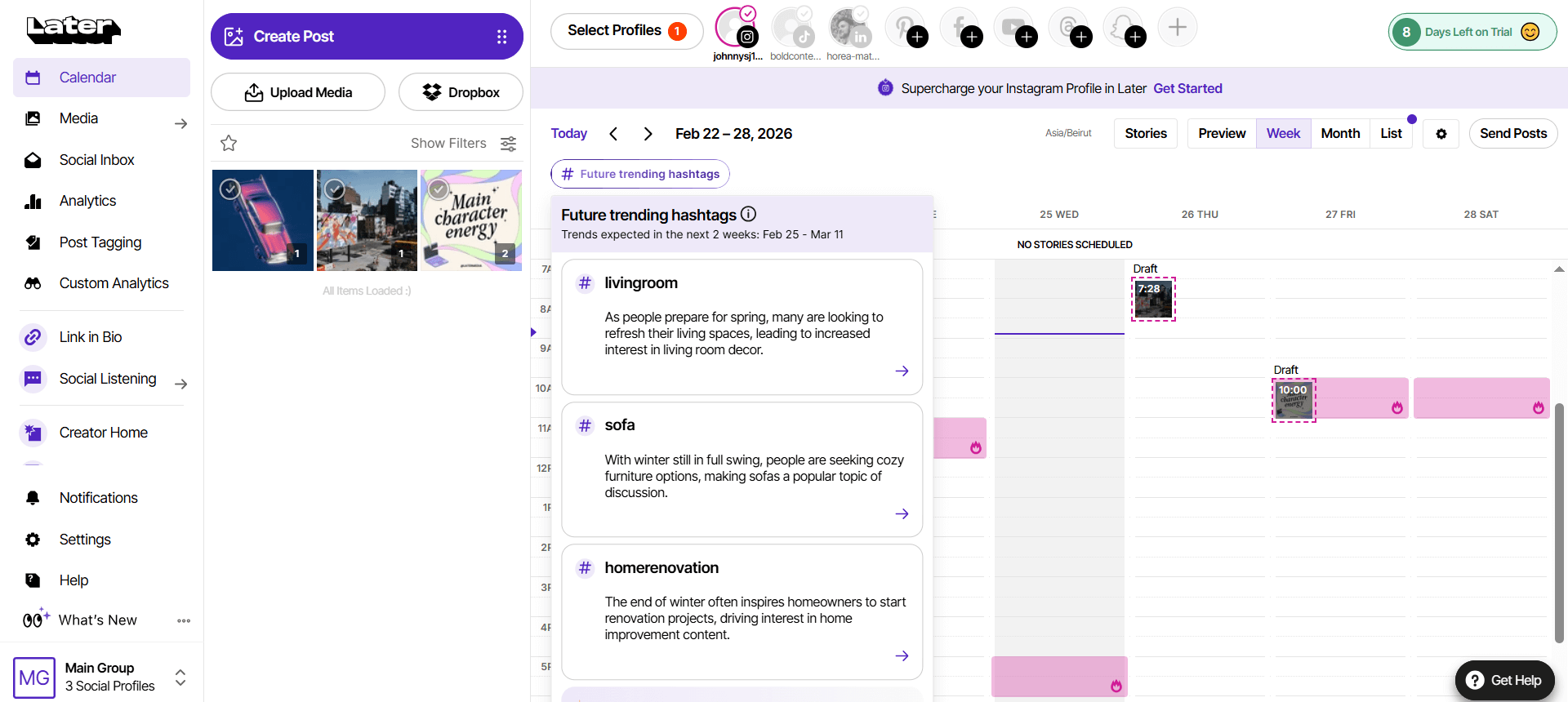
Why I picked it:Later is built around the visual grid. Drag-and-drop planning, the media library, cropper and hashtag suggestions make it the most natural fit for Instagram- and TikTok-first brands, and the Mavrck partnership adds influencer collaboration. It lost points outside visual platforms and on analytics depth.
Later started as an Instagram-only social media scheduling tool. In the meantime, it expanded to other networks, including Facebook, TikTok, LinkedIn, Pinterest, and YouTube.
It has a visual content calendar that allows marketers to manage multiple social media accounts across different channels.
Being somewhat Instagram and TikTok-oriented, Later has joined forces with Mavrck, an influencer marketing platform. This partnership complements Later’s collab features, allowing social marketers to collaborate with creators and influencers through one social media management tool.
Later doesn’t have flashy content features but offers straightforward content creation and scheduling in just a few clicks. It has built-in content creation tools such as a media library, cropper, hashtag suggestions, and a UGC finder to source content generated by your target audience.
Later standout features
Bulk scheduling across multiple channels and auto-publishing for all supported social media platforms.
Visual drag-and-drop content calendar to plan and schedule posts.
Social media analytics to track performance.
Integrations: Instagram, Facebook, TikTok, LinkedIn, Pinterest, and YouTube.
Pricing: Later no longer has a free plan; it offers a 14-day free trial. Paid plans start at $18.75/month billed annually for one user.
Pros
Cons
Visual drag-and-drop calendar and grid planning
Thinner feature set for non-visual platforms
Built-in media library, cropper, hashtag suggestions and UGC finder
Limited analytics depth
Influencer collaboration through Mavrck
Pros
Visual drag-and-drop calendar and grid planning
Built-in media library, cropper, hashtag suggestions and UGC finder
Influencer collaboration through Mavrck
Cons
Thinner feature set for non-visual platforms
Limited analytics depth
7. Zoho Social: for data-driven reporting and multi-brand publishing
Best for: data-focused in-house teams
Why I picked it: Zoho Social’s strength is data: best-time-to-post predictions and a deep set of pre-built and custom reports. It onboards quickly and has a free plan for one brand. It lost points on collaboration, because roles and approvals are simple and don’t fit multi-step sign-offs.
Zoho Social is a social media management platform built for businesses that need reliable scheduling, analytics, and team collaboration.
Zoho Social social media post composer
It handles multi-account management and reporting workflows with enough depth for professional teams, but stays streamlined enough to onboard quickly.
Users like Zoho for its data-based predictions on the best time to post and other optimization and its detailed reports.
Zoho standout features
Bulk schedule to transfer posts from a spreadsheet to Zoho Social content calendar.
Social analytics and a set of custom and pre-built reports to better understand our audience.
Mobile app to schedule and track posts on the go.
Integrations: Instagram, Facebook, X, LinkedIn, Pinterest, YouTube, TikTok, and Google Business Profile.
Pricing: Zoho Social has a Free Forever plan for one brand, six channels and one team member. Paid plans start at $10/month billed annually, with agency pricing for multiple brands and a 15-day free trial.
Pros
Cons
Detailed custom and pre-built reports
Roles and approvals are too simple for multi-step workflows
Free plan for one brand across six channels
Bulk scheduling from a spreadsheet
Pros
Detailed custom and pre-built reports
Free plan for one brand across six channels
Bulk scheduling from a spreadsheet
Cons
Roles and approvals are too simple for multi-step workflows
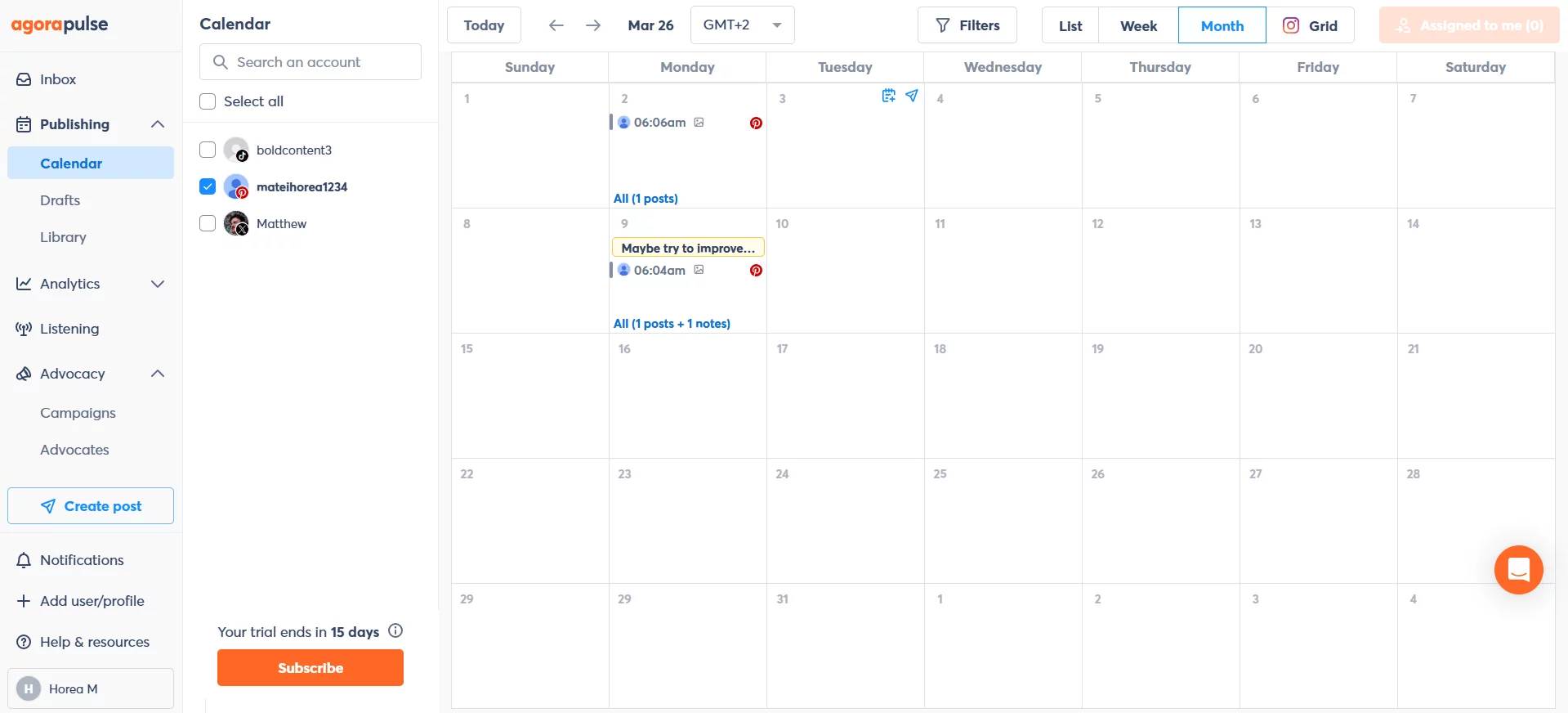
8. Agorapulse: for brand monitoring and inbox-led engagement
Best for: community managers
Why I picked it:Agorapulse is built around the inbox. Comments, mentions and reviews land in one filterable view, and the GA4 integration ties social activity to site results. It lost points on interface and on scheduling depth compared with the publishing-first tools here.
Agorapulse is a social media management platform that ticks all the right boxes: schedule and publish content, engage with the audience through comments and direct messages, listen to brand mentions, and report on content performance.
Its multi-platform publishing option saves a lot of time regarding content planning and helps you stay consistent across all social channels.
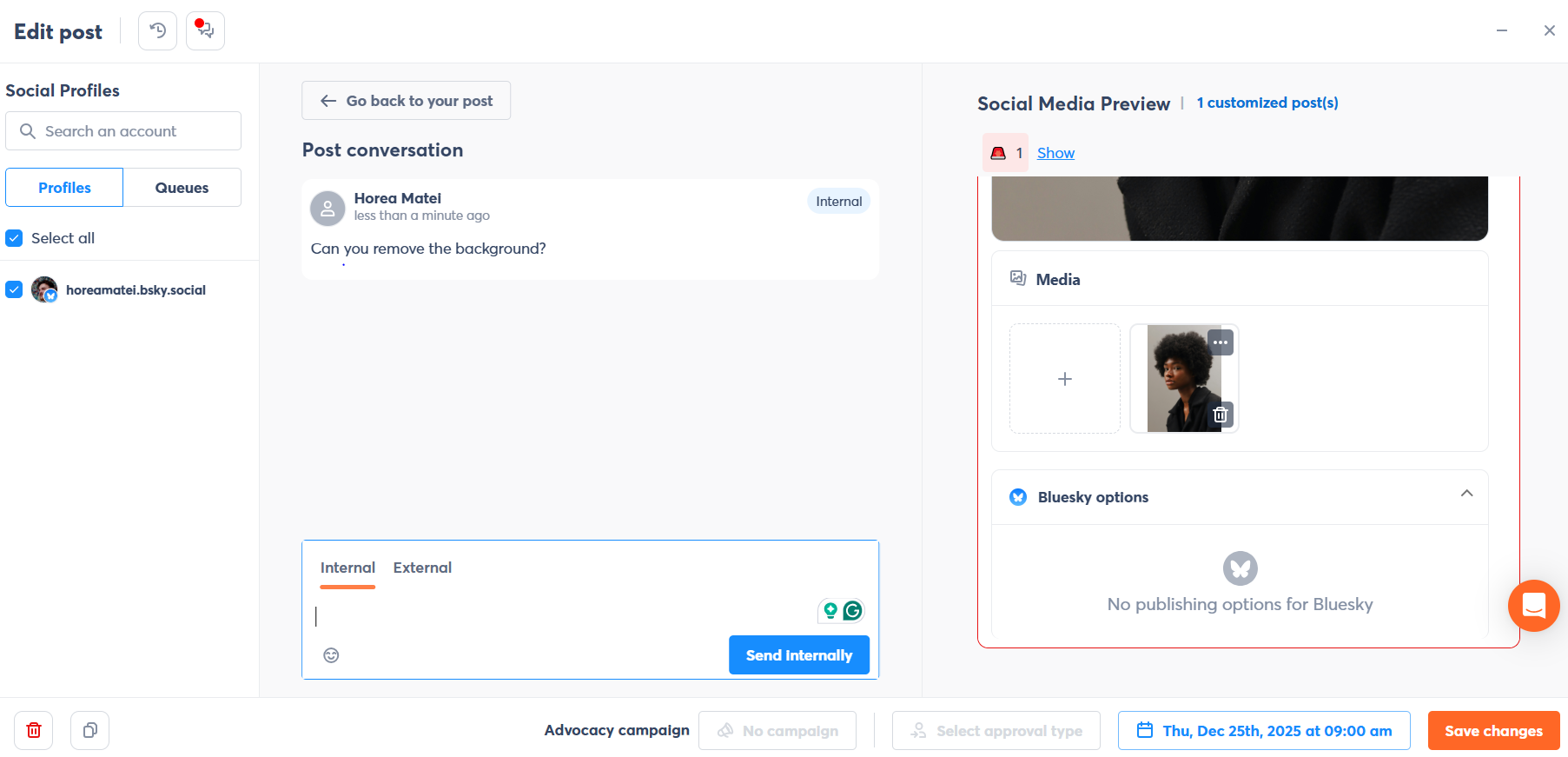
Besides, Agorapulse works as a project management tool where teams can collaborate, assign posts to each other, and leave comments to tweak copy or visuals.
Agorapulse standout features
Smart customizable social inbox to gather all the mentions, comments, and reviews and filter them with labels and tags.
Integration with Google Analytics 4 to get a holistic overview of how social content performs in terms of ROI.
Media library to organize and store all branding materials and quickly access them during content planning.
Integrations: Facebook, X, Instagram, LinkedIn, Google Business Profile, YouTube, and TikTok.
Pricing: Agorapulse offers a 30-day free trial to get started. After that, there are four paid plans available, beginning at $79/user/month.
Pros
Cons
Customizable social inbox with labels and tags
Interface isn’t the most intuitive
GA4 integration for social ROI
Scheduling and reporting are less deep than some competitors
Shared media library for brand assets
Pros
Customizable social inbox with labels and tags
GA4 integration for social ROI
Shared media library for brand assets
Cons
Interface isn’t the most intuitive
Scheduling and reporting are less deep than some competitors
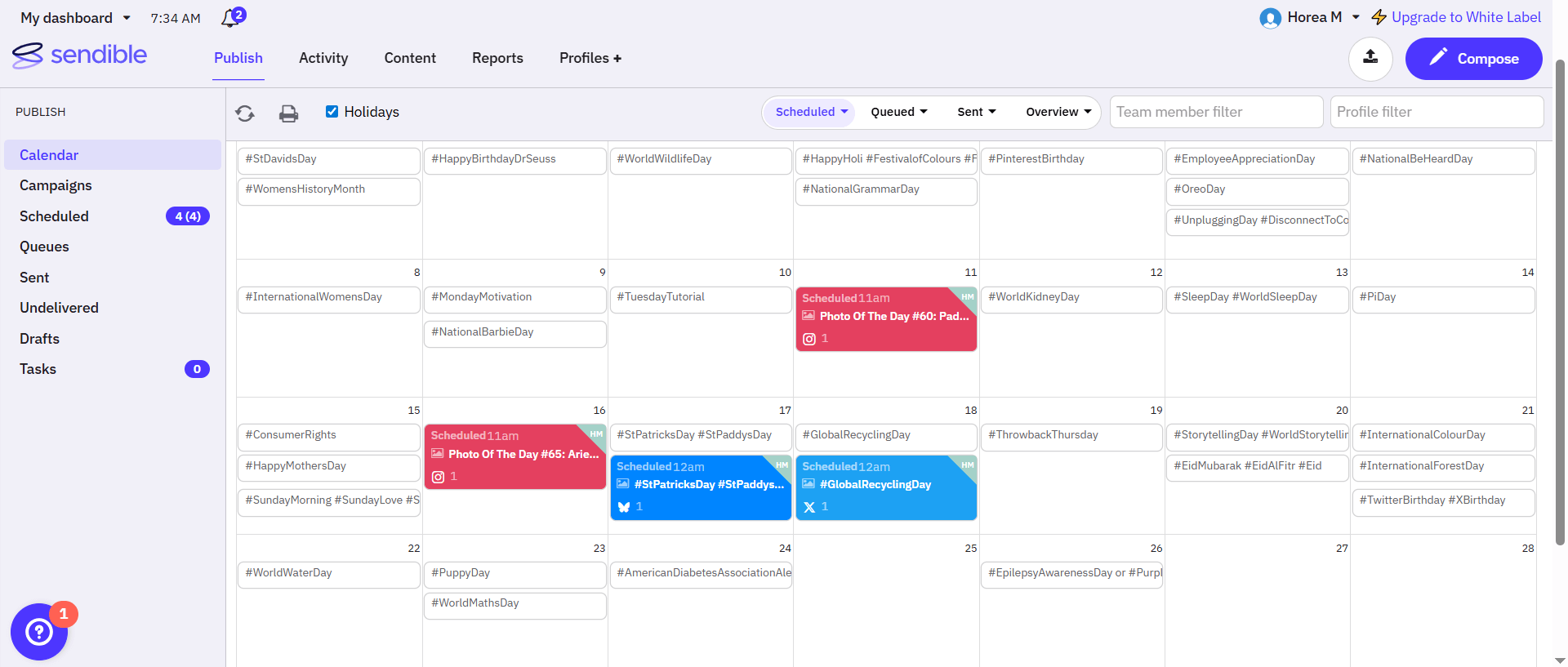
9. Sendible: for agency client management and content queues
Best for: medium-sized marketing agencies
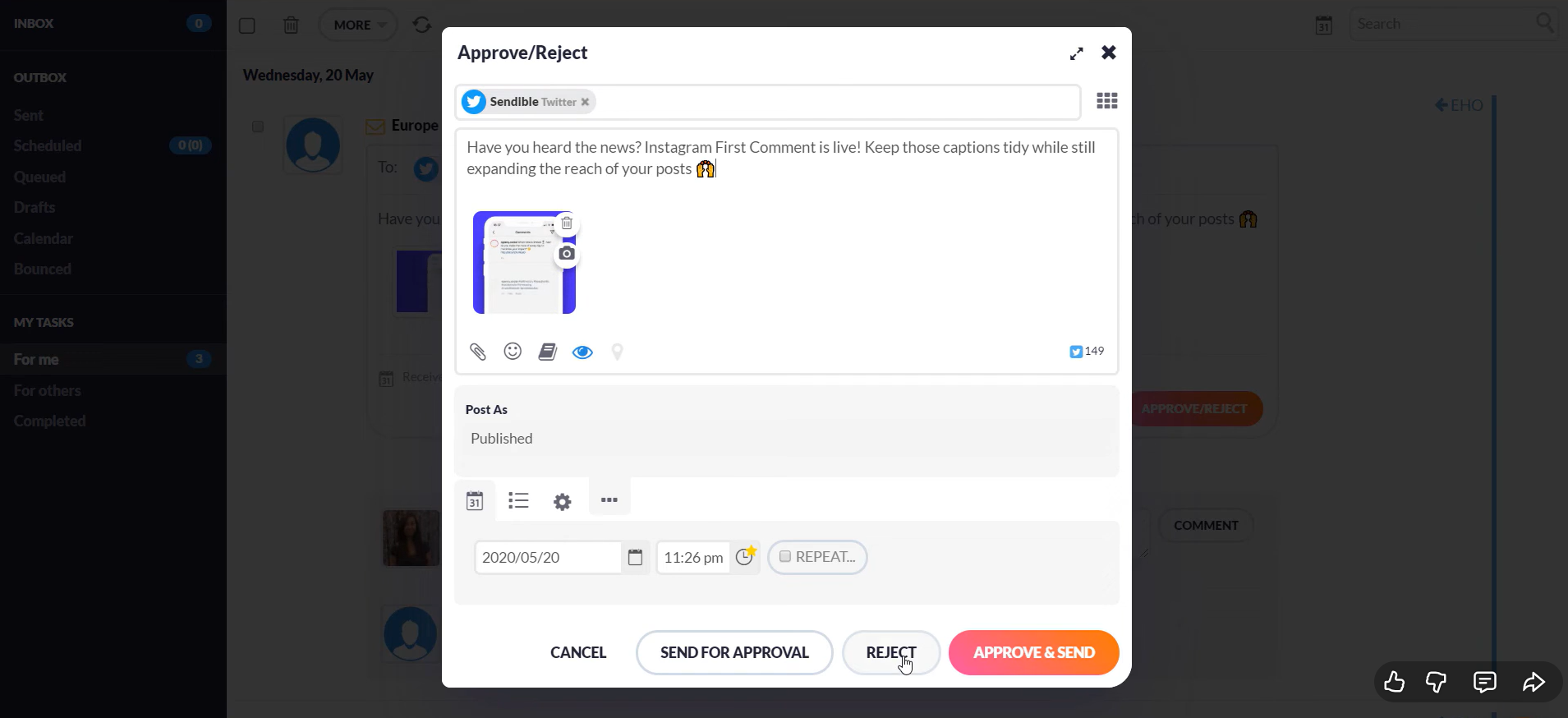
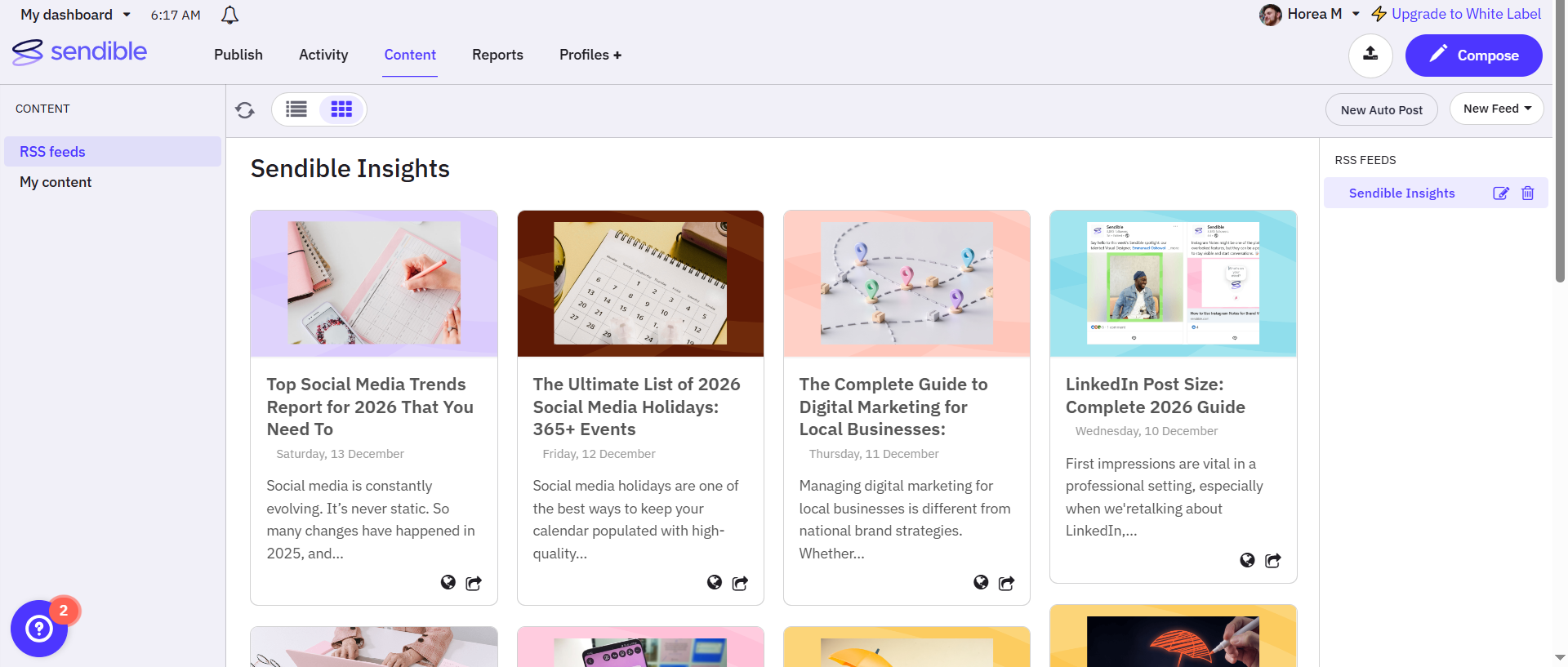
Why I picked it:Sendible is built for agencies juggling many client accounts. Thematic content queues keep calendars full, and the Canva integration brings designs straight into the composer. It lost points on UX: advanced features take time to learn.
Sendible positions itself as the top social media management tool for agencies and offers a range of plans to cater to different organizations.
It supports social media scheduling, offers content recommendations, and provides reporting on campaigns and a social inbox.
Sendible standout features
An integration with Canva allows marketers to tap into their design library when creating a new post.
Queues of thematic content to keep your editorial calendar filled to the rim.
Content social sharing feature to automatically post important updates and find relevant content to share on your accounts.
Integrations: Facebook, LinkedIn, Instagram, TikTok, Twitter, WordPress, Medium, and Tumblr.
Pricing: Sendible has a 14-day free trial period and three paid plans starting from $35/month.
Pros
Cons
Content queues and RSS-based content discovery
Occasional scheduling glitches
Canva integration in the composer
Steep learning curve for advanced features
Priced for agencies, starting at $35/month
Pros
Content queues and RSS-based content discovery
Canva integration in the composer
Priced for agencies, starting at $35/month
Cons
Occasional scheduling glitches
Steep learning curve for advanced features
10. Statusbrew: for comment moderation at scale
Best for: consumer brands with moderation needs
Why I picked it: Statusbrew is the strongest tool here for comment moderation: rules hide or delete comments by sentiment and keyword, on organic and paid posts alike. It also has multi-step approvals. It lost points on scheduling flexibility, because editing content already scheduled to several profiles is awkward.
Statusbrew is one of the most affordable social listening tools. It enables users to create polished, customizable report templates for a deep dive into social media performance.
Its social media scheduler includes tools for benchmarking your performance against competitors, AI-powered sentiment analysis, and advanced comment moderation to refine and enhance your overall social media strategy.
Statusbrew standout features
Schedule content for multiple social pages with channel-specific editing options.
Automate responses and manage social media interactions through a unified inbox.
Use an integrated CRM to track every contact received via social platforms.
Protect your brand’s reputation by hiding or deleting comments on organic and dynamic posts, based on sentiment and keyword filters.
Integrations: Facebook, Instagram, LinkedIn, X, YouTube, TikTok, Pinterest, and Google Business Profile.
Pricing: Statusbrew provides a 14-day free trial so you can test the platform. Once the trial ends, users can choose from four paid plans starting at $69/month for one user and five social profiles.
Pros
Cons
Automated comment moderation by sentiment and keyword
Complex interface for first-time users
Unified inbox with a built-in CRM
Editing posts already scheduled to multiple profiles is clunky
Customizable report templates
Pros
Automated comment moderation by sentiment and keyword
Unified inbox with a built-in CRM
Customizable report templates
Cons
Complex interface for first-time users
Editing posts already scheduled to multiple profiles is clunky
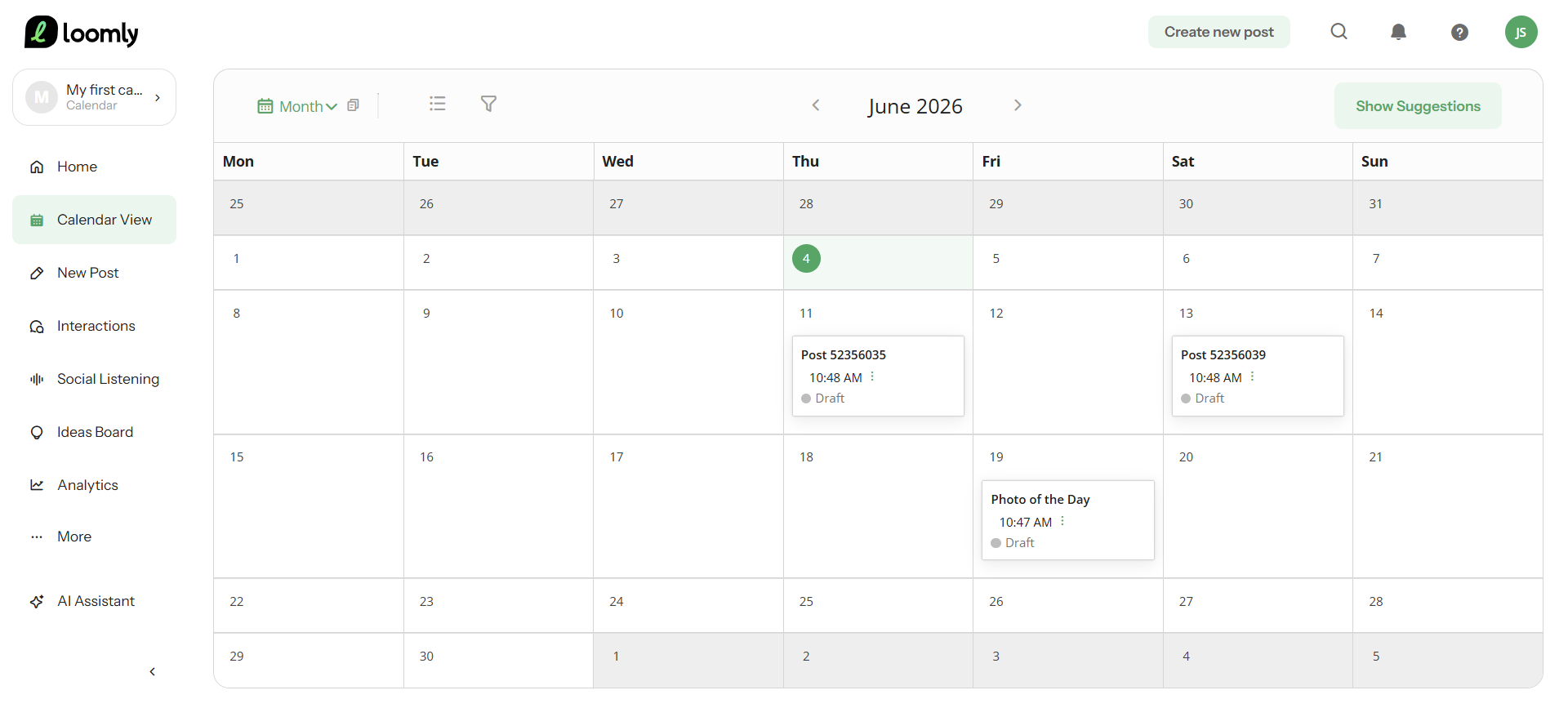
11. Loomly: for post idea generation
Best for: small in-house teams
Why I picked it: Loomly guides new users in well: the Calendar Wizard sets up accounts and preferences, and post ideas come from RSS feeds and trending topics. Approvals, comments and roles are built in. It lost points because custom workflows and roles sit on higher-priced plans.
Loomly is a social media scheduling tool for small teams that want structure in how posts get planned, reviewed and published.
It offers scheduling to most social media platforms, planning, engagement tracking, advanced analytics, and social media reports, making it a well-rounded social scheduler.
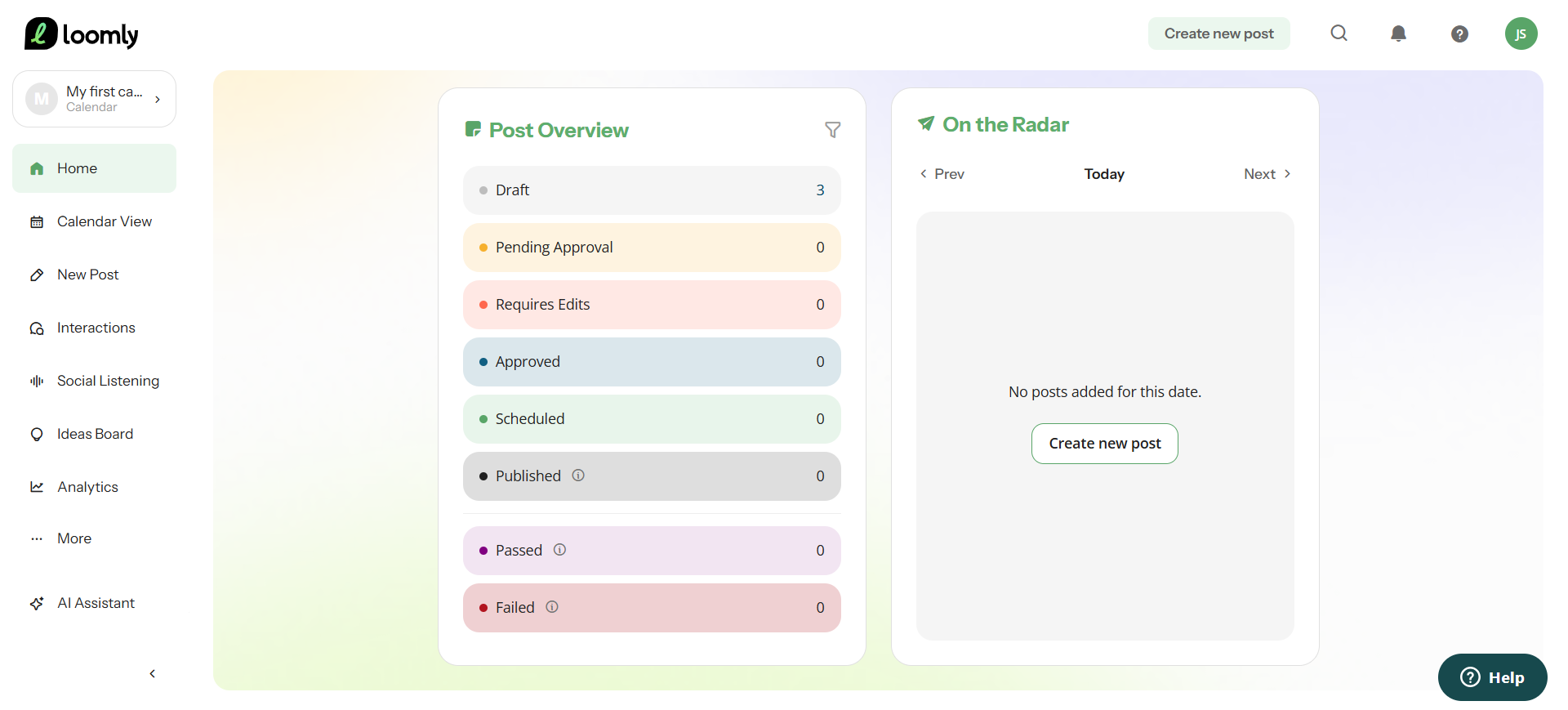
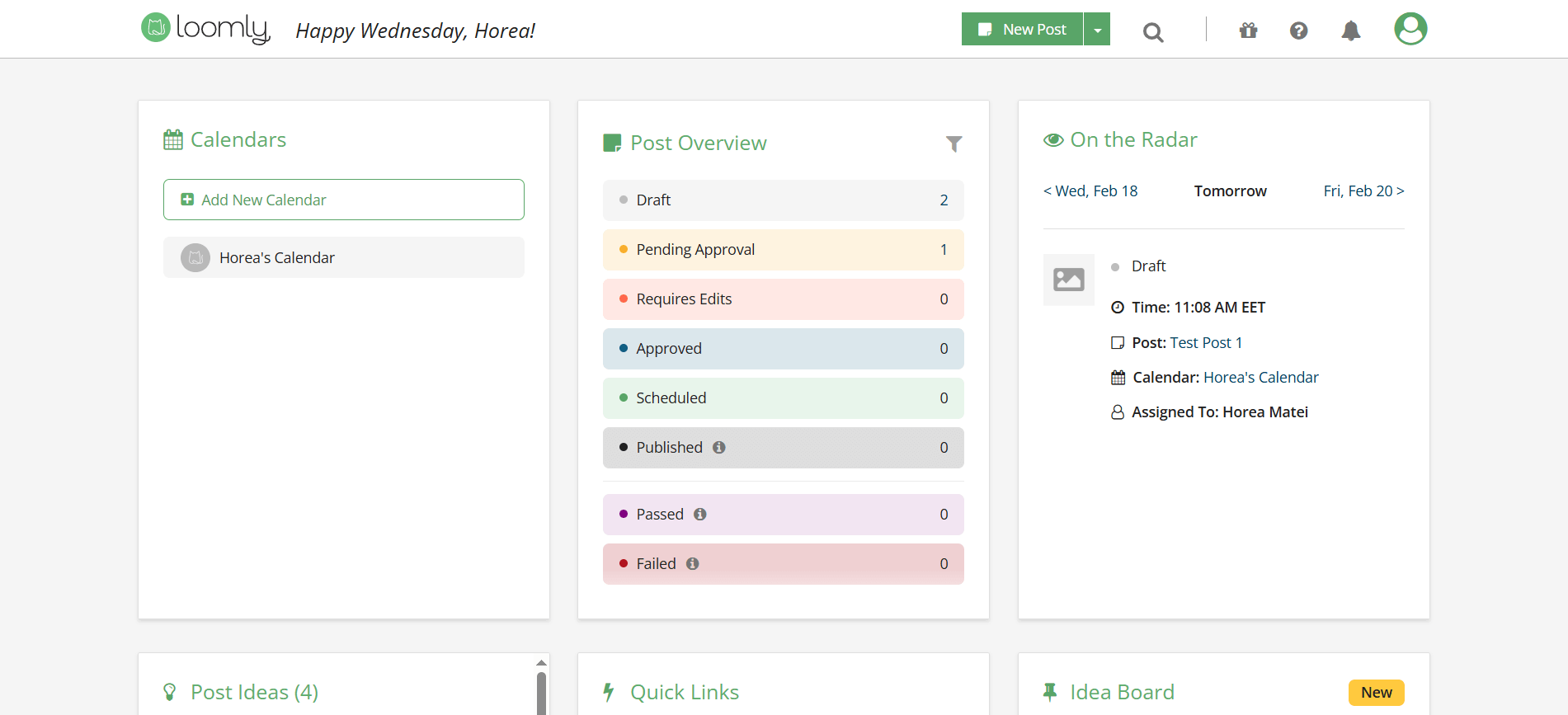
Loomly simplifies the user journey with features like the Calendar Wizard, which guides users through connecting social media accounts, setting up preferences, and initiating scheduling workflows for multiple social accounts.
Built with collaboration in mind, the social media scheduling tool has team-based functionalities such as post approvals, commenting, and role assignments.
However, some advanced features, like custom workflows and roles, are limited to higher-priced plans, which might not suit smaller teams with tight budgets.
Loomly standout features
Publish and schedule posts across popular platforms like Facebook, Instagram, TikTok, and LinkedIn.
You can use the RSS feed integration and trending topic suggestions to generate post ideas.
Assign roles, comment on posts, and manage approval workflows for all social media channels.
Receive post scheduling updates through push notifications, Slack, or Microsoft Teams for enhanced productivity.
Integrations: Instagram, LinkedIn, X (Twitter), Pinterest, Facebook, Google Business Profile, TikTok, Threads, YouTube and Snapchat.
Pricing: Loomly offers two paid plans: Starter at $49/month, with 12 social accounts and 3 users, and Beyond at $249/month, with 60 social accounts and unlimited users. Enterprise supports 61+ social accounts with custom pricing.
Pros
Cons
Post ideas from RSS feeds and trending topics
No social listening or Google Analytics integration
Approvals, comments and role assignments built in
Custom workflows and roles locked to higher tiers
Notifications through Slack and Microsoft Teams
Pros
Post ideas from RSS feeds and trending topics
Approvals, comments and role assignments built in
Notifications through Slack and Microsoft Teams
Cons
No social listening or Google Analytics integration
Custom workflows and roles locked to higher tiers
12. HubSpot: for social inbox management tied to CRM data
Best for: HubSpot Marketing Hub users
Why I picked it: HubSpot’s social tools make sense if you already run marketing in HubSpot. Every interaction links back to a CRM contact, and keyword streams flag comments worth answering. It lost points as a scheduler: you can’t buy it on its own.
HubSpot provides a dedicated social media management platform and includes all the features you need to schedule content at just the right time for maximum engagement.
Its AI uses social media performance data to provide ideal posting time suggestions, content, and campaign ideas for maximum results.
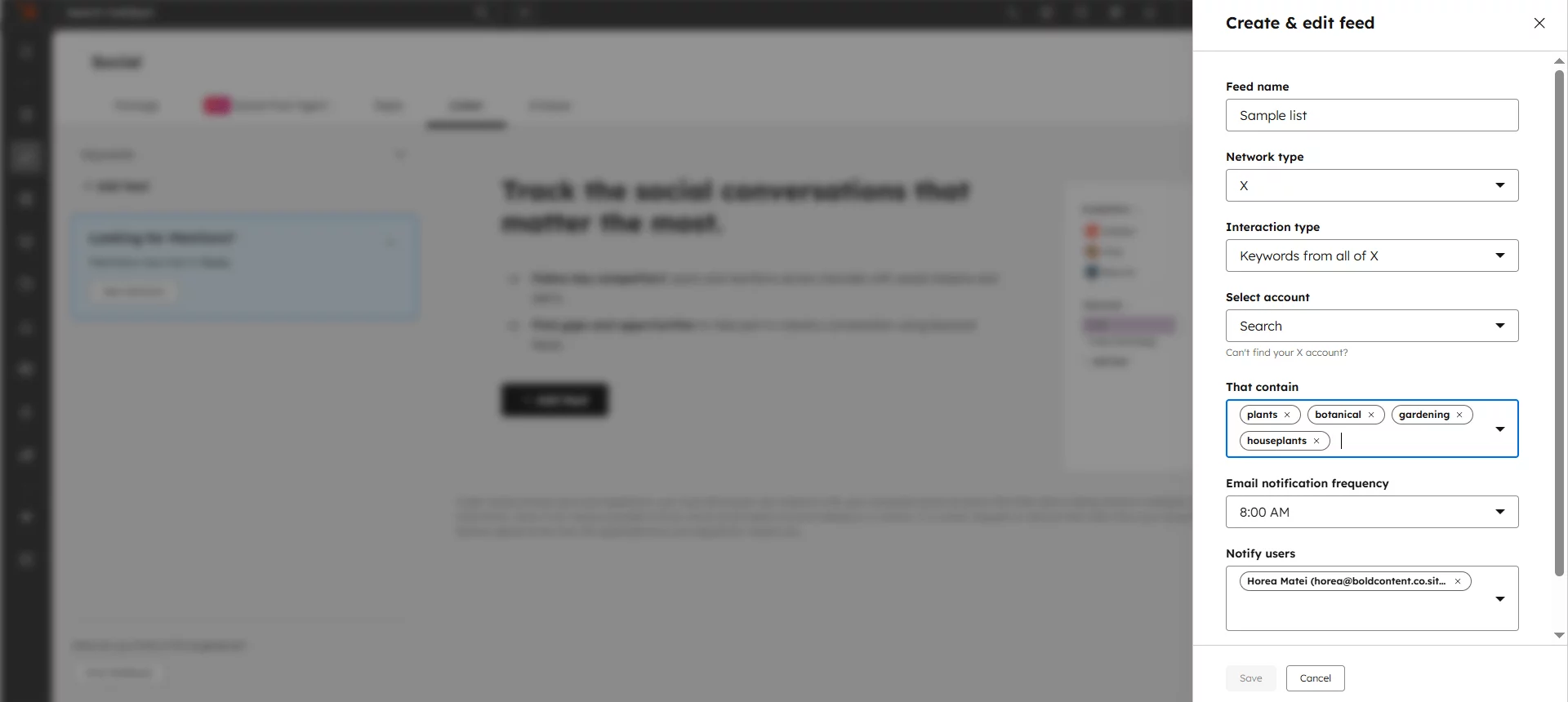
Plus, HubSpot includes a particularly social inbox management tool where you can set up keyword monitoring streams to monitor and respond to comments across social.
HubSpot keyword stream panel
Linking the social media management tools with HubSpot’s CRM also reveals extra details about your contacts and how they previously interacted with your company.
Hubspot standout features
Suggests multi-channel campaign ideas and ideal posting time suggestions based on data like your social performance, company details, marketing best practices, and more.
Sends email alerts whenever people mention specific keywords in comments.
Measure cross-channel campaign performance with the platform’s built-in analytics, and gauge social media ROI with the platform’s CRM integration.
Integrations: Facebook, Instagram, LinkedIn, X, YouTube, and TikTok.
Pricing: The social media management platform is included in HubSpot’s Marketing Hub Professional Package, which costs €792/month that includes three core seats. Additional seats start at €45/month.
Pros
Cons
Social activity tied to CRM contact records
Only available inside Marketing Hub Professional (€792/month)
Keyword monitoring streams with email alerts
No standalone social plan
Cross-channel campaign reporting
Pros
Social activity tied to CRM contact records
Keyword monitoring streams with email alerts
Cross-channel campaign reporting
Cons
Only available inside Marketing Hub Professional (€792/month)
No standalone social plan
13. SocialBee: for category-based queues and evergreen recycling
Best for: solopreneurs and personal brands
Why I picked it:SocialBee’s category queues are the best evergreen system on this list. Sort posts by type, and it rotates through them and re-queues top performers automatically. It lost points for agencies, because the workspace structure is too simple for multi-tier sign-offs or separate client environments.
SocialBee is a social media scheduling tool for solopreneurs and small businesses that need structured content queues and evergreen recycling.
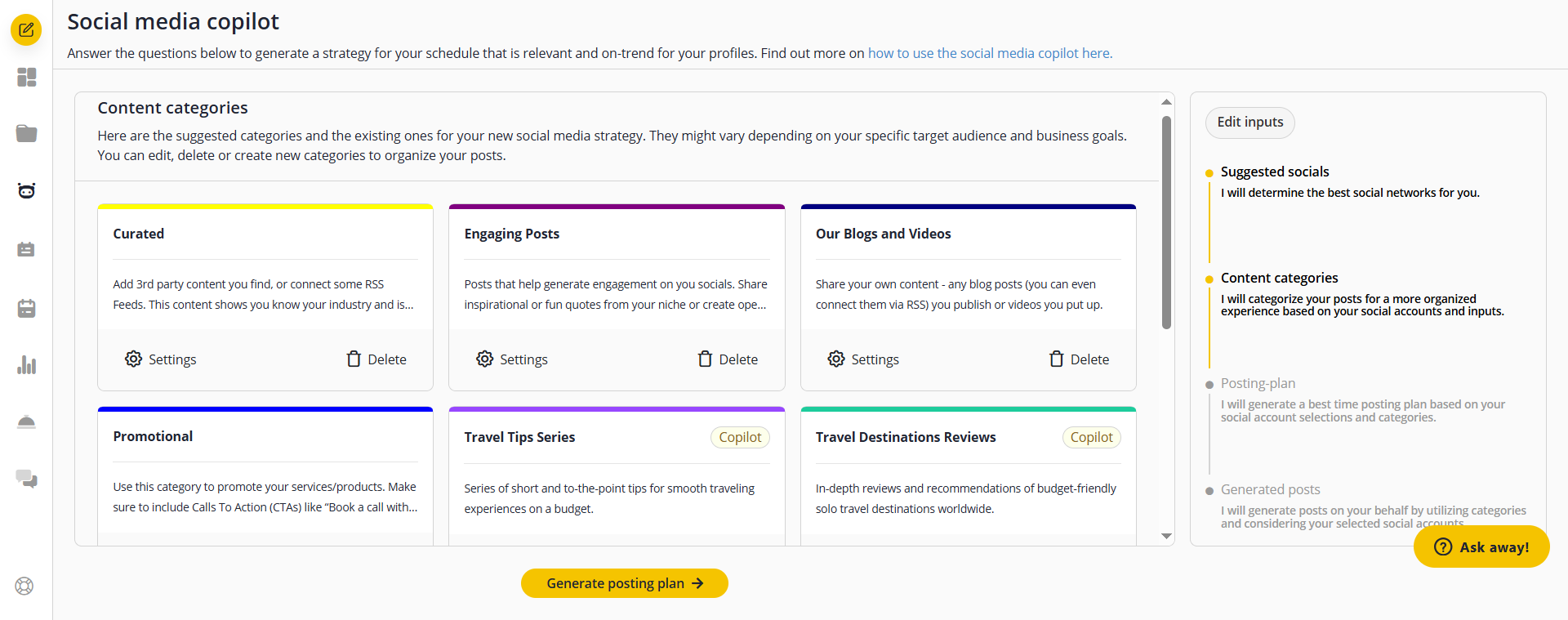
Its category-based queue system is the main differentiator: you create queues by content type (educational, promotional, curated) and SocialBee rotates through them automatically, keeping your calendar full without constant manual effort.
The evergreen recycling feature re-queues top-performing posts on a set schedule, which cuts the time you’d otherwise spend re-creating content for topics that stay relevant. An AI content assistant handles generation and repurposing inside the platform. Bulk import via CSV or RSS feed makes it practical for teams migrating large content libraries or setting up campaigns at scale.
SocialBee standout features
Category-based content queues: organize posts by content type and let SocialBee rotate through them automatically
Evergreen recycling: top-performing posts get re-queued after a set interval, without manual re-scheduling
Canva integration: access and import Canva designs directly from the scheduler
Platforms: Facebook, Instagram, LinkedIn, Twitter/X, Pinterest, TikTok, Google Business Profile, YouTube, Threads (9 platforms)
Pricing: Bootstrap $24/month, Accelerate $40/month, Pro $82/month. No free plan, but the trial is 14 days.
Pros
Cons
Category-based queues that rotate automatically
No free plan (14-day trial only)
Evergreen recycling of top-performing posts
Too simple for multi-client agency approvals
Canva integration and CSV/RSS bulk import
Pros
Category-based queues that rotate automatically
Evergreen recycling of top-performing posts
Canva integration and CSV/RSS bulk import
Cons
No free plan (14-day trial only)
Too simple for multi-client agency approvals
14. Metricool: for organic and paid performance in one calendar
Best for: in-house marketers managing organic and paid social together
Why I picked it:Metricool is the only tool here that puts Meta and Google Ads results next to organic posts in one dashboard, which saves a daily round of tab-switching. Best-time-to-post suggestions are based on your own engagement data. It lost points on approvals, which are limited compared with agency tools.
Metricool is a social media scheduling and analytics platform for marketing teams that want both functions in one tool. Its standout feature is the combination of social scheduling with paid ad analytics. Meta and Google Ads performance appears alongside organic post data in the same dashboard, which cuts the number of platforms a marketer needs to check daily.
The unified visual content calendar uses drag-and-drop scheduling. AI-powered best-time-to-post recommendations are based on per-channel engagement data, not generic benchmarks.
The competitor analytics feature tracks competitors’ public social performance directly from inside the platform, making it useful for benchmarking without switching tabs.
Metricool standout features
Best time to post: AI recommendations based on your historical engagement data per channel
Competitor analytics: track competitors’ public social performance inside the platform
Paid ad analytics: Meta and Google Ads data sits alongside organic content metrics in one view
Platforms: Instagram, Facebook, LinkedIn, Twitter/X, Pinterest, TikTok, YouTube, Google Business Profile, Twitch, BlueSky, Mastodon, Threads (12 platforms)
Pricing: Free plan for 1 brand with up to 20 scheduled posts a month and 30 days of analytics (LinkedIn and X not included). Paid plans: Starter from $20/month, Advanced from $53/month, and Custom.
Pros
Cons
Paid ads and organic results in one view
Approval workflow is limited for client work
Best-time-to-post based on your own data
Free plan excludes LinkedIn and X
Free plan and competitor tracking
Pros
Paid ads and organic results in one view
Best-time-to-post based on your own data
Free plan and competitor tracking
Cons
Approval workflow is limited for client work
Free plan excludes LinkedIn and X
Best free social media schedulers
A free plan is enough when you post to a few channels on your own. It stops being enough the moment a second person has to approve a post. Here’s what each free plan on this list covers:
Tool
What the free plan includes
Limit you’ll hit first
Planable
First 50 posts with no time limit, full approval workflow
50 posts in total, not per month
Buffer
3 channels, 10 scheduled posts per channel
The 10-post queue per channel
Zoho Social
1 brand, 6 channels (one of each network), 1 user
No teammates
Metricool
1 brand, 20 posts a month, 30 days of analytics
No LinkedIn or X
CoSchedule
1 social profile, 15 scheduled posts at a time
A single profile
Planable
What the free plan includes
First 50 posts with no time limit, full approval workflow
Limit you’ll hit first
50 posts in total, not per month
Buffer
What the free plan includes
3 channels, 10 scheduled posts per channel
Limit you’ll hit first
The 10-post queue per channel
Zoho Social
What the free plan includes
1 brand, 6 channels (one of each network), 1 user
Limit you’ll hit first
No teammates
Metricool
What the free plan includes
1 brand, 20 posts a month, 30 days of analytics
Limit you’ll hit first
No LinkedIn or X
CoSchedule
What the free plan includes
1 social profile, 15 scheduled posts at a time
Limit you’ll hit first
A single profile
If you’re testing a scheduler with a client, pick a free plan that includes approvals. Otherwise you’re only testing half the workflow.
How do I choose a social media scheduler that scales with my team?
Every tool on this list schedules posts. What separates them is what happens at volume, with more people involved. These are the five questions I tested against:
Can the calendar stay functional when you’re managing 100+ posts?
A drag-and-drop social media content calendar should help you spot gaps, avoid overlaps and keep hundreds of posts organized without a spreadsheet. Some tools slow down past 20–30 scheduled posts. Check that you can view several accounts at once, filter by label or client, and reschedule in bulk when plans change.
Do approvals support multi-tier sign-offs, including clients?
Every extra step in the feedback loop (downloading posts to email them, chasing approvals in a separate thread) adds friction. Look for tiered approvals (creative → brand → client, or franchise → regional → corporate) where external reviewers can approve without logging in, and where the post publishes automatically once the final sign-off clears. If someone still has to press “publish” after approval, the workflow isn’t automated.
Will platform connections hold as you add accounts?
Starting with Facebook, Instagram and LinkedIn is easy; scaling across TikTok, Pinterest, Threads and Google Business Profile is where tools struggle. Native API connections are more stable than third-party bridges, which can break when a platform updates its API. Watch for constant re-authentication.
Does pricing scale transparently?
Some schedulers look affordable until you add a fourth user or a tenth location. Check how the price moves with users, workspaces, channels and add-ons before you commit your workflow to a tool.
Does it handle bulk scheduling, time zones and mobile approvals?
At volume, you need CSV import, post duplication across campaigns and reusable templates. For teams working across regions, set the time zone per post, not per account, so a US post goes out at 9 AM EST and a UK post at 9 AM GMT without anyone converting by hand. And check that approvals work in the iOS and Android apps, so sign-offs don’t wait for someone to get back to a desk.
Pro tip: use the free trial to stress-test the tool with a real week of content. If it struggles with your current volume, it won’t hold up when you scale.
Which social media automation features matter by team type
Calendar at scale, structured feedback, multi-tier approvals, external sharing
Few features can be omitted when workflows involve multiple brands or stakeholders
Solo creators
Scheduling
Visual calendar
Approval layers
External client sharing
Multi-workspace management
Small in-house teams
Scheduling
Calendar
Collaborative editing
Approvals
External client sharing
Complex multi-tier approvals
Agencies and multi-location teams
Calendar at scale
Structured feedback
Multi-tier approvals
External sharing
Few features can be omitted when workflows involve multiple brands or stakeholders
Before shortlisting the social media schedulers, match the feature set to your actual workflow. The right requirements vary significantly between solo creators, in-house teams, and agencies.
Solo creators generally need a reliable scheduler and a simple visual calendar to maintain a consistent publishing cadence. Approval workflows, external sharing, and multi-workspace management usually add unnecessary complexity for a one-person operation.
Small in-house teams benefit more from collaborative editing and built-in approvals. These features help teammates review content before publishing without requiring the more complex client-sharing or multi-workspace capabilities that agencies often need.
Agencies and multi-location teams typically need the most complete workflow: a visual calendar that can handle content at scale, structured feedback, multi-tier approval chains, and external sharing that lets clients or stakeholders review content without logging in.
Native vs. third-party social media schedulers
Third-party social media scheduling tools, such as Planable, typically offer broader workflow capabilities than native schedulers built into platforms such as Meta Business Suite or LinkedIn. The main differences include:
Multi-channel publishing: manage and publish content across multiple social networks from one workspace instead of scheduling separately in each platform.
Approval workflows: let team members, clients, or stakeholders review drafts, leave feedback, and approve content before publication.
Cross-channel analytics: bring performance data from connected social networks into one place instead of reviewing results platform by platform.
How to schedule social media posts, step by step
I’ll use Planable for the screenshots, but the steps are similar in most scheduling tools.
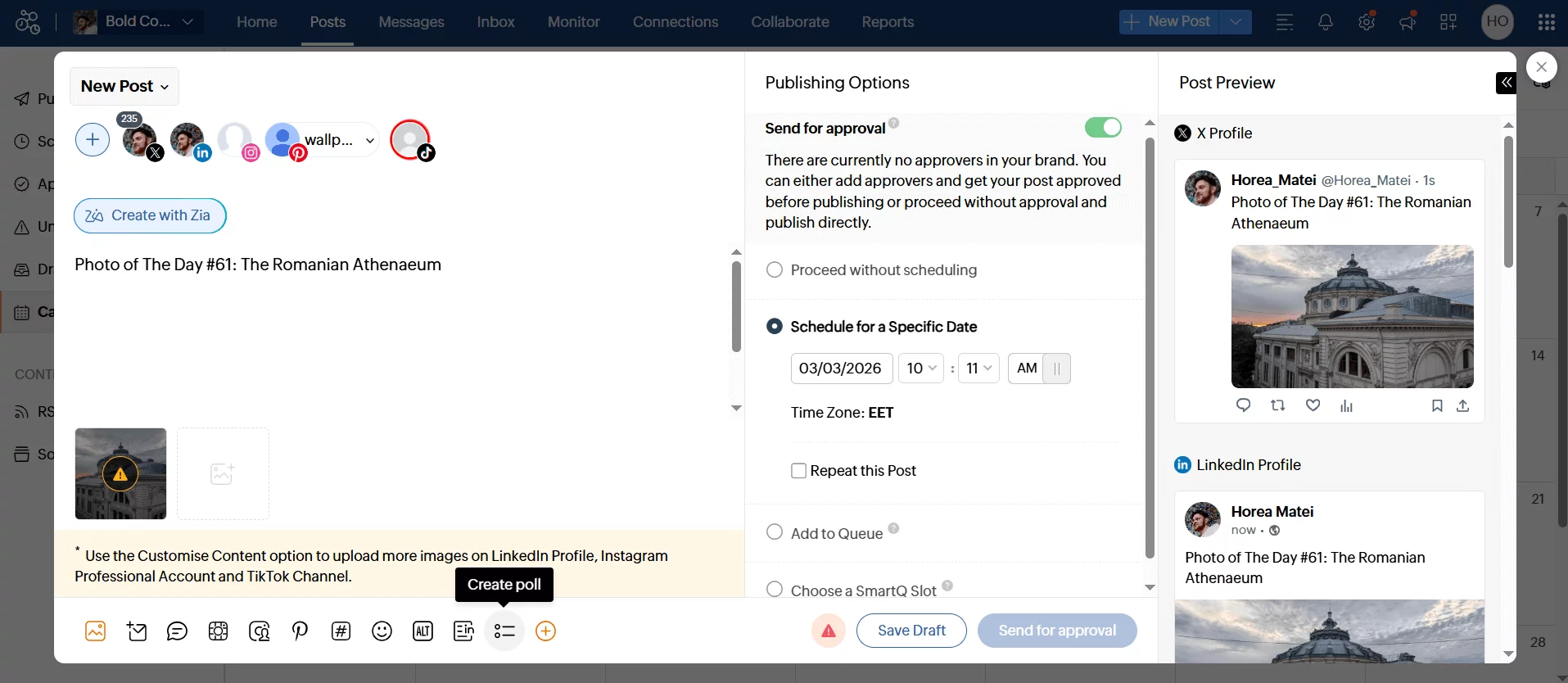
1. Create a post in your workspace in Planable: add text, videos, pictures, gifs, or anything else you’d like to share with the audience.
Scheduling a social media post to Facebook and LinkedIn from the Planable app
2. Turn on the Sync on toggle to publish the post across several social media platforms.
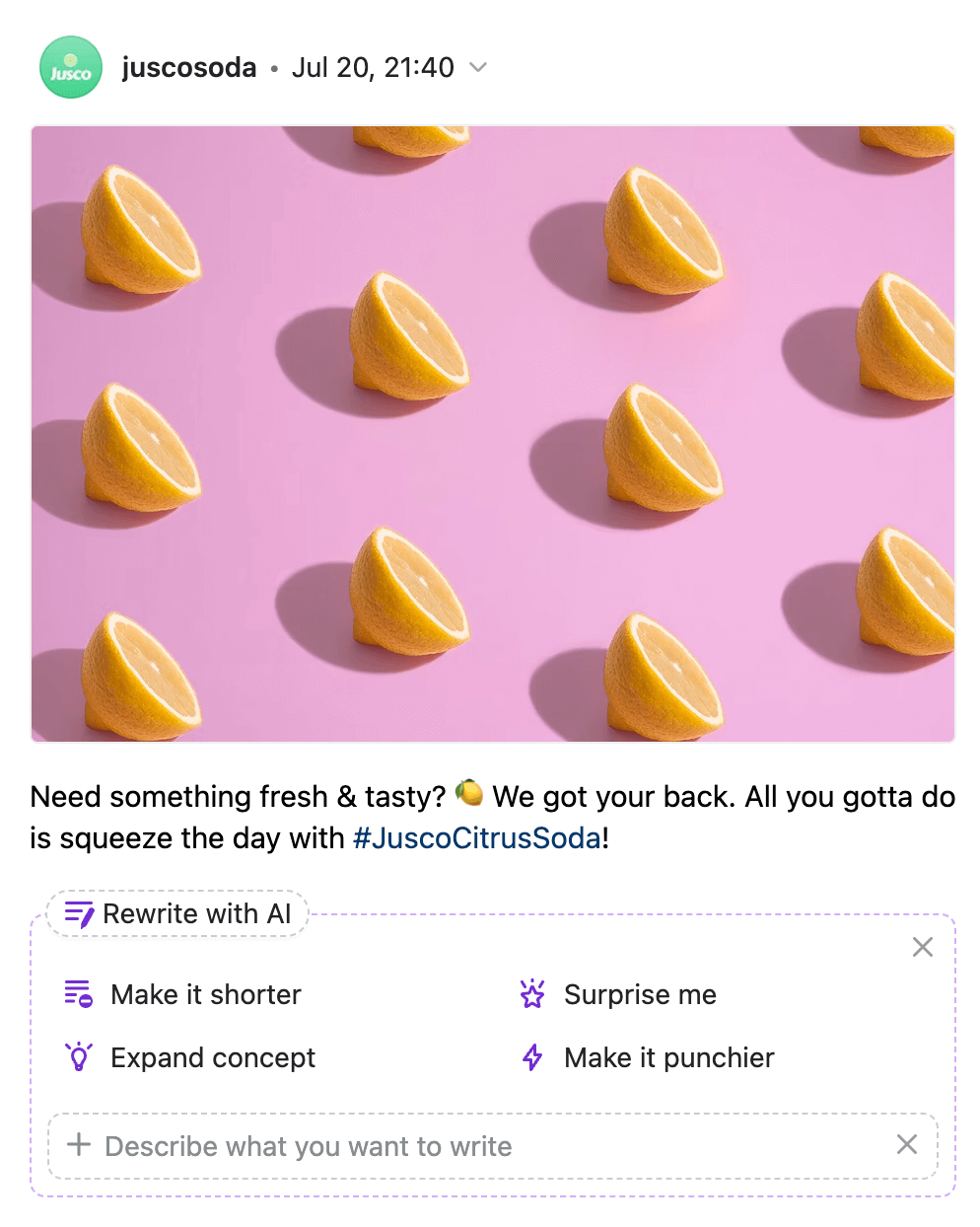
3. AskPlanable’s AI to make your post punchier or rephrase the message for another platform.
Using Planable AI when scheduling a social media post to rewrite the caption
4. Addlabels to easily filter your posts later.
Creating and adding labels for scheduled posts in Planable
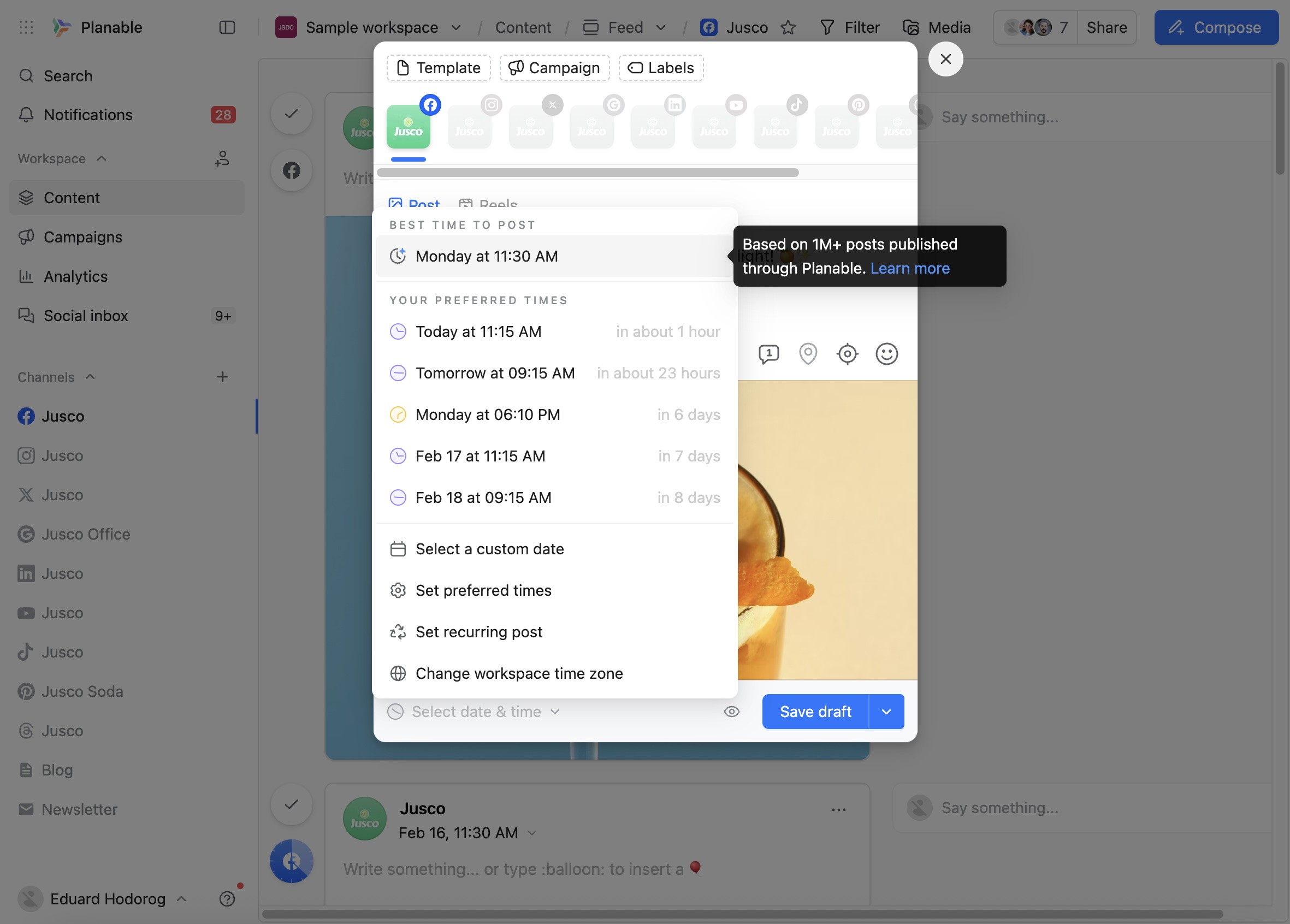
5. Add a date and time for your post to go live or use Planable’s Best Time to Post feature to choose a recommended publishing time.
Planable suggests the best time to publish a post
6. Press Schedule and pour yourself a cup of coffee. Well done!
If you only post to one brand on one network, the native scheduler may be enough: Meta Business Suite schedules Facebook and Instagram posts, and LinkedIn, TikTok and YouTube have built-in scheduling. A third-party scheduler earns its cost once you publish across several networks or need someone else to approve posts first.
How often should you schedule posts?
Two rules of thumb help you plan a week of content:
The 5:3:2 rule sets the content mix. Out of every 10 posts, 5 are curated from other sources, 3 are your own original content, and 2 are personal posts that humanize your brand. It keeps your feed useful rather than promotional. Labels in your scheduler make the ratio easy to check across a month.
The 5-5-5 rule covers daily engagement. Like 5 posts, leave 5 thoughtful comments, and reply to 5 messages or comments each day. Scheduling handles the publishing, which frees that time for the conversations around it.
Treat both as starting points. Your own engagement data should decide the final cadence.
What users say about these scheduling tools
Spec sheets tell you what a tool can do. Reviews tell you what it’s like to live with it. I pulled the current G2 and Capterra scores for all 14 tools so you can see them side by side, then read the recent reviews to see where the complaints cluster.
Scores checked September, 2026. HubSpot’s social tools aren’t reviewed separately; these scores cover the whole Marketing Hub.
Three things stand out when you read the scores together:
The spread is narrow. Every tool lands between 4.3 and 4.8, so the decimal tells you less than the sample size and the complaints behind it. Statusbrew tops both sites but with under 350 reviews combined; Hootsuite and Sprout Social sit lowest with the most reviews, and their recurring gripes are price and pricing tiers, not reliability.
Volume and score rarely move together. Zoho Social and Loomly are the exceptions: thousands of reviews and 4.6–4.7 on both platforms.
Read the one-star reviews for the tool you’re shortlisting. They tell you which of the drawbacks I listed above actually bites in daily use.
For Planable, the recent reviews keep landing on the same two things: client approvals and seeing everything in one place.
“I like the way the page is laid out. We can see the posts as they will actually look on the platforms. Being able to set up schedules and to push to multiple channels, it really saves us time” – Victoria B., Principal Marketing Specialist.
“Scheduling content and not having to post manually… the scheduling saves me SO much time from having to manually post on each platform. I also love how Planable gives me the best times.” – Aaron F., Creative Director.
“I’ve been searching for a scheduler app for a long time… It helps me maximize efficiency in terms of bulk scheduling, especially since I record my episodes ahead of time.” – Justin L., Business Owner.
FAQs
What is the best free social media scheduler?
Buffer’s free plan is the most generous for solo users: 3 channels with 10 scheduled posts per channel. Zoho Social’s Free Forever plan covers one brand across six channels, and Metricool’s free plan covers one brand with up to 20 posts a month. For teams, Planable’s free trial gives you your first 50 posts with no time limit, enough to run a real approval workflow with a client before paying.
Do scheduled posts get fewer views?
No. Scheduling posts does not reduce organic reach or engagement. Platform algorithms treat scheduled posts identically to manually published ones; reach is determined by content quality, relevance, and timing relative to your audience’s active hours, not by whether you used a scheduler.
What is the 5:3:2 rule for social media?
The 5:3:2 rule is a content mix guideline: out of every 10 posts, 5 are curated from other sources, 3 are original content you created, and 2 are personal posts that humanize your brand. It keeps your feed valuable without turning it into a stream of promotions.
What’s the difference between a social media scheduler and a social media management tool?
A social media scheduler plans and auto-publishes posts. A social media management tool adds the work around publishing: a unified inbox for comments and DMs, social listening, analytics, and approval workflows. Most tools on this list started as schedulers and grew into management platforms, which is why prices range from $5 to $199+ a month.
What’s the difference between native platform schedulers and third-party scheduling tools?
Native schedulers publish inside a single platform and work best for one brand on one channel. Third-party social media schedulers like Planable centralize multi-channel publishing, collaboration, and approvals, especially useful for teams managing multiple brands, clients, or locations.
What is the best social media scheduling tool?
The best social media scheduling tool depends on your workflow priorities: Planable (collaboration & approvals), Sprout Social (enterprise analytics & listening), Buffer (simplicity & ease of use), Hootsuite (social inbox & listening), Later (visual planning for Instagram & TikTok), CoSchedule (content marketing integration), and Zoho Social (affordable multi-account management).
Can I schedule the same post to multiple social media platforms at once?
Yes, most third-party social media scheduling tools support cross-platform scheduling. In Planable, you can write one post and schedule it to Facebook, Instagram, LinkedIn, TikTok, and 5+ other platforms from a single calendar view. You can publish the same version to all channels, or customize the caption, hashtags, and image crops per platform before scheduling.
Horea is a B2B SaaS content writer and MarTech researcher. He has written for Planable since 2023, covering social media management, scheduling, listening and collaboration software. He's spent 7+ years writing about marketing technology, with work for HubSpot, Surfer and UX Pilot AI on topics from SEO and answer engine optimization to UX and web design tools. His roundups are research-first: he tests the tools and workflows himself, then writes the comparisons that help marketers choose with confidence.






 Creation
 Scheduling
 Planning
 Social Inbox
 Collaboration
 Analytics
 Approval
 Social Listening