Looking for a way to boost productivity and cut through the chaos of managing multiple clients and creative projects? The right marketing agency project management software might just be your secret weapon. In this guide, we’ve lined up the best project management...
Redesign For multi-location brands
all your locations, one content flow
For multi-brand companies
content collaboration at scale
For agencies
impress your clients and take on more
“The team loved it from the start. Planable helps us overview the entire marketing efforts.“
For years, marketers fed the Content Monster with nonstop posts. Big names said volume won, so we treated visibility like a numbers game. That playbook’s outdated.
Engagement now hinges on quality and clear relevance. According to the GWI study for the Financial Times, global time-on-platform has dropped by nearly ten percent. Digital natives lead the decline, signaling real fatigue.
Feeds that once felt social now look like streams of what John Burn-Murdoch calls “ultra-edited content.” Generative AI sped this up by flooding platforms with quick, shallow visuals. Creation got easy, but good taste didn’t.
Strong content still wins, but only if you cut the outdated habits dragging growth down. I’ve narrowed them to seven practices worth dropping in 2026.
1. The volume trap
Nowadays, algorithms on TikTok, Instagram, and LinkedIn prioritize retention over recency. They value the time a user spends with your content far more than the timestamp. That’s why posts from 3 weeks ago surface on your feed on a random Thursday.
Consequently, flooding your feed with low-value filler content will damage your account score because it signals to the platform that you produce noise. Unfortunately, this suppresses your reach even when you finally post something brilliant.
I tested this theory right here at Planable. We slashed our posting frequency from five times a week to three. The result defied the old logic. Our reach expanded. Our engagement rates climbed. By pouring our creative energy into three high-impact pieces rather than five mediocre ones, we earned more attention with less output.
We are in good company. HubSpot’s 2025 Social Media Trends report reveals that 64% of marketers abandoned the daily posting schedule. Furthermore, Social Insider’s research shows that TikTok rewards two highly engaging posts a week far more than seven low-effort Facebook updates, all of which goes to show that attention follows quality, rather than frequency alone. Audiences respond when content feels meaningful, interactive, and worth their time.
My fix: A sustainable framework
Instead of filling a calendar grid just to see it full, focus on the mix that actually builds value. We found success with a specific balance:
Educational content: One deep dive that solves a real problem for your user.
Behind-the-scenes: One post that shows the humans behind the logo and builds trust.
Smart repurposing: One high-performing concept adapted for a new format or platform.
This approach respects your team’s bandwidth and your audience’s time. Quality wins.
2. The “corporate polish” trap
As marketers, we spent years curating the perfect Instagram grid. Overproduced content signals “advertisement” to the brain. When we see perfect studio lighting and scripted dialogue, we keep on scrolling. So I realized that audiences crave the unfiltered moment. They want to see the human mess behind the brand logo.
The case for chaos
Look at Nude Project. Their feed ignores every rule of traditional brand management. It looks chaotic. It features screenshots of video calls, messy photo dumps, and raw street photography.
This “lo-fi” aesthetic works because it removes the barrier between brand and consumer. It signals peer-to-peer communication. You become a person in their feed rather than a corporation interrupting it. It’s an example from a new brand-building book – one that I trust.
On this note, let me share another social media project that caught my eye.
Betty Booze. Their feed is highly produced. The colors are saturated. The lighting is perfect. And it works.
Betty Booze succeeds because the polish serves a specific vibe. It builds a cinematic world.
We must distinguish between “corporate polish” (stock photos, stiff acting) and “world building” (cinematic, aspirational). I fear brands that try to look too “professional” will end up looking like nothing.
My fix: Let’s get real(er)
Audit your content creation process. If you require a DSLR camera and three rounds of lighting checks to film a TikTok, you might be trying too hard (no shade to the camera, which I love, but time and place).
Shoot on mobile, too. It feels native to the platform.
Show the face. People trust people.
Leave the bloopers. Imperfection signals humanity.
Trust builds in the messy moments. Let them happen.
3. The “copy-paste” trap
As social media managers and digital marketers, we often confuse consistency with repetition.
In our quest for efficiency, we developed a bad habit. We take one piece of content, like a LinkedIn text post, for example, and reschedule it for Instagram, copy-paste the caption to Facebook, and force it onto TikTok with some stock music.
We call this efficiency, but your audience calls it spam. 😅
Psychological studies on the mere exposure effect confirm that familiarity builds trust. We like what we recognize. However, there is a tipping point where familiarity turns into content fatigue.
When a user sees the exact same asset on three different apps, the brain stops processing it. It categorizes the post as “already seen” or, worse, “low-effort ad.” You lose the attention you worked so hard to earn.
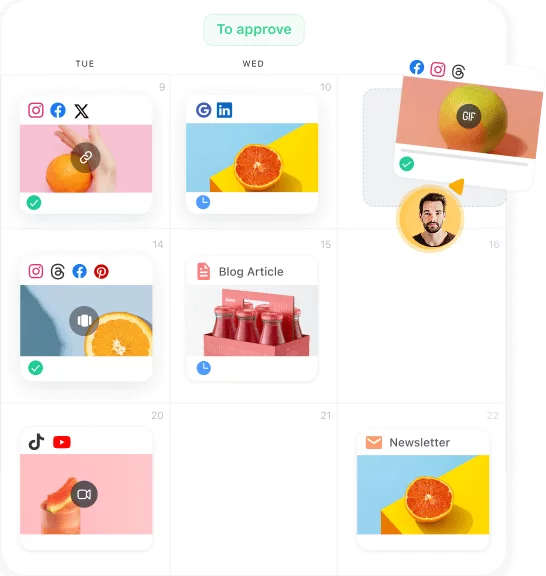
Planable calendar showing scheduled weekly posts for a new product launch across multiple platforms.
The reality check you need is: A feed needs diversity. And while repurposing content is smart, copy-pasting is lazy. Each platform has a distinct rhythm. For example:
LinkedIn users are in “learning mode.” They stop for text-heavy insights and documents.
TikTok users are in “entertainment mode.” They want raw, unpolished, face-to-camera contact.
Instagram users are in “discovery mode.” They stop for visual storytelling.
When you ignore these nuances, you create the “uncanny valley” effect, meaning when something looks almost human, but not quite. Do you know that feeling when something is close enough to feel familiar, but not authentic enough to feel real, so you get a subtle sense of discomfort or disinterest?
In social media, the same thing happens when content tries too hard to mimic trends, engagement tricks, or viral formulas without really understanding the audience.
My fix: the “remix” strategy
Maintain your brand identity (the familiarity) but change the wrapper (the format).
LinkedIn: Post the full thought leadership article.
Instagram: Turn the key quote into a visually striking graphic or carousel.
TikTok: Record a 30-second “face-to-camera” video explaining the concept.
4. The automation “uncanny valley” trap
We reached a point of saturation where AI-generated captions, auto-replies, and scheduled cross-posting created a “Zombie Internet.” Brands post content that looks real at a glance but feels hollow upon inspection.
Automation serves efficiency, not creativity, and when it takes over the entire process, authenticity suffers. Audiences possess a sharp radar for the artificial. They tell immediately when a caption came from a prompt rather than a person.
I watch brands rely too heavily on automated repurposing, like blasting the same AI-generated material everywhere, and losing their audience in the process.
PS: Have you seen the backlash Duolingo received after its CEO released their take on becoming an AI company? 👀 Humans hate it when you try to remove, trick, or automate human input.
The industry verdict
The data confirms this rejection of the artificial. A MarTech report reveals that 94% of organizations use AI for marketing, yet this mass adoption correlates with a “trust gap.”
Pew Research found that 53% of adults believe AI diminishes creativity. When your brand feels automated, you trigger the “Uncanny Valley” effect, which is a sense of unease that kills engagement.
My fix: The 80/20 rule of automation
We use a strict ratio at Planable to keep the soul in the machine:
Automate the logistics (80%): Scheduling, reporting, data analysis, and trend alerts. These tasks require precision, rather than personality.
Humanize the creative (20%): Writing the final hook, engaging in the comments, and filming the content.
Let’s allow the tech to handle the content calendar, while we handle the connection.
5. The trend-chasing vs. trend-adapting trap
When a sound blows up on TikTok, marketing teams rush to record their take before the day ends. The worry about missing the moment now beats any concern about keeping the brand’s voice straight, especially after years of joking about legal teams being too slow to approve trends.
So, it seems that following trends blindly isn’t the smarter social media strategy. When a B2B SaaS company forces its employees to do a Gen Z dance challenge, the audience winces.
They experience “brand cringe”, AKA the visceral reaction to seeing a company try to wear a costume that does not fit.
Jumping on every viral moment dilutes your identity. It confuses the algorithm and the audience. I advise teams to stop asking “How can we use this trend?” and start asking “Does our audience actually care about this?”
“Vibe culture” is becoming an overplayed card. Not all brands need to be funny.
My fix: the “audience-first” filter
Adopt a strict filter before you film.
Relevance: Does this trend relate to a problem we solve?
Voice: Can we do this without changing our personality?
Value: Will our audience laugh with us or at us?
If you hesitate on any of these, skip it. Let the trend pass. Your brand integrity matters more than a temporary spike in views.
6. The “zombie” habit (or the data audit) trap
You likely have outdated tactics running in the background right now. We call them “Zombie Habits.” They eat your budget and produce no life. You keep them alive simply because they always existed.
The best way to spot an outdated habit involves a cold look at the data, no romanticizing old practices or stuff that was cool when you started out.
If a tactic consistently underperforms or fails to drive meaningful audience engagement, it signals a need to evolve. We must stop defending the strategy if there’s no real tangible impact to back it up.
My fix: the 3-step “zombie” audit
1. The volume check
Pull your data from the last quarter. Compare your high-frequency weeks against your low-frequency weeks. Did posting 5x a week actually generate more leads than posting 3x? Often, you will find that the extra effort produces diminishing returns.
If the line stays flat despite double the work, cut the volume. PS: You can do this in one click via Planable Analytics, for all your channels.
Weekly social media performance overview with metrics on followers, reach, impressions, engagements, and profile visits.
2. Your marketer’s intuition check
Scroll your own grid as a stranger. Cover the logo. Does it look like a stock photo library? If your feed lacks human faces or unpolished moments, you suffer from the “Corporate Polish” trap.
Humans connect with humans. If your feed looks like a brochure, it is time to pivot.
3. The value check
Look at your “synergy” posts. Identify the ones you copied and pasted across platforms. Compare their engagement rate to your platform-native content. If the copy-pasted posts underperform, stop doing them. You waste time only to annoy your audience with content that feels out of place.
Perform this audit quarterly. And frankly, be as ruthless as possible. If it walks like a zombie and converts like a zombie, it’s probably a…(I’ll let you figure it out).
7. Careless social account delegation
Corporate social account managers often have no real measures of safely delegating accounts to remote colleagues, freelancers, VAs or partners. On platforms such as Linkedin, Reddit or Facebook even one login from a different country might lead to account warning messages or restriction.
Here’s another pitfall. The most commonly used method to delegate or share account access is simple: sending account login and password + confirming the 2FA method. Which is, as you might understand, is far from secure & simply not allowed by bigger companies.
For more secure account delegation to your remote colleagues from all around, special tools are needed. Some companies still use clunky RDPs and slow expensive virtual machines, but there are better options for session sharing, for example Gologin.
The platform eliminates the dangers of suspicious logins, constant 2FA requests and sharing accounts to remote freelancers. It enables secure, controlled account access so freelancers can work from anywhere without triggering security alerts or compromising account safety.
It also isolates accounts between each other on your device, meaning your accounts on same platform are not cross-tracked.
What will social media look like in the next years?
At Planable, I adopted a simple mindset to go with this shift. We do our absolute best to try to lead with creativity and personality. We show the people behind the brand. We use our expertise to educate and debate rather than just broadcast.
This shift requires bravery. You must post less. You must show your face. You must kill the safety of the corporate script. But the reward involves an audience that actually trusts you.
If you want the visual space to plan this new strategy and to focus on quality over noise, Planable helps you see the big picture.
Stop feeding the feed. Start feeding your audience. And get 50 free posts to try this strategy out. Best of luck!
George – Content Marketing Strategist, storyteller, and self-appointed cringe detector. 7 years in marketing, starting from graphic design to social, campaigns, and content. Writes, shoots, edits – if it’s creative, he’s on it. Knows what’s funny, what’s fresh, and what should never see the light of day. Always up to date, always cooking up something (and trying to hit his protein goal), all while pretending to get 8 hours of sleep.







 Create
 Schedule
 Plan
Plan Engage
 Collaborate
 Analyze
 Approve